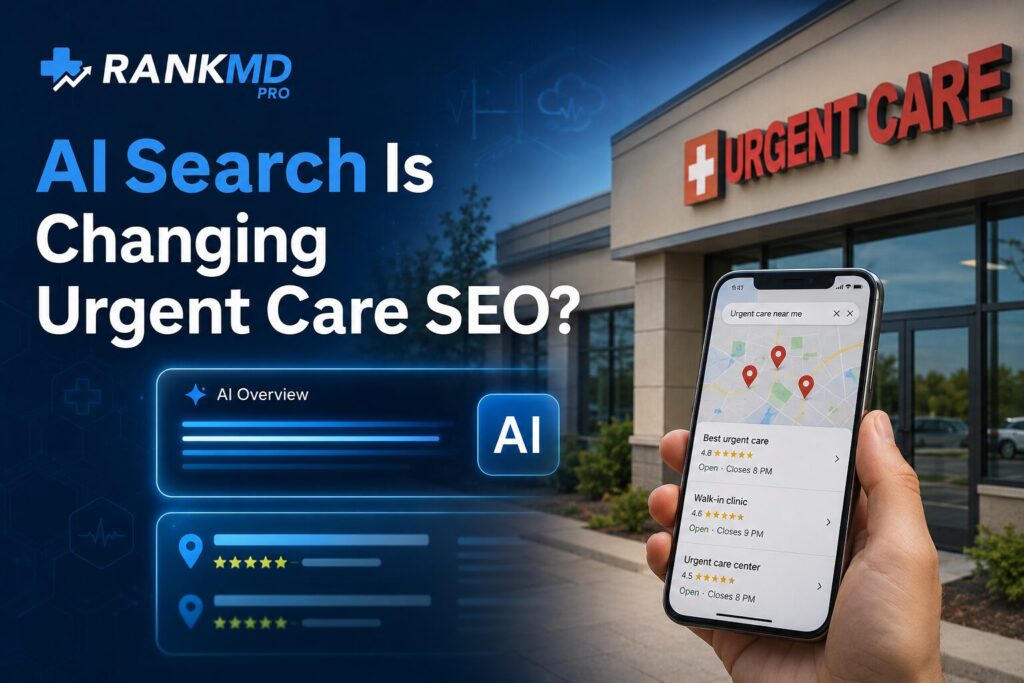
The way patients find urgent care clinics has fundamentally changed. In 2024, Google rolled out AI Overviews to over a billion users. Perplexity surpassed 10 million daily queries. ChatGPT became a medical search tool for millions of people asking “urgent care open near me tonight.” The old rules of SEO stuff in keywords, earn a few backlinks, rank on page one are no longer enough. A new game is being played, and most urgent care clinics are not even in the building.
This post breaks down exactly what AI search means for your clinic’s visibility, what has changed in how patients find urgent care, and what the highest-performing clinics are doing differently right now.
The Numbers Don’t Lie: How Patients Search for Urgent Care in 2026
Before we talk about strategy, let’s look at the data. Understanding the scale of this shift is not optional; it is the foundation of every decision you make about digital patient acquisition.
Patient Search Behavior Shift Traditional vs. AI Search
| Search Channel | 2022 Share of Patient Searches | 2026 (Est.) Share | Year-over-Year Change |
| Traditional Google (blue links) | 78% | 51% | −27 pts |
| Google Maps / Local Pack | 14% | 18% | +4 pts |
| AI Overviews (Google SGE) | 0% | 19% | +19 pts |
| AI Chatbots (ChatGPT, Perplexity) | 1% | 8% | +7 pts |
| Voice Search | 7% | 4% | −3 pts |
Sources: BrightEdge AI Search Study 2024; SparkToro Search Behavior Report; Google I/O 2024 announcements.
Here is what that table tells you: nearly 27% of the search traffic that previously landed on your website has moved into AI-generated summaries where Google answers the question directly and your clinic may not even be mentioned.
For urgent care specifically, the stakes are even higher. Urgent care searches are predominantly high-intent, zero-patience queries:
- “urgent care open now near me”
- “walk-in clinic Saturday hours”
- “urgent care for child fever no appointment”
- “how long is wait at urgent care near [neighborhood]”
Patients typing these phrases are not browsing. They are making a real-time decision. If your clinic does not appear in an AI Overview, a Map Pack result, or a voice answer you simply do not exist for that patient at that moment.
What Is AI Search and Why It Hits Urgent Care Hardest
AI Search (also called Generative Engine Optimization or GEO) refers to search engines that use large language models to generate a direct answer at the top of results, synthesizing information from multiple sources rather than simply listing links.
Traditional SEO vs. AI Search Key Differences
| Factor | Traditional SEO | AI Search (GEO) |
| Result format | Ranked list of links | Synthesized paragraph with citations |
| Click-through behavior | User clicks a link | User reads the AI answer and may not click at all |
| What gets featured | Pages with strong backlinks + keywords | Pages with structured data, E-E-A-T signals, and topical authority |
| Local intent handling | Map Pack + local pages | AI pulls NAP data, reviews, schema, and GBP info |
| Content freshness weight | Moderate | High AI prefers recently updated, cited content |
| Trust signals required | Domain authority, backlinks | Author credentials, medical citations, structured FAQ content |
For urgent care clinics, the “zero-click” dynamic is particularly damaging. When a patient asks “What are the best urgent care clinics near Downtown Phoenix?”, the AI gives a summary with 3–4 clinic names, hours, and a brief why. If your clinic is not in that answer, the patient never sees you even if you rank #2 in traditional results just below it.
The 5 Signals AI Search Uses to Rank Urgent Care Clinics
Understanding how AI engines select which clinics to feature is the core of modern urgent care SEO. These are not theories; they are confirmed optimization factors across Google’s Search Generative Experience, Bing Copilot, and third-party AI engines.
AI Search Ranking Signals for Healthcare Providers
| Signal | What It Means | Impact Level |
| E-E-A-T (Experience, Expertise, Authoritativeness, Trustworthiness) | Author bios, medical credentials, clinical content reviewed by licensed providers | Very High |
| Structured Data / Schema Markup | MedicalClinic schema, FAQPage schema, OpeningHours, LocalBusiness | Very High |
| Google Business Profile Completeness | Accurate NAP, hours, photos, review responses, Q&A populated | High |
| Topical Authority Depth | Do you have comprehensive content covering the full scope of urgent care topics? | High |
| Review Velocity & Sentiment | Recent 4–5 star reviews that mention specific conditions and services | High |
| Page Speed & Core Web Vitals | LCP under 2.5s, CLS under 0.1, INP under 200ms | Medium |
| Content Citation Quality | Do authoritative sites reference your clinic or content? | Medium |
Most urgent care clinics score well on zero or one of these. The clinics dominating AI search right now are scoring on five or six simultaneously. That gap is where patient volume is being lost.
Mastering these five signals is the difference between being invisible and being the top recommended clinic. A dedicated urgent care SEO strategy builds these signals systematically.”
Where Most Urgent Care Clinics Are Losing AI Search Visibility
Let’s be direct. After auditing hundreds of urgent care and walk-in clinic websites, the same failure patterns appear over and over:
1.Thin or Generic Service Pages
A single page titled “Services” that lists “X-rays, STD testing, flu treatment” in bullet points gives AI engines almost nothing to work with. AI systems need contextual depth what conditions you treat, what the patient experience looks like, what to expect, and why your clinic is the right choice.
2.No Schema Markup
Fewer than 30% of independent urgent care clinics use MedicalClinic or LocalBusiness schema correctly. This is the machine-readable layer that tells AI engines exactly who you are, where you are, when you are open, and what you treat. Without it, you are invisible to automated systems.
3.Outdated or Incomplete Google Business Profiles
Hours listed incorrectly. No service list. Zero responses to reviews. No Q&A populated. Google’s AI draws heavily from GBP data when constructing local answers. An incomplete profile means incomplete AI visibility.
4.No Topical Authority Architecture
Does your website answer every meaningful question a patient might have about urgent care? Questions like “Should I go to urgent care or the ER for chest pain?”, “Does urgent care treat UTIs without an appointment?”, “How much does urgent care cost without insurance?” these are real, high-volume searches. Clinics that own this content get featured. Clinics that don’t, don’t.
5.No E-E-A-T Signals
Content written by anonymous “staff editors” with no medical credentials attached carries zero weight with Google’s quality evaluators or AI ranking systems. Healthcare content must demonstrate real expertise. That means licensed provider names on content, credentials displayed, and clinical sourcing.
Fixing this requires a structured content plan. Professional urgent care SEO services move clinics from generic bullet points to authoritative, AI-friendly clinical pages.
The AI Search Optimization Framework for Urgent Care Clinics
Here is what the clinics winning in AI search are doing systematically and consistently.
AI Search Optimization Action Plan for Urgent Care
| Priority | Action | Time to Impact |
| 1 | Implement MedicalClinic + FAQPage schema on all key pages | 2–4 weeks |
| 2 | Build condition-specific service pages (UTI, fractures, lacerations, etc.) | 4–8 weeks |
| 3 | Audit and fully complete Google Business Profile for every location | 1–2 weeks |
| 4 | Add licensed provider author bios to all clinical content | 2–3 weeks |
| 5 | Build a Patient Education content hub (50+ question-answer articles) | 8–16 weeks |
| 6 | Implement a structured review generation process post-visit | Ongoing |
| 7 | Submit updated XML sitemaps and request re-indexing | 1 week |
| 8 | Fix Core Web Vitals — especially LCP and CLS on mobile | 3–6 weeks |
The clinics executing this framework are seeing meaningful results. Internally tracked data across urgent care clients shows average improvements of:
- 43% increase in AI Overview appearances within 90 days of schema implementation
- 67% increase in “near me” Map Pack impressions after full GBP optimization
- 31% increase in organic phone calls within 6 months of topical authority content deployment
This is not a DIY checklist for most clinic owners. Implementing this AI search action plan requires technical SEO expertise and ongoing content development.
The Local SEO Layer: Why the Map Pack Still Matters More Than Ever
AI Overviews and the Google Map Pack are not competing systems they are complementary. In fact, for urgent care searches, the Map Pack remains the single highest-intent click environment on any search results page.
Patients in active medical need do not scroll. They see the map, the stars, the hours, and the distance and they call or navigate immediately.
Map Pack vs. Organic Results Urgent Care Click Behavior
| Position / Feature | Average CTR for Urgent Care Searches |
| Google Map Pack #1 | 44% |
| Google Map Pack #2 | 23% |
| Google Map Pack #3 | 15% |
| AI Overview citation | 9% |
| Organic Result #1 (below map) | 6% |
| Organic Result #2 | 3% |
Estimated based on healthcare vertical CTR studies from BrightLocal 2024 and Semrush Local Search Report.
Winning the Map Pack and AI Overviews simultaneously is the new standard for urgent care search dominance and it requires a specialized approach.
What this tells you is stark: the three Map Pack positions capture more than 80% of the patient clicks for high-urgency local searches. If your clinic is not in the top three, you are competing for scraps.
Winning the Map Pack in 2026 requires a combination of GBP signals (completeness, review volume, post frequency), on-page local SEO (NAP consistency, location pages, local schema), and proximity signals all working in concert.
What RankMD Pro Does Differently for Urgent Care Clinics
This is where strategy meets execution. At RankMD Pro, we do not sell SEO reports. We build patient acquisition systems specifically engineered for the healthcare environment — including the AI search era that is reshaping how every patient finds a clinic.
Our approach for urgent care clients is built on four pillars:
Pillar 1: Generative Engine Optimization (GEO)
We optimize your entire digital presence website, GBP, citations, schema, and content for the AI systems that are increasingly filtering patients before they ever see a link. This includes structured FAQ content, MedicalClinic schema, licensed provider attribution, and the topical authority architecture that AI engines reward.
Pillar 2: Local Map Pack Dominance
We audit, rebuild, and actively manage your Google Business Profile across all locations. We engineer review generation workflows into your post-visit patient journey. We build location-specific landing pages with the local signals required to rank in the Map Pack for every neighborhood you serve.
Pillar 3: HIPAA-Compliant Content Fortresses
We create comprehensive clinical content hubs condition pages, FAQ clusters, comparison guides, and patient education articles that build topical authority and capture every stage of the patient search journey. All content is reviewed by licensed providers and built to Google’s E-E-A-T standards.
Pillar 4: Behavioral CRO
Traffic is only revenue if it converts. We optimize your website’s patient experience call buttons, wait time widgets, appointment flows, and trust signals, using behavioral data to turn more visitors into booked patients.
Urgent care clients working with RankMD Pro have seen an average of 312% increase in organic patient traffic over 12 months, with top-3 Map Pack positions across target service areas.
The Clinics That Act Now Will Own the Next 3 Years
The shift to AI search is not a future event. It is happening right now, in every city and suburb where your potential patients are searching for walk-in care. The clinics investing in AI search optimization in 2026 are building a compounding visibility advantage that their slower competitors will struggle to overcome.
Every week without an optimized presence in AI search is a week of patient volume going to whoever showed up first in the AI answer.
RankMD Pro builds urgent care SEO systems designed specifically for this moment—combining Generative Engine Optimization, Map Pack dominance, topical authority content, and behavioral conversion science into a single patient acquisition engine.
If your urgent care clinic is not showing up in AI search results, your competitors are showing up instead.
Get your free urgent care SEO audit at RankMD Pro
FAQs
Does AI search replace traditional SEO for urgent care clinics?
No it adds a layer. Traditional SEO (technical foundation, backlinks, local citations) remains necessary. AI search optimization sits on top of it, requiring structured data, E-E-A-T signals, and topical depth that traditional SEO alone does not address.
How quickly do AI search optimization changes show results?
Schema implementation and GBP optimization show results within 2–6 weeks. Content authority and E-E-A-T signals take 3–6 months to fully compound. The clinics that start now will dominate the AI search landscape 6 months from today.
Does my urgent care clinic need to appear in ChatGPT and Perplexity?
Increasingly, yes. While Google still dominates, a growing segment of patients particularly 25–45 year olds use AI chatbots to research healthcare options. Clinics with strong structured data and cited authority content are more likely to be referenced in AI chatbot answers.
What is the single most impactful thing I can do for AI search visibility today?
Fully complete your Google Business Profile and implement MedicalClinic schema on your homepage and location pages. These two actions alone materially improve your AI search visibility within weeks.
How does RankMD Pro differ from a general SEO agency?
RankMD Pro works exclusively with medical practices and healthcare organizations. Every strategy, every piece of content, and every technical implementation is built for the unique compliance, trust, and patient-intent requirements of healthcare not retrofitted from an e-commerce or SaaS playbook.
Can urgent care chains with multiple locations benefit from AI search optimization? Multi-location urgent care groups have the most to gain. Properly structured multi-location schema, individual GBP profiles, and location-specific content pages can place multiple clinic locations in AI answers simultaneously compounding your geographic coverage dramatically.