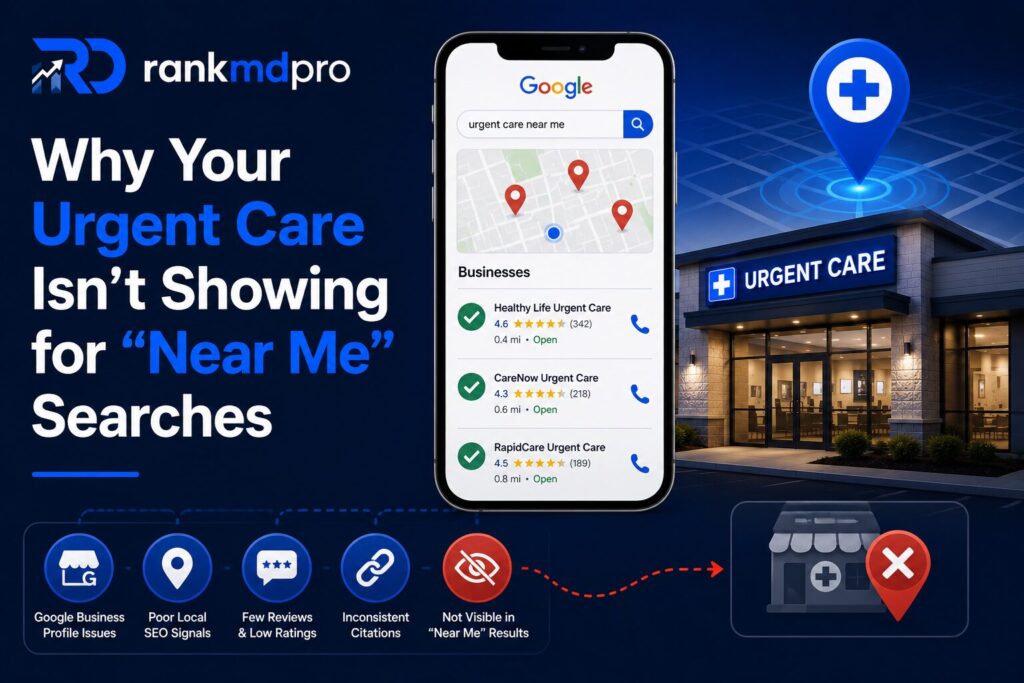
Someone three blocks from your clinic just typed “urgent care near me open now” into their phone. They needed care. They had money to spend. They were ready to walk in. And your clinic never appeared.
That scenario is not hypothetical. It is happening dozens or hundreds of times every month at urgent care clinics across the country, and the owners have no idea because the patient simply went somewhere else and the visit never registered as a loss.
“Near me” searches have grown by over 500% in the last five years according to Google Trends data. For urgent care specifically, they represent the highest-intent, most conversion-ready traffic that exists in local search. A person typing “urgent care near me” is not researching. They are deciding, right now, with their wallet open. Missing from those results is not an SEO inconvenience. It is a direct, measurable revenue problem.
This guide explains exactly why your clinic is invisible in “near me” searches and gives you a prioritized action plan to change that, starting today.
How Google Decides Which Urgent Care Clinics Show Up for “Near Me”
Before fixing the problem, you need to understand the mechanism behind it. When Google processes a “near me” search, it does not simply find the closest business. It runs every nearby urgent care listing through a three-factor algorithm: relevance, distance, and prominence.
Relevance measures how well your listing matches what the searcher needs. Distance measures proximity to the searcher’s location at the moment of the query. Prominence measures how well-known and trusted your clinic appears based on reviews, links, citations, and engagement signals.
Most clinic owners assume distance is the dominant factor. It is not. Google regularly surfaces clinics that are farther away but score higher on relevance and prominence over closer clinics with weaker signals. A competitor one mile farther from a searcher can consistently outrank you if their digital presence is stronger.
Here is how the three factors break down in practice:
| Ranking Factor | What Google Measures | Common Failure Point |
|---|---|---|
| Relevance | Business category, services listed, keywords in GBP description | Wrong primary category, sparse listing content |
| Distance | Physical proximity to searcher at query time | Cannot be changed, but can be offset by stronger prominence |
| Prominence | Reviews, rating, citations, website authority, engagement | Few reviews, inconsistent NAP data, weak website signals |
Understanding this framework tells you immediately where to focus. Distance is fixed. Relevance and prominence are entirely within your control.
Reason 1: Your Google Business Profile Is Sending Weak Relevance Signals
Google Business Profile is the single most important asset for “near me” visibility. An incomplete, generic, or poorly optimized GBP listing tells Google’s algorithm that your clinic is not a confident match for urgent care search queries, even if you are the closest clinic to the searcher.
The most damaging relevance mistakes urgent care clinics make consistently are the same across markets. Choosing the wrong primary category is the most impactful. “Medical Clinic” and “Urgent Care Center” are not interchangeable in Google’s taxonomy. “Urgent Care Center” is the correct primary category for maximum relevance to urgent care queries. Many clinics are listed under the wrong category and do not realize it.
After category, the services section is where most clinics leave enormous relevance on the table. Google allows you to list individual services with descriptions. A clinic that lists “laceration treatment,” “X-ray services,” “pediatric urgent care,” “occupational health,” and “STD testing” as individual services signals broad relevance across dozens of search queries. A clinic with no services listed signals almost nothing.
The GBP business description, limited to 750 characters, should include your primary service keywords naturally. Phrases like “walk-in urgent care,” “no appointment needed,” “open evenings and weekends,” and your specific city or neighborhood name all reinforce relevance signals Google uses to match your listing to local queries.
Photos also play an underappreciated role. Google’s own data shows that GBP listings with more than 100 photos receive 520% more calls than listings with fewer than 10 photos. Clinics that regularly upload exterior, interior, staff, and equipment photos generate stronger engagement signals that feed back into relevance scoring.
Reason 2: Your NAP Data Is Inconsistent Across the Web
NAP stands for Name, Address, and Phone number. Google uses your NAP data as an identity verification signal. When your clinic’s name, address, and phone number appear identically across your website, your GBP listing, Yelp, Healthgrades, Zocdoc, WebMD, and dozens of other directories, Google’s confidence in your business legitimacy increases. When that data is inconsistent, with variations in abbreviations, suite numbers, phone number formats, or business name spelling, Google’s confidence drops and your local rankings suffer.
This problem is far more widespread than most operators realize. A clinic that moved locations two years ago and updated its GBP but not its directory listings is sending conflicting signals to Google on dozens of platforms simultaneously. A clinic whose phone number appears as (555) 123-4567 in some places and 555.123.4567 in others has a consistency problem that accumulates into a meaningful ranking disadvantage.
| Common NAP Inconsistency | Example of the Problem |
|---|---|
| Address format variation | “Suite 100” vs “Ste. 100” vs “#100” |
| Business name variation | “CityMed Urgent Care” vs “CityMed UC” vs “City Med Urgent Care” |
| Phone format variation | (555) 234-5678 vs 555-234-5678 vs 5552345678 |
| Old address still live | Previous location still listed on 12 directories |
Fixing this requires auditing every directory where your clinic is listed and standardizing your NAP to a single exact format everywhere. Tools like BrightLocal, Whitespark, or Yext can automate much of this process and maintain consistency across hundreds of citation sources.
Reason 3: You Have Too Few Reviews and They Are Not Recent Enough
Reviews are the most visible prominence signal in local search. Google factors both the quantity and recency of reviews into your local ranking. A clinic with 400 reviews but the last one posted eight months ago is losing ground to a competitor with 120 reviews but 15 posted in the last 30 days. Recency signals active operation and ongoing patient trust.
The data is stark. According to BrightLocal’s 2025 Local Consumer Review Survey, 79% of patients say they trust online reviews as much as personal recommendations. Clinics with fewer than 25 Google reviews are effectively invisible to this trust threshold for the majority of patients.
The fix is not passive. You need a systematic, compliant review generation strategy integrated into your patient workflow. For urgent care, the highest-converting approach is a post-visit SMS sent within one hour of discharge asking patients to share their experience. Response rates on same-day post-visit review requests run between 15% and 25%, compared to under 5% for requests sent days later.
Review responses matter too. Google has confirmed that responding to reviews is a local ranking signal. Clinics that respond to every review, positive and negative, demonstrate active management of their online presence and generate stronger engagement metrics.
Reason 4: Your Website Is Not Reinforcing Your Local SEO Signals
Your GBP listing and your website work together as a system. When Google cross-references your listing with your website and finds strong alignment, both assets rank better. When your website sends weak or misaligned local signals, your GBP loses support and your “near me” visibility declines.
The most impactful website fixes for local search visibility are also among the most frequently missed. Embedding a Google Map on your contact or locations page creates a direct geographic signal. Adding LocalBusiness and MedicalClinic schema markup to your site tells Google’s crawlers precisely what your business is, where it is, and what it does, in machine-readable language that feeds directly into local ranking algorithms.
For clinics with multiple locations, individual location pages each with unique content, unique hours, unique NAP data, and location-specific reviews are essential. Using a single generic locations page or a one-size-fits-all approach across multiple clinic addresses is one of the most common and most costly mistakes in multi-location urgent care SEO.
Reason 5: You Have Zero Local Content Strategy
Content signals matter for local search in 2026 more than they did even two years ago. Google’s AI-driven ranking systems evaluate topical authority at the local level. A clinic whose website contains content about the health concerns of its specific community, seasonal illness patterns in its city, or condition-specific care information ranks as a more authoritative local resource than a clinic with only a homepage and a services page.
Locally relevant blog content, location-tagged service pages, and community health resources all contribute to what SEO professionals call topical authority. When Google sees your clinic as the most knowledgeable and locally relevant urgent care resource in your market, it rewards that authority with higher visibility across all local search queries, including “near me” searches.
Frequently Asked Questions
Why does my clinic show up sometimes but not others for “urgent care near me”?
This is caused by ranking fluctuations tied to the searcher’s precise GPS location and Google’s real-time algorithm weighting. A clinic close to the query origin may rank well for some searchers but not others depending on their exact position and how Google weights distance against prominence in that moment.
How long does it take to rank in the Google Maps Local Pack for urgent care?
With aggressive optimization of GBP, NAP consistency, and a systematic review strategy, most clinics see meaningful movement in Local Pack rankings within 60 to 90 days. Full competitive positioning in saturated urban markets can take four to six months.
Does having more locations help with “near me” searches?
Yes, but only if each location has its own fully optimized GBP listing, its own location page on the website, and its own independent review profile. Multiple locations managed under a single listing or a single website page do not receive the full ranking benefit.
Can I rank for “near me” if I am in a competitive market?
Yes. Prominence can offset distance disadvantages in competitive markets. Clinics with significantly more reviews, higher ratings, more complete GBP listings, and stronger website authority consistently outrank closer competitors with weaker signals.
What is the single highest-impact action for “near me” rankings?
For most clinics, fixing GBP category selection and launching a systematic review generation program delivers the fastest and largest ranking improvement.