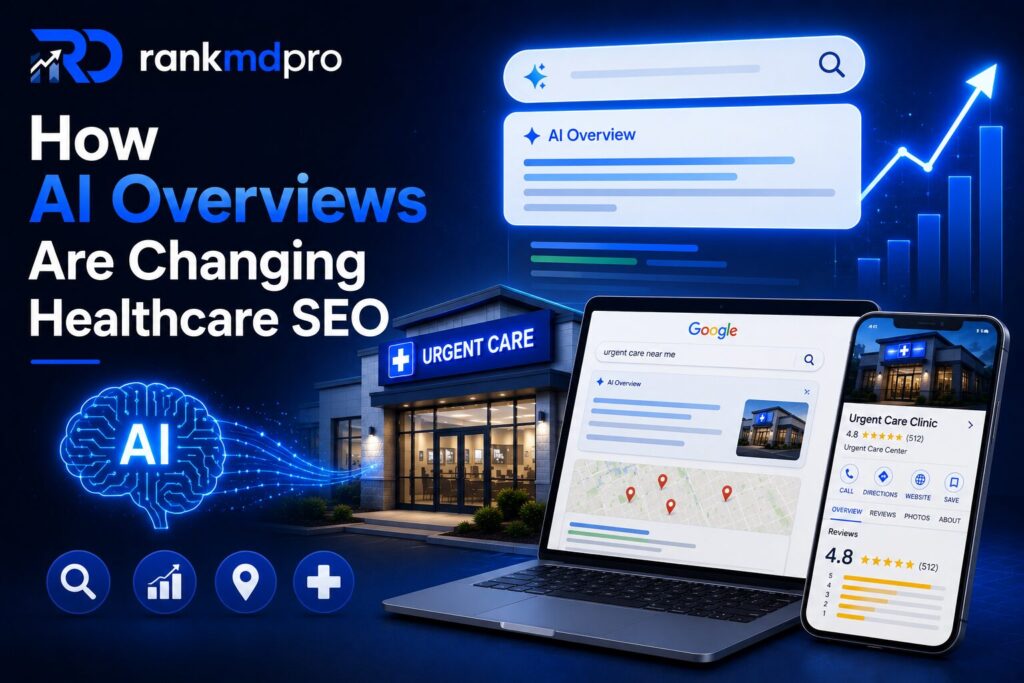
If your urgent care clinic’s organic traffic has been quietly declining despite stable rankings, you are not imagining it. Google’s AI Overviews are now answering patient questions directly on the search results page before a single click reaches your website. For healthcare, this is not a minor algorithm tweak. It is a structural change in how patients find care, and most clinics have no strategy for it. This guide breaks down exactly what is happening, what the data shows, and what your clinic must do to stay visible.
What Are AI Overviews and Why Healthcare Is Hit Hardest
AI Overviews are Gemini-powered summaries that appear at the top of Google’s search results, synthesizing answers from multiple sources before a user ever scrolls to traditional blue links. Since their 2024 launch, they have expanded into a default search surface used by over 2 billion monthly users.
Healthcare is not just affected by this shift, it is one of the most exposed industries in existence. The data is stark:
| Industry | AI Overview Trigger Rate |
|---|---|
| Healthcare | 75–88% |
| Education | 78–83% |
| B2B Tech | 78–82% |
| Finance/Insurance | 78% |
| Restaurants | 72–78% |
| E-commerce | 4–14% |
| Local Services | 7% |
This single table explains why your urgent care clinic feels the pressure more than a restaurant or retail competitor down the street would. Healthcare queries trigger AI Overviews at near-total saturation rates, while e-commerce and local-service queries remain largely protected because they are transactional rather than informational. Symptom searches, “is it the flu or a cold,” and “urgent care vs ER” queries are exactly the informational format AI Overviews are built to intercept.
The Click-Through Rate Collapse And the Recovery Most Clinics Don’t Know About
How Much Traffic Are AI Overviews Actually Taking?
The honest answer: significant, but not permanent in the way most agencies describe it. Industry data shows that when an AI Overview appears on a healthcare-related query, click-through rates drop from approximately 1.6% down to just 0.6%.
But the full picture is more nuanced than a simple decline. A longitudinal study tracking 2.43 billion impressions found that organic click-through rate on AI Overview-present queries collapsed by roughly 65% through September 2025, then rebounded 85% by February 2026 while CTR on AIO-absent queries rose substantially over the same period.
The takeaway: the gap between being cited inside the AI Overview versus being absent from it is now the defining factor in your traffic not whether AI Overviews exist at all.
What Happens If Your Clinic Is Actually Cited
This is the part most healthcare SEO content gets wrong by only reporting the bad news. Brands that are cited inside AI Overviews see 35% more organic clicks and 91% more paid clicks compared to brands that are not cited. Being mentioned inside the AI answer is not a traffic loss it is a trust signal that increases downstream clicks.
The strategic shift for 2026 is clear: stop trying to “beat” AI Overviews and start engineering your content to be the source they cite.
Why Ranking #1 No Longer Guarantees AI Overview Citation
The Decoupling of Rankings and Citations
For years, SEO operated on a simple premise: rank higher, win the click. That premise has broken. Only 17–38% of AI Overview citations now come from pages that rank in the organic top 10, a steep drop from 76% in early 2024. Ranking is no longer a reliable predictor of AI visibility.
Healthcare specifically shows a different pattern than most industries. Healthcare and insurance content shows 68–75% overlap between organic rankings and AI Overview citations notably higher than e-commerce, which stayed essentially flat. This is actually good news for urgent care clinics: strong traditional SEO still matters more in healthcare than it does in most other verticals. But it is no longer sufficient on its own.
What Actually Drives Citation in 2026
Google’s AI systems no longer evaluate content at the page level they evaluate it at the passage level. Facts are extracted, clustered, scored, and reassembled into an answer pulled from multiple sources simultaneously. This means thin, generic content gets mined for nothing, while comprehensive, well-structured content gets pulled apart and cited.
| Content Format | Citation Lift |
|---|---|
| Original data/research | 3–5x standard blog content |
| Comparison pages with 3+ tables | +25.7% citations |
| List-structured validation content | +26.9% citations |
| Short, direct-answer sentences (≤10 words avg) | +18.8% citations |
| Pages with 5–7 current statistics | +20% citation likelihood |
This is precisely why structured, data-dense content not vague wellness blogging is the format winning AI visibility in healthcare right now.
The Review Signal Most Clinics Are Completely Ignoring
Reviews Now Influence AI Citation, Not Just Map Pack Rankings
This connects directly to what we cover in our review rankings guide but the AI dimension changes the stakes. Brands with no third-party review profile have a median AI citation rate of just 1%, while brands with even a minimal review presence of 1–13 reviews jump to 53.5% a 52 percentage point swing.
For urgent care clinics, this means your Google Business Profile reviews, Healthgrades presence, and Zocdoc ratings are no longer just local ranking signals they are AI trust signals that directly determine whether ChatGPT, Gemini, and AI Overviews recommend your clinic when a patient asks “what’s the best urgent care near me with short wait times.”
Authority Beyond Your Own Website
Off-site brand mentions show the strongest correlation with AI Overview appearances stronger than backlinks or domain authority. This is a fundamental shift for healthcare marketing. Your clinic’s AI visibility now depends as much on what Healthgrades, local news, and patient review platforms say about you as it does on your own website’s SEO.
What Your Urgent Care Clinic Must Do Right Now
1. Restructure Content Around Direct-Answer Passages
Stop writing long, narrative-style blog introductions before answering the question. AI systems extract passages lead with the direct answer, then expand. Every H2 and H3 on your service pages should answer a specific question in the first two sentences.
2. Build E-E-A-T Into Every Page
Because healthcare is classified as Your Money or Your Life content, your website must meet Google’s Experience, Expertise, Authoritativeness, and Trustworthiness framework credentialed author bylines and verified physician reviews are essential trust signals. Anonymous, unattributed content is increasingly invisible to both traditional rankings and AI citation.
3. Strengthen Your Review Infrastructure Across Every Platform
Not just Google. Healthgrades, Zocdoc, Vitals, and Yelp all feed into the brand-mention signals AI systems use to evaluate trustworthiness. A clinic with reviews concentrated only on Google is leaving citation opportunity on the table.
4. Fix Your Technical Foundation
Server-side rendering matters more than ever, since it pre-assembles your page content into a fully readable document that both Google and AI bots can process instantly and Core Web Vitals remain a key ranking signal tied to AI Overview eligibility. A site that AI crawlers cannot parse efficiently simply will not be cited, regardless of content quality.
5. Publish Original Data, Not Recycled Advice
Generic “5 signs you need urgent care” content is now competing against thousands of identical articles. Original patient volume data, local wait-time trends, or seasonal illness pattern data specific to your clinic gives AI systems something unique to extract and cite.
Is Your Clinic Invisible in AI Search Without Knowing It?
Most urgent care clinics have no visibility into whether they are being cited or excluded from AI Overviews and conversational AI platforms like ChatGPT and Perplexity. Google Search Console does not show this data. Your rankings can look stable while your actual AI visibility quietly erodes underneath them.
This is the blind spot RankMD Pro was built to close. We specialize exclusively in healthcare SEO, and our approach to urgent care centers now includes AI visibility tracking across Google AI Overviews, ChatGPT, and Perplexity alongside the technical SEO, E-E-A-T content architecture, and review infrastructure that drive AI citation in 2026.
We offer a complimentary AI Visibility and Local Ranking Audit that shows you exactly where your clinic stands whether you are being cited, ignored, or replaced by competitors in the answers patients are seeing before they ever reach a search results page.
Frequently Asked Questions
Do AI Overviews mean SEO is no longer worth investing in for urgent care clinics?
No. Healthcare shows 68–75% overlap between organic rankings and AI citations, meaning strong traditional SEO remains a prerequisite for AI visibility in this vertical, even though it is no longer sufficient alone.
Can a clinic with strong reviews but weak SEO still get cited in AI Overviews?
It is possible but inconsistent. Review presence dramatically increases citation likelihood, but content structure, technical accessibility, and E-E-A-T signals still determine whether AI systems can extract and trust your information.
How do I know if my urgent care clinic is being cited in AI Overviews?
Standard tools like Google Search Console do not track this. Specialized AI visibility tracking tools or an agency audit are currently the only reliable ways to see citation data across AI Overviews, ChatGPT, and Perplexity.
Should urgent care clinics still optimize for Google Maps and local pack if AI Overviews are growing?
Yes. Local, transactional searches like “urgent care near me” remain largely protected from AI Overview disruption, since these queries are commercial rather than informational in intent.
What content format gets cited most often in healthcare AI Overviews?
Structured content with comparison tables, list-based formats, original statistics, and short direct-answer sentences consistently outperforms long narrative blog content in citation studies.
Does having a credentialed physician review my clinic’s content actually impact AI visibility?
Yes. E-E-A-T signals, including verified medical reviewer credentials, are a core evaluation factor Google’s AI systems use to determine source trustworthiness for YMYL healthcare content.