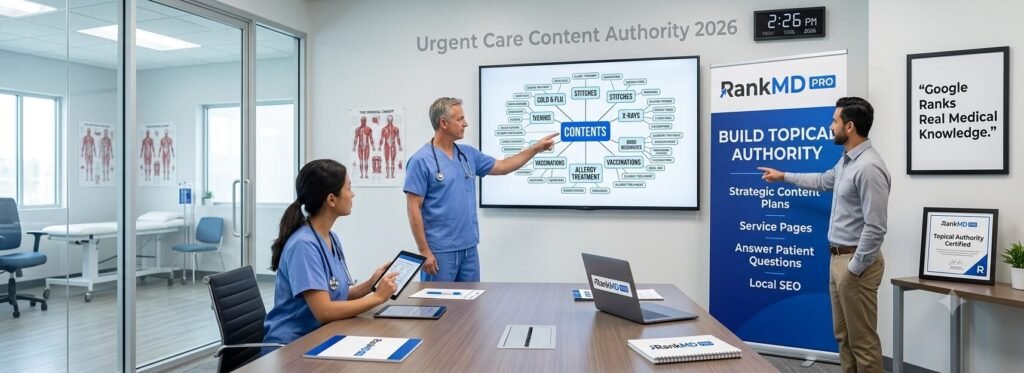
Topical authority is one of the most important parts of successful urgent care SEO in 2026. Google’s main goal is to rank websites that show real knowledge and medical expertise. At the same time, patients are looking for health information they can truly trust.
If your urgent care website can provide detailed, helpful answers to common patient questions, people will believe in your clinic more. As a result, your website will rank higher for many more keywords, bringing a steady stream of new visitors to your site. In this guide, you will learn exactly how to build this vital topical authority for your urgent care website.
What Is Topical Authority?
Topical authority means your website has become the “go-to” expert on one specific subject. It is not about just writing one extremely long, complex article. Instead, it involves creating many different helpful pages that focus on the same core subject, but from different angles.
For example, an established urgent care website should answer a wide variety of health questions. It must clearly explain all available services and help patients understand exactly when they should visit urgent care versus an emergency room. When your website covers these subjects comprehensively, search engines will trust your site more, and patients will too.
Why Topical Authority Matters in 2026
The world of SEO has changed dramatically. Today, Google prioritizes content that demonstrates high quality, real-world experience, and genuinely helpful information. AI-powered search results also heavily prefer trusted, authoritative websites.
By establishing your website as an unwavering expert in urgent care, your clinic can enjoy numerous competitive benefits, including:
-
Significantly better Google rankings.
-
A major increase in highly relevant local SEO traffic.
-
Higher levels of immediate patient trust.
-
Improved click-through rates from search results.
-
More actual appointment requests and walk-ins.
-
A much stronger overall online reputation.
Topical authority is no longer just an optional strategy; it is a fundamental requirement for growth in 2026.
Benefits of Topical Authority
| Benefit | How It Helps Your Clinic |
| Better Rankings | More of your pages show up in search results for diverse queries. |
| More Traffic | You attract a wider audience of patients actively searching for care. |
| Higher Trust | Patients quickly see your clinic as a reliable source of medical help. |
| More Appointments | Truly helpful content naturally turns website visitors into real patients. |
| Better Local SEO | Your clinic becomes much easier to find for people nearby in your community. |
| Stronger Brand | Local people remember your clinic when they need quick medical attention. |
Start With One Main Topic
The first step is always to choose one central topic. For your website, that main topic is, of course, urgent care.
Once you have established that foundation, you need to break it down into much smaller, more specific sub-topics. These smaller topics will form the basis of your content clusters. Excellent examples include:
-
Cold and flu treatment
-
Fever management in children and adults
-
Ear infections symptoms and care
-
Cuts and wound care (including stitches)
-
Minor burns and first aid
-
Sprains, strains, and minor fractures
-
Diagnostic services like X-rays
-
Preventive physical exams (sports, school, DOT)
-
Routine vaccinations and immunizations
-
Common skin infections and rashes
-
Allergy treatment and relief
-
Food poisoning and stomach bugs
Build Topic Clusters
A topic cluster is simply a strategic set of linked pages. Every single page in the cluster answers one very specific patient question. All of these individual pages then link back to the main topic page, and to each other. This clear structure helps Google easily understand the depth of knowledge your website possesses on that entire subject.
Example Topic Cluster:
Main (Pillar) Page:
-
Urgent Care Services
Related (Cluster) Pages:
-
Can urgent care treat a high fever?
-
Can I visit urgent care for pneumonia diagnosis?
-
Can urgent care handle stitches and wound closure?
-
Does urgent care perform diagnostic X-rays on-site?
-
Can urgent care provide treatment for minor burns?
This logical structure explicitly builds authority.
Answer Real Patient Questions
Patients are actively searching for answers to real-world questions, not medical theory. Your website must provide immediate, comprehensive answers to these queries. High-value questions include:
-
Can I walk in for urgent care without an appointment?
-
Does urgent care accept my specific insurance plan?
-
Can an urgent care prescribe antibiotics for my infection?
-
Does urgent care do blood tests and basic lab work?
Cover Every Stage of the Patient Journey
A patient’s needs and search behavior change depending on where they are in their healthcare journey. You must create targeted urgent care content for every critical stage.
Before the Visit (Research Phase): Patients are actively researching:
-
Their specific symptoms (e.g., “symptoms of ear infections”).
-
Available treatment options.
-
Determining exactly when they should visit a walk-in clinic.
-
accepted health insurance plans and estimated costs.
During the Visit (Logistics Phase): Patients want to know what to expect:
-
Details on the clinic check-in process.
-
Current estimated wait times.
-
What happens during medical exams or procedures.
-
How lab testing or diagnostic imaging works.
After the Visit (Recovery Phase): Patients will continue to search for:
-
Detailed recovery and aftercare tips for their condition.
-
Simple, effective home care instructions.
-
A clear list of warning signs that indicate a more serious problem.
-
Information on necessary follow-up visits or specialist referrals.
Providing this complete journey of information gives patients total confidence in your clinic’s expertise.
Make Superior Service Pages
Every single medical service you offer should have its own dedicated, comprehensive page. Resists the temptation to list all services on one generic page. Instead, create specialized, in-depth pages for:
-
Flu and Cold Treatment
-
Comprehensive COVID-19 Testing and Care
-
Sports Physicals and School Physicals
-
DOT Physicals for commercial drivers
-
Minor fractures and sprains care
-
Wound care and stitches for cuts
-
Digital X-rays and diagnostic imaging
-
Routine immunizations and vaccinations
-
Skin infections, rashes, and bite treatment
-
Lab testing for STDs, strep, or blood work
Each individual service page must thoroughly explain:
-
Which specific symptoms you treat.
-
The exact treatment options available.
-
The clear benefits of choosing urgent care for this issue.
-
Specific guidance on when to seek treatment immediately.
-
A comprehensive “Frequently Asked Questions” section.
Write Helpful Blog Posts
Your blog is the ideal tool for answering common, real-time patient questions that service pages might not cover. When writing, keep every article simple, compassionate, and straightforward. Prioritize being helpful over being complicated.
Use short paragraphs, clear headings, and always focus entirely on supporting the individual through their medical concern. High-value topics consist of:
-
When should I visit urgent care for a high fever?
-
Can I get a pneumonia diagnosis at a walk-in clinic?
-
How to know if a cut needs professional stitches.
-
Can urgent care treat dehydration from illness?
-
What are the most common causes of recurring ear infections?
Add Internal Links
Internal linking is not optional; it is a critical requirement for building topical authority. Every new page you create should link back to related content on your site. For instance, a detailed page about fever management can naturally link to pages such as:
-
Flu and Cold Treatment
-
Strengthening your immune system against illness
-
When a fever is a signs of pneumonia
-
Understanding the risks of dehydration
Strategic internal links help patients find the complete picture and signal to search engines that your site is a interconnected web of real expertise.
Update Old Content
Health guidelines, best practices, and medical information change constantly. Search engines prioritize new, updated content over outdated material. Review your existing blog articles and service pages every few months. Proactively update:
-
Obsolete medical guidelines.
-
Outdated health statistics or data.
-
Available treatment options or protocols.
-
User-submitted “Frequently Asked Questions.“
-
Internal linking to ensure maximum content discovery.
Fresh, accurate, and relevant content dramatically performs better than old material.
Show Medical Expertise (E-E-A-T)
Patients look for trusted, credentialed advice when they have a medical concern. Your goal should be to explicitly build clinical trust. Wherever possible, your content must be backed by true experience and expertise, clearly displaying:
-
Medical Reviewers: State when content has been reviewed by a licensed physician.
-
Licensed Providers: Feature profiles of your actual doctors and medical staff.
-
Years of Experience: Highlight the combined years of expertise your clinical team has.
-
Medical Certifications: Showcase clinic and physician awards, certifications, and recognitions.
This dedication to quality explicitly improves patient trust and strengthens your broader healthcare reputation management.
Focus on Local SEO
The vast majority of urgent care patients search for care in their immediate vicinity. You must integrate local SEO principles naturally throughout your content clusters.
Target high-intent localized search terms such as:
-
“Urgent care near me”
-
“Walk-in clinic in [City Name]”
-
“Same-day medical care near [Neighborhood Landmark]”
-
“Weekend urgent care appointment”
-
“Flu treatment in [Neighborhood Name]”
In your content, naturally mention your city, surrounding neighborhoods, and prominent local landmarks to capture local intent.
Optimize Every Single Page
Topical authority is supported by proper page-level optimization. Ensure that every single page on your
includes:
-
One clear, high-intent page title.
-
A single, descriptive H1 heading.
-
Clearly structured, helpful subheadings (H2s and H3s).
-
Short, easy-to-read paragraphs.
-
Clear bulleted or numbered lists for readability.
-
Logical, strategic internal links to related content.
-
Optimized medical images and infographics with proper alt-text.
-
A unique and compelling meta-description.
Comprehensive page optimization is essential for turning content into actual search rankings.
Add Helpful Visual Content
Patients seek clarity, and visual content helps them understand complex medical issues better than text alone. Incorporate:
-
Custom infographics that explain entire processes.
-
Clear, accurate medical illustrations of conditions or treatments.
-
Easy-to-digest treatment charts and decision diagrams.
-
Simple service icons for streamlined navigation.
-
Authentic photos of your clinic interior and friendly medical staff.
High-quality visual content dramatically improves the overall user experience for patients.
Build Trust Signals
Trust is your most important currency in healthcare. Don’t just state that you are trustworthy; prove it to both patients and search engines. Make your core credibility markers immediately visible:
-
Prominently display recent patient testimonials and star ratings.
-
Feature detailed provider profiles showcasing credentials and experience.
-
Highlight clinical awards, certifications, and community recognitions.
-
List accepted health insurance plans and clear self-pay pricing options.
-
Provide multiple, instant, and clear contact methods.
-
State your exact operating hours, including holidays.
Improve Website Speed
Patients seeking urgent medical attention do not have patience for slow-loading websites. A slow site frustrates users and leads to high bounce rates. Increase your site speed by:
-
Compressing all images and medical graphics without sacrificing quality.
-
Investing in high-performance medical web hosting.
-
Minifying heavy code and large scripting files.
-
Removing unused plugins or obsolete features.
A fast, smooth website keeps patients on your site and increases your chances of conversion.
Make Your Website Mobile Friendly
The vast majority of urgent care searches—especially high-intent searches like “urgent care near me”—occur on mobile devices. A failure to optimize for mobile SEO is a failure to acquire patients. Your mobile experience should offer:
-
Immediate load times on cellular networks.
-
Large, easily tap able buttons (especially for calling or booking).
-
Streamlined, easy-to-use menu navigation.
-
A layout that displays correctly across all smartphone and tablet devices.
True mobile usability is an absolute prerequisite for success in 2026.
Use Structured Data (Schema)
Schema markup is specialized code that acts as a translator, explicitly explaining your content’s meaning directly to search engines. For building medical authority, utilize relevant structured data like:
-
Medical Clinic: Crucial for providing key location and service details.
-
FAQ: Instantly enables rich snippets in search results.
-
Local Business: Essential for strengthening local SEO.
-
Organization: Connects your clinic to your specific medical expertise.
-
Article: Properly identifies and catalogs your helpful blog content.
Build Helpful Backlinks
While internal content is key, third-party validation (backlinks) still matters immensely. Focus on acquiring reputable, clinically relevant links from sources like:
-
Local news publications and community journals.
-
Respected local community organizations and health charities.
-
Highly reputable healthcare blogs and medical forums.
-
Accredited medical associations and clinical databases.
-
High-authority local business directories.
A strong, credible link profile signals to search engines that your expertise is recognized by others.
Track Your Results
You cannot manage what you are not measuring. Closely monitor key metrics to understand your progress and the ROI of your topical authority efforts:
| Metric | Why It Critically Matters to Your Strategy |
| Organic Traffic | Shows your overall growth and effectiveness in search results. |
| Keyword Rankings | Tracks your visibility for competitive medical search terms. |
| Click-Through Rate (CTR) | Measures how compelling your search results appear to users. |
| Time on Page | A strong indicator of genuine patient interest and engagement. |
| Bounce Rate | Highlights potential issues with content relevance or page speed. |
| Appointment Requests | The ultimate goal, demonstrating effective patient acquisition. |
| Local Rankings | Measures how well you dominate your specific geographic service area. |
Simple Content Plan
A strong, consistent content plan helps you build authority significantly faster.
Month 1 (Core Foundations):
-
Urgent Care Services Pillar Page
-
Cold Treatment and care
-
Comprehensive Flu Treatment guide
-
Fever management in children vs. adults
Month 2 (Common Ailments):
-
Ear Infection symptoms and care
-
Pink eye treatment options
-
Allergy Management and relief
-
Sore throat and strep testing
Month 3 (Minor Injuries):
-
Evaluating and treating cuts
-
When a wound needs stitches
-
Identifying sprains and minor fractures
-
Care for broken bones and stabilizing injuries
Month 4 (Wellness & Diagnostics):
-
Sports physicals and school physical exams
-
Routine Vaccinations and immunizations
-
Laboratory tests (STD, strep, blood work)
-
X-Ray and diagnostic imaging capabilities
Commit to consistently adding high-quality, relevant content to your library every single month.
Final Thought
In 2026, building authentic topical authority is the single most powerful strategy for growing an urgent care website. Effective SEO is no longer about maximizing the output of isolated articles. It is about building a comprehensive, interconnected, and trusted library of helpful resources for patients.
Focus your efforts on directly answering real patient questions. Create specialized, detailed service pages. Strategically link all your related content together into strong clusters. Prove your clinical credentials and expertise. Over time, search engines will naturally view your website as the definitive source of information. Most importantly, patients will trust your clinic above all others before they even set foot inside.
Need help increasing your patient calls? If you are ready to dominate your local market through strategic urgent care SEO services, partner with the specialized team at Rank MD Agency today.
Frequently Asked Questions
1. What is a topic cluster?
A topic cluster is simply a strategic collection of interconnected articles that deeply explore a single main web page of a website.
2. How often should I publish new content?
A solid goal for urgent care is to publish two to four useful, high-quality blogs every single month.
3. Should every single service have its own dedicated page?
Yes. Creating separate service pages helps both patients and search engines deeply understand the specific medical assistance you provide.
4. Do clinic blogs truly help with local SEO?
Yes, absolutely. Clinic blogs directly answer patient questions and can be easily optimized to attract highly relevant local search traffic.
5. How important are internal links for medical websites?
They are absolutely critical. Strategic internal linking connects related pages and provides the foundation for an authoritative website structure.