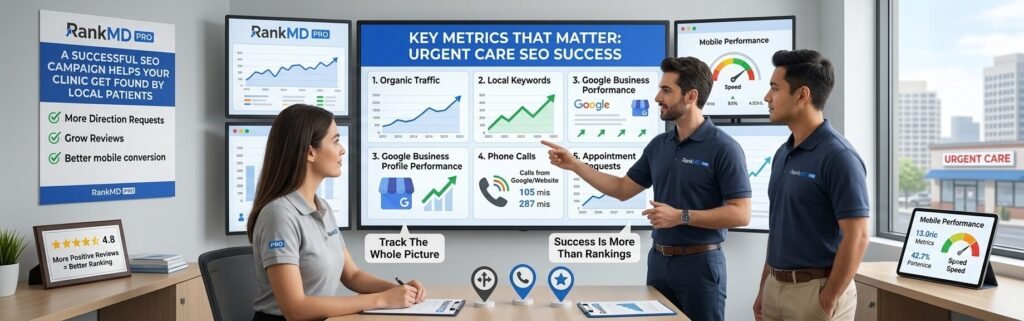
A successful urgent care SEO campaign is not measured by Google rankings alone. While being at the top of search results is great, the real objective is to bring more patients through the doors of your urgent care center.
Effective SEO ensures your website appears exactly when people nearby are searching for immediate medical care. However, true success comes from tracking the right numbers, not just vanity metrics. Many healthcare marketing centers make the mistake of focusing solely on where they rank. High rankings are only useful if they lead to more phone calls, clinic visits, and appointments.
To understand the real impact of your digital marketing, you must look at the full picture. In this article, you will learn the key SEO metrics that actually matter for urgent care clinics and how you can improve them.
What Makes an Urgent Care SEO Campaign Successful?
A successful SEO campaign goes beyond visibility. It helps your clinic:
-
Get found easily by local patients.
-
Rank for the specific keywords patients actually use.
-
Increase targeted website traffic.
-
Receive more phone calls from prospective patients.
-
Get more online appointment requests.
-
Build a trustworthy reputation online.
-
Increase actual patient visits.
-
Improve your return on investment (ROI).
Why SEO Matters for Urgent Care Clinics
Most people today search online before choosing a medical provider. They use high-intent keywords like:
-
“Urgent care near me”
-
“Walk-in clinic open now”
-
“Urgent care for fever”
-
“X-ray urgent care”
-
“Weekend urgent care”
If your clinic appears at the top of these search results, more people will visit your website. If your website provides the right information clearly, many of those visitors will become patients. This is why a solid healthcare SEO strategy is essential.
Success Starts with the Right Goals
Before you dive into urgent care marketing, you must set clear, simple objectives. Without goals, you cannot accurately measure your progress. Your goals might include:
| SEO Goal | Why It Matters |
| More local traffic | To reach patients living near your clinic. |
| More phone calls | To increase immediate patient inquiries. |
| More appointment bookings | To directly grow clinic visits. |
| Better Google rankings | To improve visibility for important search terms. |
| Higher website trust | To build credibility before a patient visits. |
| More positive reviews | To increase patient confidence in your care. |
| Better ROI | To ensure your marketing helps grow your business profitably. |
Key SEO Metrics That Matter
Here are the most significant numbers every urgent care center should track to measure SEO success.
1. Organic Traffic
Organic traffic refers to visitors who find your website through unpaid search engine results. This is one of the foundational metrics for SEO. Generally, more organic traffic means better visibility. You should monitor:
-
Total monthly visitors.
-
New visitors vs. returning visitors.
-
Growth trends over time.
Steady, month-over-month development is a very positive sign of successful medical SEO.
2. Local Keyword Rankings
Since urgent care is a local business, ranking for local SEO searches is critical. You should track keywords specific to your services and location, such as:
-
“Urgent care [Your City]”
-
“Walk-in clinic near me”
-
“Flu treatment”
-
“Sports physicals”
-
“X-ray clinic”
Remember, ranking #1 for a generic keyword that does not drive patients has little value. Ranking high for patient-focused keywords that indicate a need for immediate care matters much more.
3. Google Business Profile Performance
For local healthcare marketing, your Google Business Profile (GBP) is often more important than your actual website. It is usually the first thing patients see in Google Maps or local search. Track these actions:
-
Profile views: How many people saw your listing.
-
Calls: Direct clicks to call your clinic from the profile.
-
Direction requests: People planning to drive to your location.
-
Website clicks: Visitors going from GBP to your site.
A strong, updated profile with regular photo updates brings in more local patients.
4. Website Click-Through Rate (CTR)
CTR shows the percentage of people who click on your website link after seeing it in Google search results. A higher CTR indicates that your page titles and descriptions are compelling and relevant to what the patient is searching for.
You can improve CTR by writing clear, action-oriented titles. For example, instead of a simple title like “Urgent Care Services,” use “Walk-In Urgent Care Open Today in [City Name] | Fast Medical Care.“
5. Conversion Rate
Traffic alone does not sustain a clinic; patients do. Your conversion rate measures what percentage of website visitors take a desired action. In urgent care marketing, important conversions include:
-
Clicking to call the clinic.
-
Booking an appointment online.
-
Filling out a contact or pre-check-in form.
-
Clicking for driving directions.
A higher conversion rate means your website is designed well for patient acquisition and effectively guides visitors to the next step.
6. Phone Calls
Many urgent care patients are in a rush or have a specific question, so they call before visiting. Tracking phone calls is one of the best indicators of SEO success. You should measure:
-
Total calls generated.
-
Calls originating specifically from Google search (via GBP).
-
Calls originating from the website (especially mobile users).
7. Appointment Requests
Every appointment request is a direct lead for your clinic. More requests almost always result from stronger SEO. Track:
-
Online booking confirmations.
-
“Walk-in intent” form submissions.
-
Same-day care requests.
8. Google Maps Visibility
Many patients search directly within Google Maps to find the closest care option. Tracking your visibility and ranking within Google Maps is crucial. The higher you appear in the “Local 3-Pack,” the more patients you will attract without them ever needing to visit your full website.
9. Bounce Rate
Bounce rate indicates the percentage of visitors who leave your website after viewing only one page. While a high bounce rate isn’t always bad (if they found the phone number and called immediately), a very high rate can signal issues such as:
-
A slow-loading website.
-
Poor or confusing design.
-
Content that doesn’t answer the searcher’s question.
10. Time on Page
This metric tells you how long visitors stay on a specific page. Longer visits usually indicate that your content is helpful, easy to read, and engaging. If visitors are leaving important service pages too quickly, you may need to improve the quality of your content.
11. Page Speed
Patients seeking urgent care are often stressed and will not wait for a slow website to load. If your site is slow, you will lose visitors to competitors. Fast websites:
-
Rank better in Google.
-
Convert visitors into patients at a higher rate.
-
Keep visitors engaged longer.
12. Mobile Performance
The vast majority of urgent care searches happen on mobile devices. Your website must work perfectly on smartphones. Crucial mobile SEO factors include:
-
Fast mobile loading speed.
-
Easy, intuitive navigation.
-
Prominent, easy-to-tap “Click-to-Call” buttons.
-
Readable text without needing to zoom.
13. Patient Reviews
Reviews significantly impact both your local SEO rankings and patient trust. You should actively monitor:
-
Total number of Google reviews.
-
Your average star rating (aim for 4.5+).
-
The frequency of new reviews.
-
Your clinic’s responses to both positive and negative reviews.
More positive reviews help you rank higher and encourage hesitant patients to choose your clinic.
14. Backlinks
Backlinks are links from other reputable websites to yours. They act as votes of confidence, increasing your website’s authority in Google’s eyes. Focus on quality over quantity. Valuable local backlink sources include:
-
Local news websites.
-
Medical directories.
-
Community organization websites.
-
Local school or sports team websites (via physical sponsorships).
15. Content Performance
Every blog post or service page on your site should have a purpose. Track how well your content is helping patients and driving results by looking at:
-
Individual page views.
-
Time spent on those specific pages.
-
Rankings for target keywords within that content.
Regularly updating older articles with fresh information can significantly improve their performance.
Tools to Track SEO Success
You do not have to guess how your medical marketing is performing. Use these trusted, essential tools:
| Tool | What It Tracks |
| Google Analytics 4 (GA4) | Overall website traffic, user behavior, and conversions. |
| Google Search Console | How Google sees your site, technical issues, and keyword performance. |
| Google Business Profile Insights | Local search views, calls, and direction requests. |
| Call Tracking Software | Exactly how many calls are generated by your SEO efforts. |
| Rank Tracking Tools | Daily/weekly updates on where you rank for key local terms. |
Signs Your Urgent Care SEO Campaign Is Working
SEO growth usually happens gradually over several months. You know your campaign is successful when you notice steady increases in:
-
Total website visitors.
-
Rankings for important, patient-focused keywords.
-
Visibility in Google Maps.
-
Volume of phone calls.
-
Online appointment bookings.
-
Positive patient reviews.
-
Overall clinic revenue.
Common SEO Mistakes to Avoid
Avoid these frequent pitfalls that can hinder your success:
-
Tracking only keyword rankings and ignoring actual leads.
-
Ignoring local SEO and GBP optimization.
-
Publishing “thin content” that doesn’t help the patient.
-
Neglecting the mobile user experience.
-
Ignoring slow page speeds.
-
Failing to measure conversion actions (calls and forms).
Frequently Asked Questions (FAQs)
-
How long does urgent care SEO take to show results? Most clinics begin seeing noticeable improvements in traffic and leads within three to six months. Highly competitive markets may require more time.
-
What is a good conversion rate for an urgent care website? While averages vary, a healthy urgent care website usually sees a strong combined conversion rate (calls + form completions) because the user intent is high. A steady upward trend is the best indicator of success.
-
How often should SEO performance be reviewed? You should review key metrics every month to identify trends, double down on what is working, and fix what is not.
-
What is organic traffic? Organic traffic includes visitors who find and click on your website through unpaid search engine results, rather than through paid ads.
-
Can blogging really improve urgent care SEO? Yes. Helpful, well-written blog posts answer specific patient questions, target valuable long-tail keywords, and build your clinic’s authority, which drives more traffic.
Conclusion
A successful urgent care SEO campaign is about much more than just rankings. It is about helping real patients find your urgent care center when they need treatment immediately.
A truly effective campaign boosts your local online presence, increases targeted website traffic, produces more phone calls, and leads to more confirmed appointments. Focus on tracking these critical action-oriented metrics rather than chasing vanity numbers. Concentrate on the patient experience, local search optimization, quick website performance, and useful content.
If you are searching for expert urgent care SEO services for your clinic, then visit RankMd agency.