Your med spa website might attract steady visitors, your search rankings could look great, and your social posts may drive active clicks. Even paid ads can successfully send people to your landing pages. However, you might face one major issue: visitors are refusing to book appointments. This hurdle can feel incredibly frustrating, making you assume you simply need more traffic. Fortunately, higher traffic volume is rarely the core solution; instead, your website likely suffers from a conversion barrier. A high-performing cosmetic platform must do more than attract eyeballs it needs to guide users toward taking real action. Maximizing lead conversion requires specialized aesthetic seo strategies paired with optimized user paths. Below, we examine the main reasons your site drives traffic without generating bookings.
1. Your Website Is Hard to Use
Consumers demand clean, straightforward websites. If your scheduling buttons or menus are buried, potential clients will quickly abandon ship. Maintaining an intuitive layout optimized through professional med spa digital marketing ensures your main menu features clear options:
-
Services
-
About
-
Before and After
-
Pricing
-
Contact
-
Book Now
2. Your Booking Button Is Not Clear
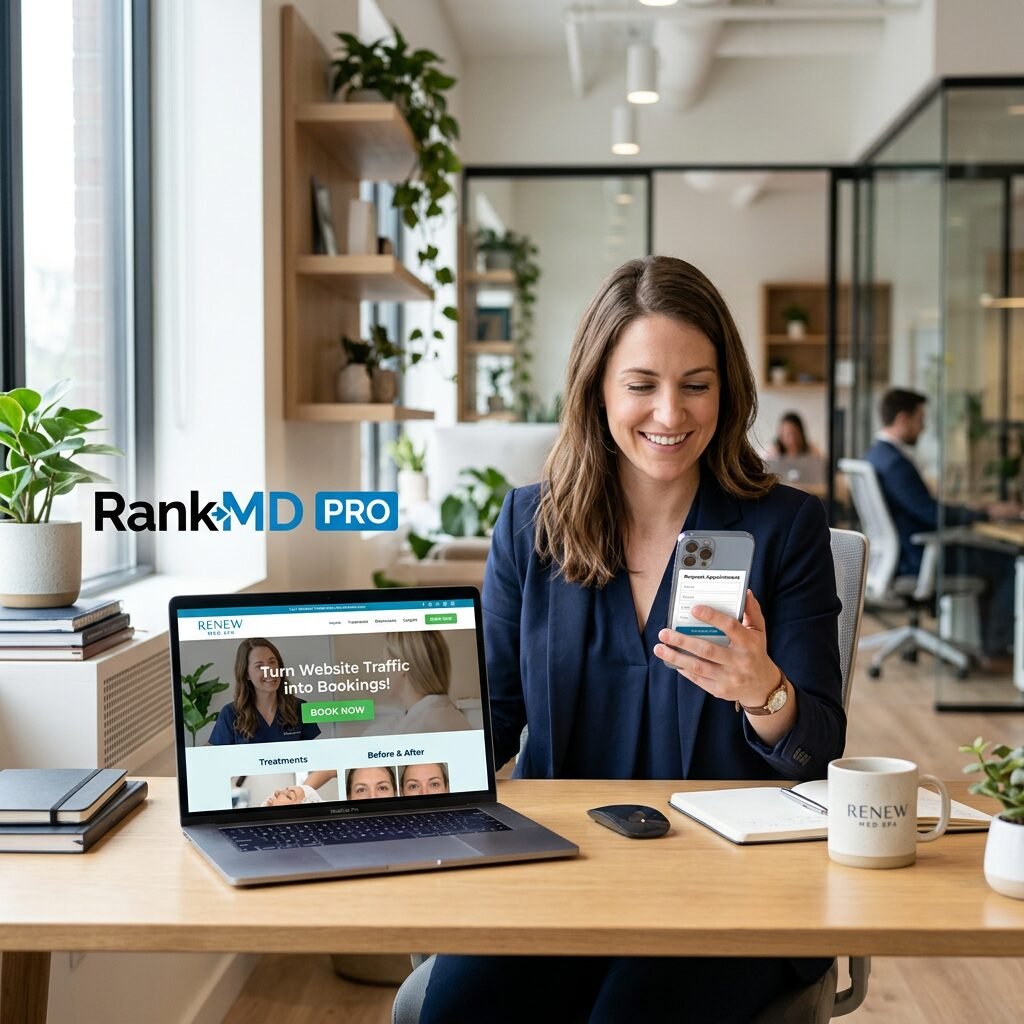
This represents one of the most common conversion hurdles. A visitor might love your treatments, trust your medical team, and genuinely want a procedure, yet feel completely lost on what to do next. Effective conversion rate optimization for clinics dictates using explicit calls to action. Instead of passive phrases like “Learn More,” use direct prompts like “Book Your Consultation.” Rather than hiding behind “Contact Us,” use actionable text like “Book Your Appointment.”
3. Your Website Is Too Slow
Website speed heavily impacts consumer behavior. If pages take too long to load, frustrated visitors will bounce immediately. Technical issues or poor hosting can ruin your visitor retention. Routine audits focusing on website speed optimization require testing across both desktop and mobile environments while checking:
-
Page load speed
-
Image size
-
Mobile speed
-
Booking page speed
-
Form speed
Your primary objective is keeping every web page lightning-fast and effortless to navigate.
4. Your Website Does Not Build Trust
Aesthetic treatments are deeply personal choices, meaning prospective clients must feel completely safe and confident in their provider selection. Strong medical authority building tactics help establish instant credibility from a visitor’s very first click by showcasing vital trust signals:
-
Provider names
-
Provider credentials
-
Real team photos
-
Client reviews
-
Before-and-after photos
-
Treatment details
-
Safety information
-
Clear contact details
-
Frequently asked questions
While stock images look polished, real photography fosters a much stronger sense of honesty and reliability.
5. Your Website Does Not Explain the Service
A visitor might search for Botox, while someone else looks up laser hair removal or a specialized facial. Each user arrives with distinct questions regarding:
-
What the treatment does
-
Who it is designed for
-
How the procedure works
-
Expected pricing structures
-
When visible results appear
If your service page fails to answer these core inquiries, users will leave. Detailed medical content marketing ensures every service page provides clear educational answers before smoothly guiding the visitor toward booking.
6. Your Pricing Is Too Hard to Find
Transparency regarding cost is vital for cosmetic consumers. If your pricing details remain completely hidden, prospective clients often exit your site out of frustration. While individualized treatment plans mean you cannot always post a single fixed rate, you can clarify this openly. Using informative phrasing such as “Treatment prices vary by area and personalized plans. Book a consultation for a custom quote” eliminates doubt, builds trust, and supports overall patient acquisition strategies.
7. Your Website Does Not Match Search Intent
Not every web visitor is ready to schedule a treatment immediately; some are conducting early-stage research, while others are ready to choose a provider today. Aligning your content with patient intent optimization ensures you serve both groups effectively. For example, an educational query like “What is Botox?” requires informative content, whereas a high-intent search like “Botox near me” demands immediate booking paths.
8. Your Mobile Website Is Poor
Because an overwhelming share of patients browse from smartphones, flawless mobile responsiveness is non-negotiable. Targeted mobile-first indexing strategies require evaluating these essential mobile checkpoints:
| Website Area | What to Check |
| Menu | Is it easy to open? |
| Text | Is it easy to read? |
| Buttons | Are they easy to tap? |
| Forms | Are they short? |
| Images | Do they load fast? |
| Booking | Is it easy to complete? |
| Phone number | Can users tap to call? |
9. Your Booking Form Is Too Long
Extremely long inquiry forms kill conversion rates. Visitors have little patience to fill out twenty separate fields just to request a basic appointment. Streamlining your intake forms using efficient UI/UX design for medical sites means asking only for essential details:
-
Name
-
Phone
-
Email
-
Service
-
Preferred date
10. Your Website Does Not Show Real Results
Patients want visual proof of what a procedure can achieve. Responsible use of genuine before-and-after imagery supported by proper client consent helps manage expectations while showcasing real outcomes. Adding contextual disclaimers (e.g., explaining that individual results vary) is a hallmark of transparent visual asset optimization.
11. Your Reviews Are Hard to Find
Social proof heavily influences consumer confidence. When visitors wonder whether your practice is trustworthy, authentic client feedback provides the answer. Integrating verified reviews directly onto service pages and near appointment buttons is a powerful aspect of professional online reputation management.
12. Your Call to Action Is Weak
Every important page on your site must feature a prominent, context-specific next step supported by smart search engine optimization for med spas:
| Page Type | Strong CTA |
| Botox Page | Book a Botox Consultation |
| Facial Page | Book Your Facial |
| Laser Page | Schedule a Laser Consultation |
| Pricing Page | Get Your Treatment Quote |
| About Page | Meet Our Team |
| Contact Page | Book Your Appointment |
13. Your Website Does Not Answer Common Questions
Unanswered questions create hesitation, and hesitation stops bookings. Incorporating structured FAQ sections into your service pages addresses common consumer doubts instantly:
-
How long does the treatment take?
-
Is there downtime?
-
When will I see results?
-
How many sessions may I need?
-
Is a consultation required?
-
What should I do before treatment?
-
What should I do after treatment?
14. Your Contact Details Are Hard to Find
Basic contact information should never require hunting across your entire website. Clearly displaying your active phone number, physical address, business hours, and an interactive map is a vital part of local aesthetic medical marketing designed for regional clinics.
15. Your Website Looks Outdated
Visual aesthetics directly impact brand trust. An archaic, poorly structured website makes prospective clients question whether your practice is active or modern. Your online platform must be clean, fast, simple to read, and fully mobile-friendly.
You Are Measuring Traffic but Not Conversions
Raw traffic volume is a misleading indicator of business success. To truly evaluate your growth, you must track actual user actions using dedicated healthcare analytics tracking:
-
Appointment bookings
-
Phone calls
-
Form submissions
-
Consultation requests
-
Booking page visits
-
Booking completion rate
Final Thoughts
A med spa website can generate high traffic volume while still failing to produce new client bookings. The underlying problem is rarely rooted solely in poor search positioning; instead, it stems from the user experience. Visitors require transparent information, reliable trust signals, clean navigation, and a frictionless way to book. Rather than focusing entirely on driving more visitors, focus intensely on converting the traffic you already command. If you are searching for dedicated aesthetic seo services for your multi-location Med Spa, visit Rank Md agency.
Frequently Asked Questions:
-
Why does my med spa website get traffic but no bookings?
Your site likely suffers from a conversion barrier, such as complicated booking steps, weak CTAs, poor mobile design, slow load times, or a lack of trust signals supported by structured aesthetic seo.
-
How can I get more med spa appointments from my website?
Simplify your scheduling path, add clear CTAs, display client reviews, explain procedures thoroughly, and ensure your site is fast, responsive, and answers common patient questions.
-
Should I add reviews to my med spa website?
Yes. Authentic reviews build instant credibility. Place selected testimonials directly on service pages and near conversion buttons.
-
Are before-and-after photos useful?
Yes, they help set clear expectations. Always secure proper consent and avoid making exaggerated or guaranteed promises.
-
What should I fix first?
Begin with your booking path by making schedule buttons instantly visible. Next, evaluate mobile performance, service copy, review placement, form length, and pricing visibility.