If your medical practice is getting website visitors but patient calls and appointment requests remain low, adding more traffic may not solve the problem. The first question is whether those visitors are actually looking for a provider and, if they are, what stops them from contacting your practice.
A patient searching “what causes knee pain?” has a different intent from someone searching “orthopedic doctor for knee pain near me.” The first person may be researching. The second may be comparing providers.
That distinction should shape your SEO, landing pages, calls-to-action, and conversion tracking.
Why Is My Medical Website Getting Traffic but No Calls?
A medical practice may receive website traffic without calls because visitors are researching rather than choosing a provider, landing on irrelevant pages, finding insufficient provider information, struggling to contact the practice, or encountering problems with mobile navigation and appointment scheduling. Analyze the search query, landing page, user action, and final conversion together.
1. Your Traffic May Not Be Coming From People Looking for a Doctor
Look at the actual queries generating your organic visits.
A dermatology practice might rank for:
- “why is my skin itchy”
- “causes of dry skin”
- “how to treat acne”
- “skin rash pictures”
Those searches can produce substantial impressions and clicks without producing many appointment requests.
Now compare them with:
- “dermatologist near me”
- “acne specialist in [city]”
- “dermatologist accepting new patients”
- “skin doctor for rash near me”
These searches provide much stronger evidence that the person is considering professional care.
Check Google Search Console by query and page. If most visits come from broad informational topics while your service pages receive little search exposure, the issue may be the type of traffic—not the amount.
2. Your Blog May Be Ranking Better Than Your Revenue Pages
This is a common pattern in medical SEO.
Suppose your article “10 Causes of Shoulder Pain” receives 1,500 monthly visits, while your “Shoulder Specialist” page receives 80.
The blog is winning the traffic competition, but the service page is closer to the appointment decision.
The important question becomes:
What happens after someone reads the article?
If there is no relevant internal link to your orthopedic service, treatment, or specialist page, the visitor may leave after getting the information they wanted.
A useful content structure can move readers naturally:
Symptom article → condition information → relevant specialty → service page → appointment
The connection needs to make sense for the reader. A medical article should not suddenly turn into an advertisement.
3. Your Service Page May Be Too Focused on the Service and Not the Patient’s Decision
A page titled “Cardiology Services” can describe echocardiograms, stress testing, cardiac monitoring, and other services without answering what a prospective patient actually wants to know.
For example:
Does this practice treat my condition?
Which cardiologist provides care?
Where is the office?
Are new patients accepted?
How do I schedule?
What should I bring to my appointment?
The exact information will vary by specialty and practice, but the principle is consistent: the page needs to help the visitor determine whether your practice is appropriate.
For YMYL healthcare content, Google’s guidance places particular importance on experience, expertise, authoritativeness, and trustworthiness. Google Search Central: Creating Helpful, Reliable, People-First Content
4. Patients May Not Know Who Is Actually Treating Them
Look at your provider pages from the perspective of someone who has never heard of your practice.
Can they quickly identify:
- Physician name
- Specialty
- Relevant qualifications
- Clinical areas of focus
- Practice location
- Services provided
- Appropriate professional affiliations
- Medical content authorship or review where relevant
A generic statement such as “Our experienced team provides exceptional care” tells a prospective patient very little.
Specific information is more useful.
For example, a cardiology page can identify the physician responsible for the service, explain their specialty, and connect the provider to the conditions and services offered by the practice.
That is much more meaningful than repeating broad claims about being “trusted” or “leading.”
5. Your Phone Number May Be Technically Present but Practically Difficult to Use
Open your website on a phone and behave like a first-time patient.
Start with a Google search.
Open the result.
Find the service.
Then try to call.
If you have to:
open menu → scroll → open contact page → scroll again → find number
the practice has created unnecessary friction.
For an urgent care clinic, the first screen may need to make hours, location, phone number, and walk-in information immediately accessible.
For a specialist, the priority may be provider, condition treated, location, and appointment request.
The CTA should reflect what the visitor came to accomplish.
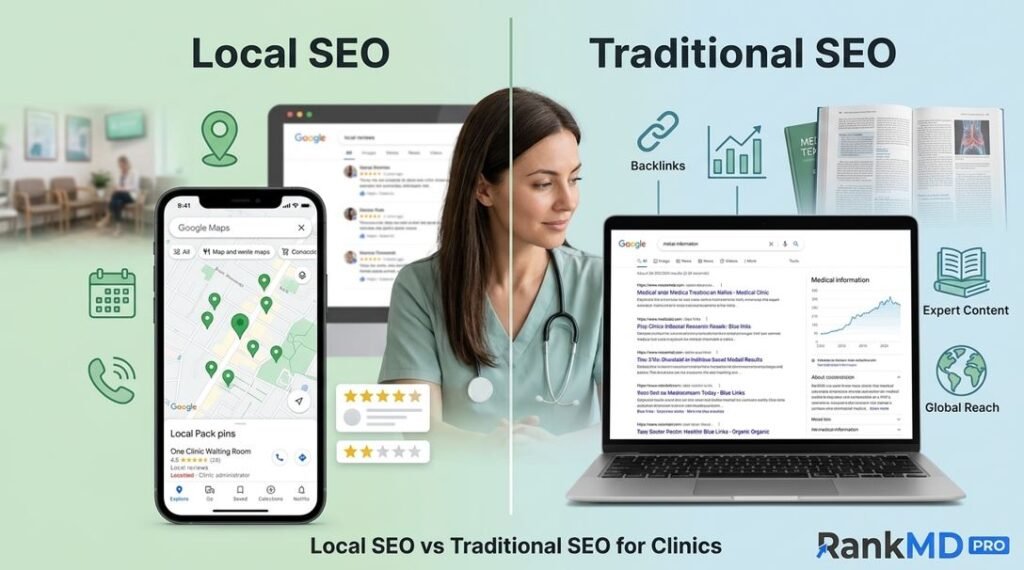
6. Your Google Business Profile May Be Losing the Patient Before the Website Does
For local healthcare searches, the website isn’t always the first destination.
A patient may search:
“pediatrician near me.”
Google can display practices with:
- Location
- Reviews
- Hours
- Phone number
- Website
- Directions
- Business information
The patient may call directly from the search result without visiting your website.
Google identifies relevance, distance, and prominence as important factors in local results. Google Business Profile Help: How to improve your local ranking on Google
That means your local SEO work should not stop at adding a city keyword to a webpage.
Check whether your:
- Business name
- Address
- Phone number
- Hours
- Services
- Website
- Practice locations
are accurate and consistent.
7. One Generic Location Page Can’t Represent Every Market You Serve
A multi-location practice often creates one page such as:
“Medical Services Across Texas”
and expects it to rank for every city.
That approach gives search engines little information about what happens at each actual location.
A legitimate location page should answer questions specific to that location:
Where is the office?
Which providers practice there?
What services are available?
What are the hours?
How can patients schedule?
Which nearby communities does the location reasonably serve?
Don’t create dozens of pages simply by replacing one city name with another. If the information is substantially identical, the pages provide little additional value.
8. Your Mobile Website May Be Losing Patients Who Were Ready to Call
Healthcare searches frequently happen when people need an answer quickly.
A patient may be searching while:
- Sitting in a parking lot
- Looking for an appointment after work
- Trying to find an open urgent-care clinic
- Comparing specialists
- Checking whether a practice is nearby
If the mobile page has intrusive pop-ups, tiny buttons, slow-loading elements, confusing menus, or an appointment form that is difficult to complete, the visitor can abandon the process.
Test your most important pages on an actual phone.
Don’t just check whether they technically load.
Try to complete the action a patient is supposed to take.
9. Your Website May Not Be Tracking the Calls It Generates
This creates another problem: you may not know whether SEO is producing inquiries.
A patient might:
- Find your practice through Google.
- Read your service page.
- Click the phone number.
- Call the office.
- Never submit a website form.
If your reporting only measures form submissions, that patient may disappear from your SEO data.
Healthcare call tracking can therefore provide important context. Invoca’s 2026 healthcare benchmark report found that 43% of answered healthcare calls in its dataset were identified as leads. That is benchmark data, not a universal conversion rate for every medical practice.
Your reporting should connect organic search with meaningful actions such as:
- Phone calls
- Appointment requests
- Online bookings
- Contact forms
- Direction requests
- Qualified inquiries
10. The Problem May Be Happening After the Phone Rings
Not every website conversion problem is actually a website problem.
Suppose your SEO produces 40 additional calls in a month.
But:
- 15 calls go unanswered.
- 8 callers cannot reach the scheduling team.
- 5 are told to call back later.
- 4 don’t receive a response to their web form.
The website generated opportunities, but the practice didn’t convert them into appointments.
Review:
How many calls are answered?
How quickly are missed calls returned?
How quickly are forms reviewed?
Can staff explain the relevant service?
Can new patients schedule without unnecessary transfers?
This is why healthcare marketing performance should be reviewed beyond the website itself.
11. Your Competitor’s Page May Make the Decision Easier
Search for one of your highest-value services.
Open the first three competing practices.
Don’t just compare headings and keywords.
Compare the actual information available to a patient.
Does the competitor show:
| Patient Concern | Your Page | Competitor |
| Provider information | ||
| Conditions treated | ||
| Services explained | ||
| Location | ||
| Phone number | ||
| Appointment option | ||
| Insurance information | ||
| Reviews | ||
| Mobile experience |
You may discover that the competitor isn’t winning simply because it has more backlinks.
Its page may answer the patient’s questions faster.
12. More Traffic Is Not Always the Correct Solution
Imagine a practice receives 1,000 monthly visits to a service page and only two appointment inquiries.
Increasing that traffic to 2,000 without fixing the page would not address the underlying problem.
First determine:
Are these visitors looking for this service?
Does the page answer their questions?
Can they verify the provider?
Can they easily contact the practice?
Are calls being tracked?
Does the scheduling process work?
Only after those questions are answered does additional traffic become a meaningful growth strategy.
How to Diagnose a Medical Website That Gets Traffic but No Calls
Use this sequence rather than immediately publishing more content:
1. Export Search Queries
Identify the keywords generating clicks.
Separate provider/service searches from broad informational queries.
2. Identify the Landing Pages
Determine which pages receive those visitors.
A high-volume blog post and a high-value service page should not be evaluated the same way.
3. Compare Intent With Page Content
Ask whether the landing page actually satisfies the query.
Someone searching for an orthopedic surgeon should not routinely land on a generic homepage.
4. Review the First Screen
On mobile, can the visitor immediately identify the practice, service, location, and appropriate next action?
5. Verify Provider Information
Make legitimate expertise, credentials, specialty, authorship, and clinical information easy to understand and verify.
6. Test Local Search
Check the practice’s Google Business Profile and the search results for important services in the communities you serve.
7. Track Calls and Bookings
Connect search traffic with actual inquiries.
8. Test the Scheduling Process
Call the practice yourself and submit a test inquiry.
You may uncover the conversion problem faster than another SEO report will.
Should You Focus on SEO or Conversion Optimization?
| What You Are Seeing | What to Investigate First |
| Very little relevant traffic | Search targeting and SEO |
| High informational traffic | Content intent and internal linking |
| Strong service-page traffic but no calls | Conversion and page relevance |
| Strong local rankings but few website actions | Google profile and landing-page experience |
| Many calls but few appointments | Scheduling and call handling |
| Traffic from the wrong locations | Local targeting and location architecture |
| Good rankings but poor engagement | Search-result/page intent match |
The answer is not automatically “more SEO.”
The correct priority depends on where the prospective patient stops progressing toward an appointment.
Frequently Asked Questions
Why is my medical practice getting website traffic but no patient calls?
The traffic may come from informational searches rather than provider-selection searches, or the landing pages may fail to provide enough information, trust, location details, or convenient contact options.
How do I know if my medical website traffic is valuable?
Review the actual search queries, geographic locations, landing pages, and conversion actions. A smaller number of visitors searching for a specific medical service in your service area can be more valuable than thousands of general health-information visits.
Should medical practices put a phone number on every page?
For practices that rely heavily on phone inquiries, the phone number should be easy to find, particularly on mobile. The appropriate CTA depends on the service and how patients typically schedule.
Why are my blog posts getting traffic but my service pages aren’t?
Blog posts often target broader informational searches, while service pages target provider and treatment decisions. A strong internal-linking structure can connect relevant educational content with the appropriate service and specialty pages.
Can local SEO increase medical appointment inquiries?
It can contribute to discovery for geographically relevant searches, particularly for practices dependent on local patients. However, local rankings alone do not guarantee appointments; the website, reviews, services, contact process, and appointment availability also influence the final decision.
Can an SEO agency guarantee more patient calls?
No legitimate agency can guarantee a specific number of calls or appointments. Search demand, competition, website performance, reputation, location, scheduling capacity, and patient behavior all affect results.
Your Traffic Report May Not Be Showing the Real Problem
If your medical practice is getting visitors but the appointment calendar isn’t reflecting that traffic, don’t judge the situation from sessions alone.
Start with the evidence:
Which searches brought them?
Which page did they enter?
What information did they need?
Could they identify the provider?
Could they find the practice?
Could they call or book without friction?
Did anyone answer when they called?
Those answers reveal whether the problem is search intent, SEO targeting, content, local visibility, website conversion, or patient access.
RankMD Pro can evaluate these points through a healthcare SEO and conversion audit, examining the search queries, service pages, local presence, technical foundation, content quality, competitor positioning, and conversion paths affecting your practice.
If your medical website is generating traffic but not generating enough patient inquiries, diagnose the conversion gap before investing in more traffic.
Get Your Healthcare SEO Audit →