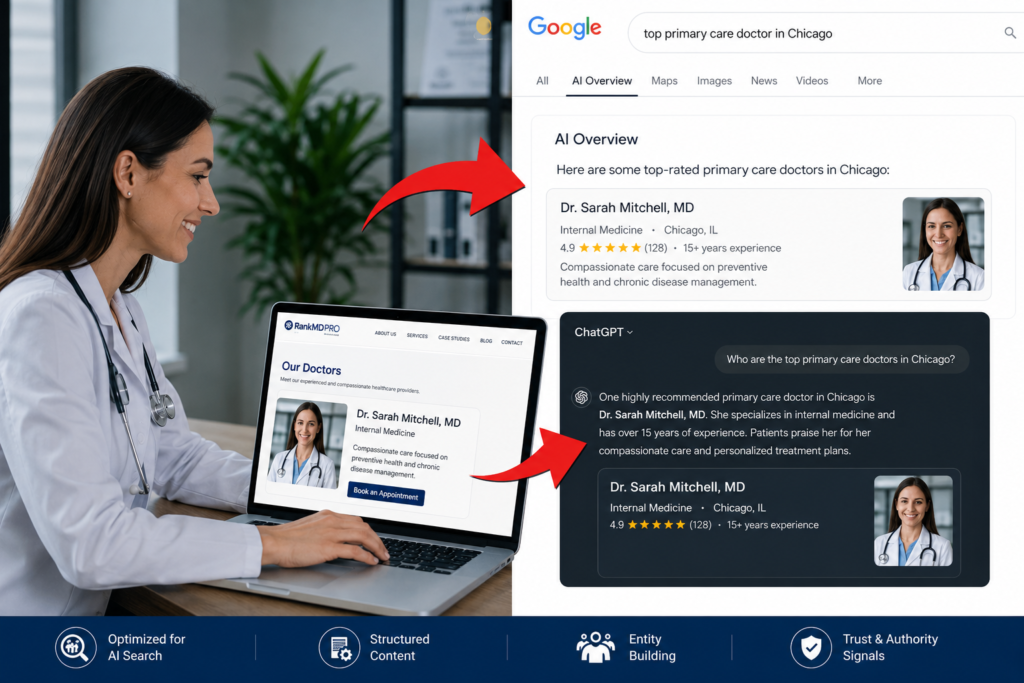
Patients are changing how they search for healthcare.
Instead of typing only “dentist near me” or “best psychiatrist in Chicago,” patients increasingly ask longer, conversational questions such as:
“What should I look for in a psychiatrist?”
“Which urgent care clinics near me accept my insurance?”
“What is the best dental practice for implants in my area?”
“Can you recommend a cardiologist who specializes in my condition?”
These searches create a new visibility opportunity for medical practices: Answer Engine Optimization (AEO for Healthcare.
AEO for healthcare focuses on making your practice, services, expertise, and content easier for answer engines and AI-powered search experiences to understand and surface.
Google’s AI features can provide AI-generated summaries with links to supporting webpages, while ChatGPT Search can search the web and provide sources and links within its answers.
That means healthcare organizations should not think only about ranking blue links anymore. Your strategy should also consider how your practice can become a relevant, trustworthy source when patients ask AI-powered search systems healthcare questions.
What Is AEO for Healthcare?
AEO for Healthcare, or Answer Engine Optimization for Healthcare, is the process of structuring and improving healthcare content so that answer engines can better understand, retrieve, summarize, and potentially reference it when answering patient questions.
Traditional healthcare SEO often focuses on ranking for searches such as:
- “medical billing services”
- “dentist near me”
- “psychiatrist in Chicago”
- “urgent care in Dallas”
Healthcare AEO expands that approach toward conversational questions and informational intent.
For example, instead of optimizing only for:
“urgent care Chicago”
an AEO strategy may also address:
“What should I look for when choosing an urgent care clinic in Chicago?”
Instead of targeting only:
“dental implants Chicago”
the content can answer:
“How do I choose a dental practice for dental implants?”
This creates content that is useful for both traditional search and AI-driven discovery.
Google’s current guidance confirms that there are no special technical requirements or dedicated AI schema needed to appear in AI Overviews or AI Mode. Pages still need to meet Google’s normal technical requirements and be eligible for Search, while helpful, reliable, people-first content remains fundamental.
Why Google AI Overviews and ChatGPT Matter for Medical Practices
Healthcare search is increasingly becoming conversational.
A patient may start with a broad question, ask a follow-up question, compare providers, and then decide where to schedule an appointment.
AI-powered search experiences can potentially influence several stages of this journey.
For example:
Discovery:
“What type of specialist treats chronic back pain?”
Research:
“What should I ask a pain management doctor?”
Comparison:
“How do I compare pain management practices?”
Local intent:
“What are reputable pain management clinics near me?”
Conversion:
“Which clinic should I contact?”
This makes AEO for Healthcare more than a visibility exercise. It can become part of a broader patient acquisition strategy.
Google explains that AI Overviews and AI Mode can surface relevant links from its Search systems, while its newer generative AI guidance emphasizes unique content, strong foundational SEO, and information that provides genuine value to users.
For healthcare organizations, that means your website needs to provide more than generic definitions.
It needs to demonstrate expertise, relevance, clarity, local context, and trust.
How Google AI Overviews Find and Use Healthcare Content
One of the biggest misconceptions about AEO for Healthcare is that you can simply add a special piece of code and make Google recommend your practice.
That’s not how Google’s current guidance describes AI search.
Google states that AI Overviews and AI Mode rely on its existing Search systems and that traditional SEO fundamentals remain relevant. Google also describes techniques such as retrieval-augmented generation and query fan-out, where related searches may be explored to build a broader answer.
For a healthcare website, this means your content should clearly establish:
- What your practice does
- Which conditions and services you treat
- Where you provide care
- Who your providers are
- What makes your expertise relevant
- What questions patients commonly ask
- What evidence or authoritative information supports your claims
- How patients can take the next step
The goal is not to manipulate an AI answer.
The goal is to make your website the most useful and trustworthy source for the questions you want to be known for.
How ChatGPT Search Can Discover Healthcare Practices
ChatGPT Search provides another important opportunity for medical practices.
When ChatGPT uses web search, it can retrieve current information from the web and provide links to relevant sources. OpenAI states that website ranking in ChatGPT Search is based on multiple factors intended to help users find relevant and reliable information, and placement is not guaranteed.
This creates an important distinction.
You cannot simply “submit your practice to ChatGPT” and guarantee recommendations.
Instead, your website should be:
Crawlable → Indexable → Relevant → Authoritative → Clearly structured → Consistent across the web.
OpenAI also states that websites need to allow OAI-SearchBot to crawl the site to be eligible for inclusion in ChatGPT Search.
That makes technical accessibility an important part of ChatGPT SEO for healthcare.
10 AEO Strategies Healthcare Practices Should Implement
1. Build Content Around Real Patient Questions
The first step in (Answer Engine Optimization) AEO for Healthcare is understanding what patients actually ask.
Don’t build your content strategy entirely around short keywords.
Build content around complete questions.
For example:
Traditional SEO:
“psychiatrist Chicago”
AEO opportunity:
“How do I choose a psychiatrist in Chicago?”
Traditional SEO:
“urgent care services”
AEO opportunity:
“When should I visit urgent care instead of my primary care doctor?”
Traditional SEO:
“dental implants”
AEO opportunity:
“What questions should I ask before getting dental implants?”
Question-based content gives search engines and AI systems clear information to retrieve and summarize.
2. Give Direct Answers Before Expanding the Topic
AI systems need to understand what your page is actually saying.
One effective content structure is:
Question → Direct answer → Explanation → Supporting evidence → Practical next step
For example:
What does an urgent care clinic treat?
An urgent care clinic typically treats non-life-threatening illnesses and injuries that require prompt medical attention but do not necessarily require an emergency department.
Then expand into examples, limitations, when emergency care is appropriate, and how patients can contact the practice.
This structure improves readability for patients while making the information easier to identify and understand.
It is an important component of AEO for Healthcare because the content directly addresses conversational search intent.
3. Establish Healthcare E-E-A-T
Healthcare is a high-stakes search category.
Patients need reliable information before making healthcare decisions.
Your website should therefore demonstrate:
- Provider credentials
- Medical expertise
- Author information
- Clinical experience
- Clear service descriptions
- Accurate medical information
- Updated content
- Appropriate references where necessary
- Transparent practice information
- Real-world experience
Google has repeatedly emphasized helpful, reliable, people-first content and quality signals such as experience, expertise, authoritativeness, and trustworthiness.
AEO for Healthcare, authority isn’t simply about repeating keywords.
It’s about giving search systems strong reasons to understand your practice as a credible source.
4. Create Topical Authority Around Your Specialty
One blog post rarely establishes complete topical authority.
A stronger healthcare content strategy creates connected content around an entire subject.
For example, a psychiatry practice could develop content around:
- Psychiatry services
- Psychiatric evaluations
- Depression treatment
- Anxiety treatment
- Medication management
- Telepsychiatry
- Choosing a psychiatrist
- When to seek psychiatric care
- Psychiatric treatment FAQs
- Insurance and psychiatry services
These pages can naturally link to one another.
This creates a structured content ecosystem rather than a collection of unrelated blog posts.
RankMD Pro’s AEO for Healthcare SEO approach similarly emphasizes topical authority, content hubs, medical expertise, and AI-search visibility as part of a broader patient acquisition system.
5. Strengthen Internal Linking
Internal links help users and search engines discover related content.
They also help establish relationships between your services, location pages, specialty pages, and educational resources.
For example, a healthcare practice can connect:
Blog → Service page → Specialty page → Location page → Provider page
For practices that need a larger-scale strategy, RankMD Pro’s Healthcare SEO Services combine healthcare SEO, local search, technical SEO, content authority, and AI-search optimization.
You can also explore our Healthcare SEO Audit & Growth Strategy to identify technical, content, competitive, and visibility gaps.
A strong internal linking structure can help create a clearer topical architecture for both visitors and search systems.
6. Optimize Local Healthcare Signals
A patient asking ChatGPT or Google for a healthcare provider may include geographic intent.
Examples include:
- “best pediatrician in Dallas”
- “dentist near me”
- “psychiatrist in Chicago”
- “urgent care open near me”
- “cardiologist in Houston”
This is why local healthcare SEO should be integrated with AEO.
Make sure your website consistently communicates:
Practice name + specialty + services + location + provider expertise.
Your Google Business Profile should also contain accurate and current information.
Google’s AI search guidance specifically recommends keeping Business Profile information up to date alongside other foundational SEO practices.
For practices targeting local patient acquisition, our Local Search & Maps strategy focuses on local visibility, AEO for Healthcare, Google Business Profile optimization, geographic signals, and Map Pack performance.
7. Make Your Website Easy for Search Engines to Crawl
Excellent content cannot help if search engines cannot properly access or index it.
Review:
- Robots.txt
- XML sitemap
- Indexability
- Canonical tags
- Internal links
- Mobile usability
- Page speed
- Core Web Vitals
- HTTPS
- Broken links
- Redirects
- JavaScript rendering
- Structured data
Google says pages must meet normal Search technical requirements and be indexed and eligible to appear with a snippet to be considered as supporting links in AI Overviews or AI Mode.
That is why AI search optimization should begin with strong technical SEO rather than replacing it.
8. Use Structured Data Correctly
Healthcare practices should use appropriate structured data where applicable and ensure that the markup accurately reflects visible page content.
But don’t fall for the idea that there is a special “AI Overview schema.”
Google explicitly says there is no special schema.org structured data required for AI Overviews or AI Mode.
Instead, focus on accurate implementation of appropriate structured data and strong visible content.
For medical websites, this can support clearer communication about entities such as:
- Organization
- Physician
- Medical clinic
- Services
- Location
- Website
- Contact information
The structured data should reinforce not contradict the information patients can see on the page.
9. Build Strong Provider and Practice Entities
AI systems need context.
A page saying:
“Dr. Smith is a great doctor.”
provides little useful information.
A stronger provider profile might explain:
Dr. Smith is a board-certified psychiatrist in Chicago who focuses on adult psychiatric evaluations, medication management, and anxiety and mood disorders.
Now the relationship between:
Person → Specialty → Location → Services → Expertise
is much clearer.
This is part of medical entity optimization.
Your practice should have consistent information across its website, Google Business Profile, healthcare directories, professional profiles, and other authoritative sources.
10. Measure AI Visibility Without Chasing Vanity Metrics
Traditional SEO reporting often focuses on:
- Rankings
- Organic traffic
- Impressions
- Clicks
These remain important.
But medical practice AI visibility requires additional monitoring.
Track:
- AI Overview appearances where observable
- Brand mentions
- Practice mentions in AI answers
- Referral traffic from AI platforms
- Search impressions
- Branded searches
- Local visibility
- High-intent keyword performance
- Appointment conversions
- Phone calls
- Form submissions
- New patient inquiries
Do not treat a single AI response as proof of success.
AI-generated answers can change based on query wording, location, sources, freshness, and other factors.
What Makes Healthcare AEO Different From Traditional SEO?
Traditional SEO primarily asks:
“How do we rank this page?”
AEO asks a broader question:
“How do we become a useful, credible source when someone asks this question?”
That changes the content strategy.
Traditional SEO may focus heavily on:
keyword → page → ranking
AEO expands the model to:
question → intent → answer → entity → authority → supporting content → conversion
For healthcare, this distinction is particularly important because patients may ask complex questions before choosing a provider.
A successful AEO for Medical Practices strategy therefore combines:
SEO + content authority + local SEO + technical SEO + entity optimization + conversion strategy.
Common AEO Mistakes Healthcare Practices Should Avoid
Writing Generic AI-Generated Content
Publishing hundreds of similar AI-generated pages isn’t a shortcut to AI visibility.
Google warns that generating large amounts of content without adding value can violate its scaled content abuse policies. Google recommends focusing on accuracy, quality, relevance, and original value.
Use AI as a research, organization, or drafting tool when appropriate but make sure the final content provides genuine expertise and value.
Stuffing Every Paragraph With Keywords
Repeating “AEO for Healthcare” in every paragraph will not make a practice more likely to appear in AI answers.
Use the primary keyword naturally and cover related concepts comprehensively.
Ignoring Local Search
A medical practice serving one city doesn’t need to compete only for national healthcare keywords.
Local relevance can be critical when patients are looking for providers they can actually visit.
Creating Separate Pages With Nearly Identical Content
Publishing the same article with only the city name changed can weaken the usefulness and distinctiveness of your site.
Each local page should provide genuinely relevant local information.
Making Unsupported Medical Claims
Healthcare content should prioritize accuracy.
Avoid exaggerated claims such as:
“We are the best doctor in the city.”
Instead, explain qualifications, services, experience, specialties, and patient-relevant information that can be verified.
How to Optimize a Healthcare Page for Google AI Overviews and ChatGPT
A practical page structure could look like this:
Clear H2 question
Direct two-to-three sentence answer.
Detailed explanation
Explain the topic in patient-friendly language.
Supporting questions
Answer related follow-up questions.
Provider expertise
Explain who provides the service and their qualifications.
Local relevance
Mention the service area naturally.
Trust signals
Include credentials, experience, policies, and appropriate supporting information.
Internal links
Connect the page with relevant service, specialty, and educational pages.
Conversion path
Give the patient a clear next step.
This structure is useful because it serves both humans and search systems.
How RankMD Pro Helps Practices Build AI Search Visibility
AEO should not operate as an isolated marketing tactic.
It works best as part of a complete healthcare search strategy.
RankMD Pro focuses specifically on healthcare SEO and patient acquisition, including technical SEO, local search, content authority, and AI-search optimization. Its current service framework includes AI Search & Answer Engine Optimization, designed around Google AI Overviews, ChatGPT, conversational intent, semantic entities, and healthcare authority.
For practices that need to understand where their visibility is currently being lost,our Healthcare SEO Audit & Growth Strategy provides a broader assessment of technical SEO, competitive positioning, content gaps, patient intent, and search performance.
For practices that depend heavily on local patients, RankMD Pro’s Local Search & Maps services can help strengthen the local signals that support traditional search and AI-driven discovery.
Practices can also use our Mental Health SEO Services or Dental SEO Services when they need specialty-specific search strategies rather than a generic SEO campaign.
For practices whose website itself is creating technical or conversion barriers, our Healthcare Website Development services focus on healthcare-specific website architecture, performance, usability, and conversion.
The advantage of this integrated approach is that AEO becomes part of the entire patient acquisition system rather than a standalone attempt to appear in an AI-generated answer.
Can You Guarantee That Google AI Overviews or ChatGPT Will Recommend Your Practice?
No.
Any agency promising guaranteed placement in Google AI Overviews or guaranteed recommendations from ChatGPT should be approached carefully.
Google explicitly states that meeting its requirements and best practices does not guarantee that a page will be crawled, indexed, or served, and Google also warns that third-party SEO providers cannot guarantee search performance.
OpenAI similarly states that ChatGPT Search ranking uses multiple factors and that placement is not guaranteed.
The realistic objective is to increase your practice’s eligibility, relevance, authority, and discoverability across the search ecosystem.
That means building a website that AI systems can understand and patients can trust.
AEO for Healthcare Is the Next Layer of Medical SEO
The future of healthcare search isn’t necessarily about choosing between Google and ChatGPT.
Patients may use Google Search, AI Overviews, ChatGPT, maps, social platforms, directories, and healthcare websites throughout the same decision journey.
Your practice needs to be visible wherever patients are looking for answers.
AEO for Healthcare helps expand traditional medical SEO into this conversational search environment by focusing on patient questions, topical authority, medical expertise, local relevance, technical accessibility, and trustworthy information.
The practices that invest early in AEO for Healthcare AI search optimization, Medical AEO, and Generative Engine Optimization for healthcare can build a stronger foundation for how patients discover and evaluate them.
The objective isn’t simply to get mentioned by an AI.
It’s to become the credible source that AI-powered search has a reason to reference.
If your medical practice is struggling to appear in Google Search, AI Overviews, or conversational search results, RankMD Pro can evaluate your current visibility and identify opportunities to strengthen your healthcare search presence.
Call RankMD Pro at (708) 497-9659 to discuss your AEO for healthcare SEO and AEO strategy.
Frequently Asked Questions About AEO for Healthcare
What is AEO for Healthcare?
AEO for Healthcare is the practice of optimizing healthcare websites and content so answer engines and AI-powered search systems can better understand and retrieve information about a medical practice, its services, expertise, and patient questions.
Can AEO get my medical practice into Google AI Overviews?
AEO can improve the quality, relevance, and accessibility of your content, but no legitimate SEO strategy can guarantee inclusion in Google AI Overviews. Google says AI features rely on existing Search systems and foundational SEO practices.
How can I get my healthcare website into ChatGPT Search?
Make sure your website is accessible to search crawlers, including OpenAI’s OAI-SearchBot, and publish relevant, reliable information that clearly answers user questions. OpenAI states that ChatGPT Search ranking uses multiple factors and does not guarantee placement.
Is AEO replacing healthcare SEO?
No. AEO builds on traditional SEO rather than replacing it. Google specifically states that its existing SEO best practices remain relevant for AI Overviews and AI Mode.
What should a medical practice do first for AEO?
Start with a AEO for healthcare SEO and content audit. Identify the questions patients ask, assess technical accessibility, strengthen provider and practice information, improve topical authority, build relevant internal links, and create direct answers to high-intent patient questions.