
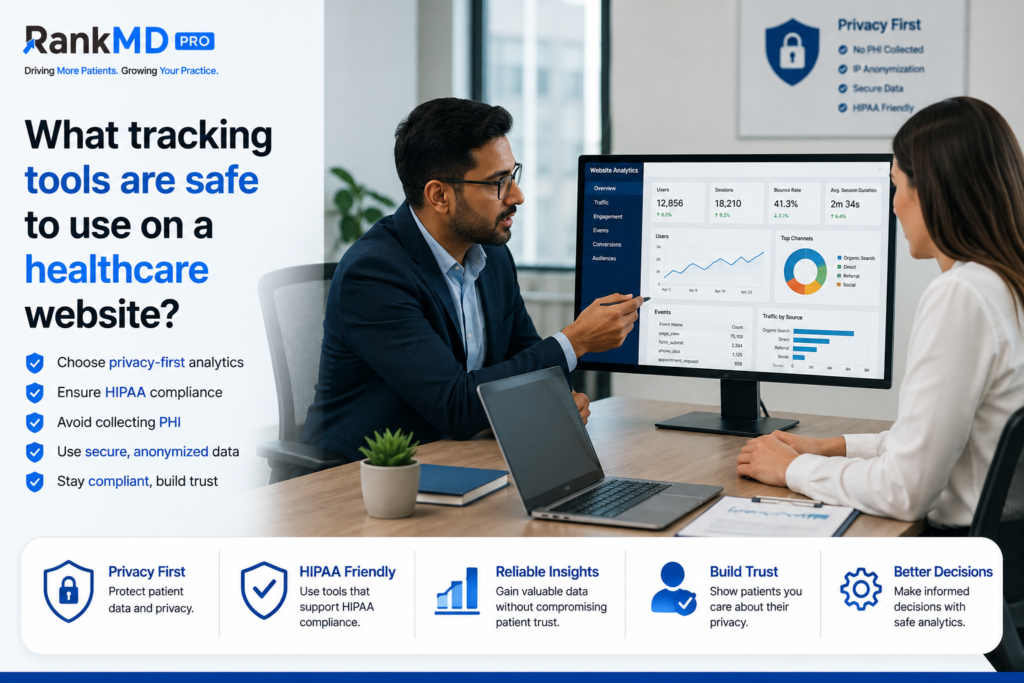
The safest tracking tools for a healthcare website are those that can be configured to prevent unnecessary PHI disclosure and, when the vendor handles PHI on the practice’s behalf, support an appropriate BAA. No analytics platform is automatically HIPAA-compliant simply because it is marketed as “privacy-first.” The technology, vendor relationship, and implementation all matter.
RankMDPro’s healthcare SEO strategy can help practices measure organic growth while making privacy and tracking considerations part of the technical SEO process.
Which Tracking Tools Should Medical Practices Consider?
Rather than choosing software from a generic “HIPAA-approved tools” list, evaluate the platform against your actual data flow.
A practical shortlist can include:
- Healthcare-focused analytics platforms: Consider providers that specifically support healthcare privacy requirements and offer appropriate contractual protections when PHI is involved.
- Privacy-focused analytics: Solutions with stronger data controls, limited third-party sharing, or self-hosting options may reduce exposure.
- First-party measurement: Where appropriate, measuring aggregate website and SEO performance with minimal personal information can reduce unnecessary data collection.
- BAA-supported vendors: If a tracking vendor creates, receives, maintains, or transmits PHI on behalf of a covered entity, HIPAA generally requires an appropriate BAA.
A BAA alone does not make a tracking setup compliant. HHS says practices must also ensure disclosures are permitted, use appropriate safeguards, and address tracking technologies through risk analysis and risk management.
Audit the Entire Tracking Stack
The biggest mistake is checking only Google Analytics. A healthcare website may also contain:
Meta pixels, session-replay tools, heatmaps, chat widgets, call tracking, tag managers, advertising scripts, appointment forms, and embedded third-party software.
HHS specifically warns that tracking technologies can transmit information such as IP addresses, email addresses, appointment information, device identifiers, or information entered into forms.
For example, if a patient enters symptoms or appointment information into an online form, a third-party tracking script running on that page could potentially receive that information. The practice needs to understand exactly what is being transmitted and to whom.
Build a Privacy-Conscious SEO Measurement System
You can still measure Healthcare SEO, Local SEO, Map Pack performance, high-intent rankings, organic visibility, conversion rate optimization, and patient acquisition without collecting unnecessary patient information.
Explore RankMDPro’s healthcare SEO services to develop an SEO measurement approach that balances useful marketing data with healthcare privacy considerations.
Before installing any tracking tool, map the data flow first: what is collected, where it goes, whether PHI is involved, what contractual protections apply, and whether the configuration matches your practice’s HIPAA obligations.