Medical practices often face a frustrating problem: website traffic looks high on analytics, yet appointment bookings and phone inquiries remain low. Generating traffic is only half the battle. If your digital presence contains hidden technical errors, weak trust signals, or poor mobile formatting, potential patients will click away to a competitor.
Addressing 10 healthcare website SEO problems that can reduce patient inquiries requires aligning search visibility with high-conversion landing page design.
1. Weak Google EEAT Signals and Missing Medical Disclaimers
Google applies stringent standard checks Your Money or Your Life (YMYL) to medical and healthcare websites. If your medical articles lack verifiable author credentials, peer reviews, or clear medical disclaimers, search algorithms drop your rankings, directly reducing incoming patient leads.
- The Problem: Content written without named medical professionals or missing physician review badges reduces search confidence and patient trust.
- The Solution: Add clear author bio boxes with medical credentials (MD, DO, DDS) on every clinical page. Ensure every medical article links to a verified physician reviewer profile on your main team roster at RankMDPro.
2. Slow Mobile Page Speed and Lagging Core Web Vitals
Over 65% of healthcare searches occur on mobile devices. A slow website frustrates users seeking urgent care or specialist consultations, leading to high bounce rates before they reach your contact form.
| Core Web Metric | Target Score | Impact on Patient Conversions |
| Largest Contentful Paint (LCP) | Under 2.5s | Ensures main treatment content loads instantly. |
| Interaction to Next Paint (INP) | Under 200ms | Guarantees instant response when clicking “Book Appointment”. |
| Cumulative Layout Shift (CLS) | Under 0.1 | Prevents form fields and buttons from jumping while tapping. |
Resolving technical performance barriers on your core practice pages requires a thorough site speed optimization through RankMDPro.
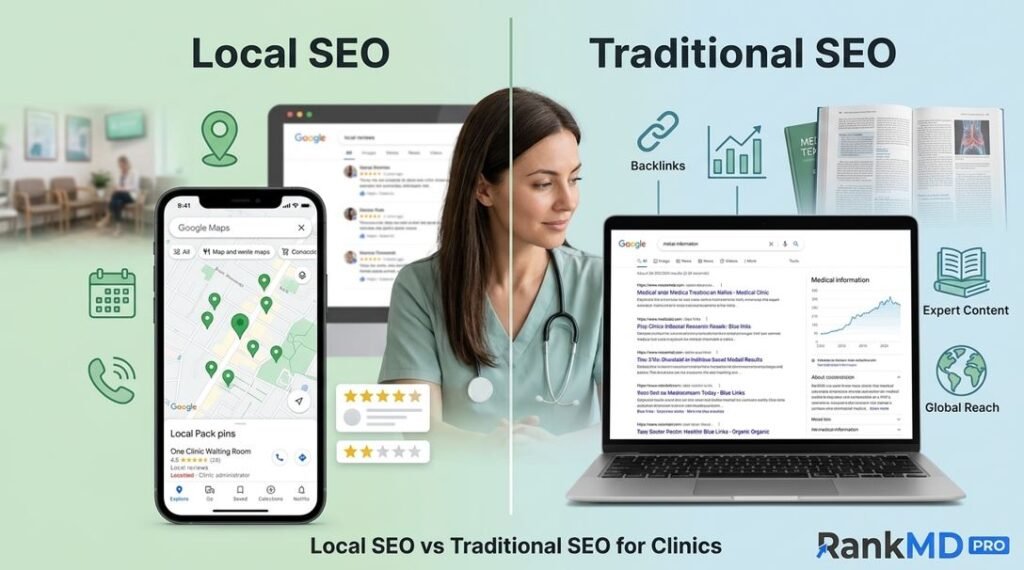
3. Misaligned Google Business Profile and Local SEO Citation NAP Data
Local search visibility drives high-intent patient inquiries. If your clinic’s Name, Address, and Phone Number (NAP) vary across online directories, local search algorithms lose trust in your practice location.
[ Correct Directory Sync ]
Practice Name –> Exact Match across GBP, Web Footers, Citations
Primary Phone –> Trackable, direct line match
Physical Address –> Precise suite number & street formatting
Inconsistent NAP data confuses AI search engines and Google Maps, pushing your practice out of the Local 3-Pack. Fix your practice’s localized footprint by consulting the local search experts at RankMDPro.
4. Poor Conversion Rate Optimization (CRO) and Hidden Call-to-Actions
Ranking #1 on Google produces no ROI if your website hides booking buttons or relies on complex, multi-page contact forms.
- Friction Points: Requiring extensive health history upfront, missing click-to-call buttons on mobile headers, and placing forms below the fold.
- Fixing CRO: Place an explicit “Schedule a Consultation” or “Call Now” button in your persistent website header. Pair every high-traffic blog post with a direct service link back to RankMDPro.
5. Neglecting Answer Engine Optimization (AEO) and AI Search (GEO)
Search behavior is shifting toward conversational AI platforms like Google AI Overviews, ChatGPT, and Perplexity. If your medical content lacks concise direct answers, these platforms will exclude your practice from summary answers.
- Direct-Answer Formatting: Structure key clinical questions with direct, 40-to-50-word summaries immediately below H2 headers.
- Structured Data Usage: Use Schema markup to give search models structured context about your services.
6. Thin Service Pages and Duplicate Treatment Descriptions
Publishing short, generic 300-word descriptions for complex medical treatments fails to answer critical patient queries regarding pricing, recovery times, risks, and qualifications.
- The Fix: Create comprehensive, 1,200+ word condition-and-treatment landing pages. Detail what patients should expect before, during, and after a procedure. Connect these resources with your core offering pages via RankMDPro.
7. Broken Internal Linking Architecture and Orphaned Pages
Search engines index websites using crawling spiders. If your condition guides and doctor profiles lack internal text links connecting them back to core service offerings, page authority cannot flow through the site.
[ Ideal Internal Link Flow ]
Homepage
└─► Primary Service Page
├─► Targeted Treatment Page
└─► Supporting Educational Article (Links back to Service Page)
Ensure every educational post links back to a primary conversion page on website.
8. Missing Structured Data (MedicalWebPage & Physician Schema)
Search engines rely on structured code to interpret clinical details. Without accurate schema markup, your site misses out on rich snippet features like star ratings, clinic hours, and location details in SERPs.
- MedicalClinic Schema: Defines your practice category, geographic coordinates, and accepted insurance.
- Physician Schema: Connects individual doctors to their respective specialty pages on RankMDPro.
- FAQPage Schema: Displays direct Q&A blocks directly inside Google search results.
9. Ignoring Accessibility (ADA Compliance) and User Experience
Healthcare websites must accommodate all patients, including those with visual, auditory, or cognitive impairments. Non-compliant websites create usability barriers that prevent patients from scheduling appointments.
- Key Requirements: High-contrast text modes, screen-reader-friendly alt text on images, keyboard-navigable forms, and clear visual focus states.
- Impact: Improving accessibility broadens your reach, lowers bounce rates, and supports your overall site strategy on RankMDPro.
10. Failing to Address Patient Fear and FAQ Objections
Patients seeking medical care often experience anxiety regarding pain, recovery times, costs, and practitioner expertise. Websites that focus purely on technical medical terms without addressing patient concerns suffer lower conversion rates.
- Address Anxiety Head-On: Include clear FAQs detailing insurance coverage, payment options, consultation expectations, and sedation options.
- Build Immediate Trust: Pair video testimonials with detailed procedure guides across your service pages at RankMDPro.
Frequently Asked Questions
How long does it take to fix SEO problems on a healthcare website?
Technical fixes like speed optimizations, schema markup additions, and internal link updates can yield positive visibility changes within 30 to 60 days. Comprehensive content rebuilds and local citation alignment typically take 3 to 6 months to reach full performance.
Why is EEAT so critical for medical practices compared to other industries?
Google categorizes health content as “Your Money or Your Life” (YMYL). Misinformation in healthcare can directly harm patients. As a result, Google requires higher standards of author proof, peer-reviewed accuracy, and physician oversight for healthcare sites.
How do AI Search Engines (GEO) affect patient inquiries?
AI search engines aggregate answers directly from structured, highly authoritative web content. If your website lacks direct answers, structured schema, and updated local entity references, AI platforms will recommend alternative practices.