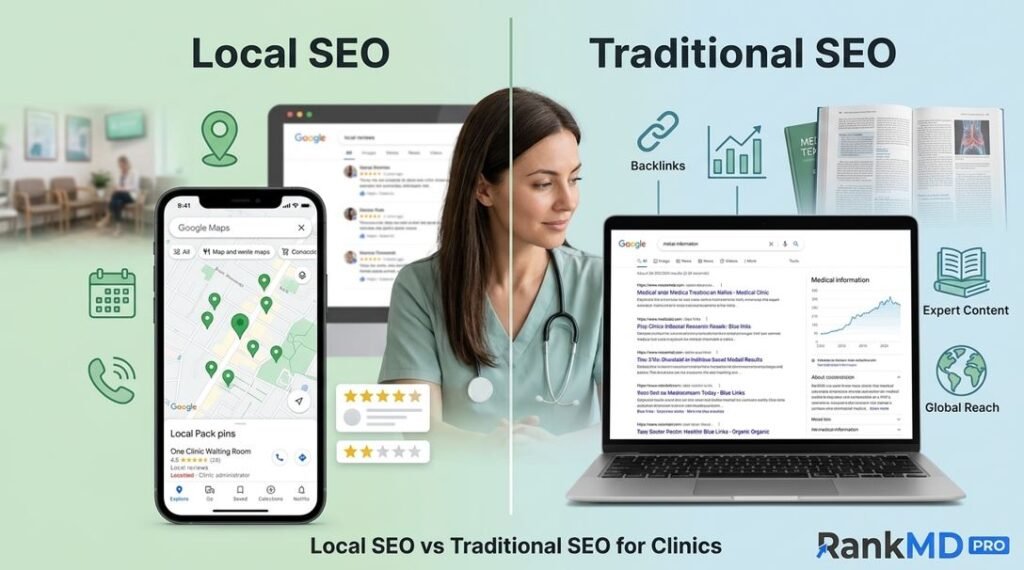
Local SEO helps your business appear when people search for something nearby, such as “dentist near me” or “urgent care open now.” It relies on your Google Business Profile, reviews, proximity and consistent listings. Traditional SEO helps your website rank for broader, non-location-specific searches such as “what causes migraines” or “how does Botox work.” It relies on content, backlinks and technical site quality. Most clinics need both, but not with equal weight or in the same order.
If you run a medical practice, you can read the rest of this guide with a clinic lens. The same principles apply to any business with a physical location.
What Is Local SEO?
Local SEO is the process of optimizing your online presence so you appear in location-based search results: the Google Map Pack, Google Maps, the local finder and “near me” searches.
Google’s local results are driven by three factors: relevance (how well your profile matches the search), distance (how close you are to the searcher) and prominence (how established and trusted you appear online). You can’t change your physical location, but you can strengthen relevance and prominence.
Local SEO typically includes:
- Google Business Profile (GBP) optimization
- Consistent name, address and phone number (NAP) across directories
- Review generation and management
- Location pages and local schema markup
- Local citations and community-based links
Example searches: “family dentist in Naperville,” “urgent care near me,” “med spa Chicago,” “therapist accepting new patients near me.”
What Is Traditional SEO?
Traditional SEO, often called organic or national SEO, is optimizing your website to rank in standard search results for topics and services regardless of where the searcher is. It draws on content quality, site architecture, technical performance, and backlinks and authority.
Example searches: “how long does Botox last,” “signs of anxiety disorder,” “what is dermal filler made of.”
These searchers are usually researching, not booking. They may live anywhere, and they may never become patients. Traditional SEO builds the authority that supports every other page on your site.
Local SEO vs Traditional SEO: Side-by-Side Comparison
| Factor | Local SEO | Traditional SEO |
| Primary goal | Be chosen by nearby searchers ready to act | Be visible across many topics and queries |
| Geographic scope | City, neighborhood or service area | Regional, national or global |
| Typical search intent | Local, transactional (“near me,” “open now”) | Informational, commercial, navigational |
| Main SERP feature | Map Pack, Google Maps, local finder | Organic blue links, featured snippets, AI Overviews |
| Key ranking factors | Proximity, GBP, reviews, NAP consistency, local relevance | Content depth, backlinks, technical SEO, topical authority |
| Cornerstone asset | Google Business Profile | Website content and authority |
| Link building | Local citations, community sites, local partnerships | Industry publications, editorial links, digital PR |
| Content focus | Service and location pages, local FAQs, reviews | Educational guides, pillar pages, topic clusters |
| Success metrics | Calls, direction requests, bookings, map views | Organic traffic, rankings, engaged sessions, leads |
| Best for | Businesses that serve customers in a defined area | Businesses that serve a wide audience or sell online |
The 7 Key Differences Explained
1. Search Intent: “Ready to Act” vs “Ready to Learn”
Local searches usually signal urgency. Someone searching “emergency dentist near me” wants a phone number in the next few minutes. Someone searching “why do wisdom teeth hurt” wants an explanation. Local SEO captures the first person. Traditional SEO captures the second and builds trust for later.
Local intent also doesn’t always include a location word. Google often infers it from the searcher’s device location, which is why “urgent care” alone can trigger a map.
2. Ranking Factors: Proximity and Reviews vs Authority and Backlinks
Traditional SEO leans on content quality, links and site structure. Local SEO adds signals that don’t exist in standard results: how close you are to the searcher, how many reviews you have, how recent and relevant those reviews are, and whether your business information matches across the web.
Because of this, a small clinic with strong local signals can outrank a large hospital network in the Map Pack, even if the hospital’s website has far more authority.
3. Search Results: The Map Pack vs Blue Links
Local SEO targets the Map Pack, the three listings shown with a map above standard results. Traditional SEO targets organic listings, featured snippets and AI-generated summaries. A single search can show both, so clinics often need to compete in two places at once.
4. Website Structure: Location Pages vs Topic Clusters
Traditional SEO favors pillar pages and topic clusters that show depth on a subject. Local SEO requires pages tied to real places and real services: a page for each physical location, and service pages that reference the communities you serve.
Each location page should be unique. That means its own address, hours, providers, directions, local FAQs and embedded map. Avoid creating “service area” pages for places where you have no presence. This is a common shortcut that weakens trust.
5. Link Building: Local Trust vs Broad Authority
Local link building focuses on community relevance: local chambers of commerce, hospital and provider directories, local news, sponsorships and professional associations. Traditional link building targets editorial mentions and high-authority publications in your industry. Both matter, but they work differently and are measured differently.
6. Measurement: Calls and Bookings vs Traffic and Rankings
A traditional SEO win might be a 40% increase in blog traffic. A local SEO win is more phone calls, appointment requests and driving-direction taps. Traffic alone can be misleading: a guide read by thousands of people outside your service area won’t fill your schedule.
For clinics, track:
- Calls from your Google Business Profile
- Direction requests and website clicks from GBP
- Form submissions and online booking requests
- Map Pack visibility for your priority services and locations
- New-patient inquiries, not just sessions
7. Compliance and Trust: Higher Stakes in Healthcare
Medical content is YMYL (“Your Money or Your Life”) content, so search engines and AI systems apply stricter trust standards. That affects both types of SEO:
- Traditional SEO: Medical content should show clear provider credentials, medical review, and accurate, sourced information (E-E-A-T).
- Local SEO: Profile information must be exact, and review responses must never reveal patient information. Follow HIPAA and your state’s advertising rules, and have your compliance lead review anything patient-facing.
Where AI Search Fits In
AI Overviews and answer engines like ChatGPT and Perplexity now sit on top of both types of search. They pull from the same trust signals: consistent business data, clear entity information (who you are, what you treat, where you’re located), reviews, structured data and authoritative content.
That’s why the two disciplines are converging. Clinical schema (such as LocalBusiness, Physician, MedicalProcedure and MedicalCondition markup) helps machines connect your providers, procedures and locations. Learn more in our guide to what clinical schema is and how it helps your clinic.
Which Does Your Practice Need: Local SEO, Traditional SEO, or Both?
The answer depends on how you get patients.
Start with local SEO if:
- You have one or more physical locations
- Patients choose you based on convenience and reviews
- You offer time-sensitive care (urgent care, dental emergencies, same-week appointments)
- You’re a newer practice with limited website authority
Lean on traditional SEO if:
- You offer telehealth or serve patients across a wide region
- You want to be recognized as an authority in a specialty
- Your treatments involve long research cycles (cosmetic procedures, weight management, functional medicine)
- You have content to publish and experts to review it
Use both if: you want to be found when patients research and chosen when they’re ready to book. This describes most clinics.
| Practice Type | Local SEO Priority | Traditional SEO Priority |
| Urgent care | Very high | Moderate |
| Dental practice | Very high | Moderate to high |
| Aesthetic clinic / med spa | High | High (patients research heavily before booking) |
| Mental health practice | High | High (educational content builds trust) |
| Multi-location group | Very high (per-location strategy) | High (brand authority) |
This is a general guide. Your own market, competitors and goals should shape the actual plan.
We build specialty-specific programs for both urgent care SEO and aesthetic clinic SEO.
Not sure where your clinic stands? RankMD Pro offers a free audit covering technical, on-page and local visibility, plus competitor insights and a custom 90-day roadmap. Request your free SEO audit or call (708) 497-9659.
How Local and Traditional SEO Work Together
Think of it as a funnel:
- Awareness (traditional SEO): A patient searches “what causes jaw pain” and finds your educational guide.
- Consideration (both): They search “TMJ specialist near me.” Your service page and Map Pack listing both appear.
- Decision (local SEO): They compare reviews, hours and distance, then call or book.
If you only do traditional SEO, you may earn traffic that never converts. If you only do local SEO, you may win the Map Pack but lack the content depth that builds trust and captures earlier research.
A Practical Priority Order for Clinics
- Fix your foundation. Verify your Google Business Profile, choose the most specific primary category, and make NAP consistent everywhere.
- Build strong service and location pages. One page per treatment and one per physical location, each with unique content and a clear call to action.
- Add structured data. Implement local business and medical schema so search engines and AI systems can parse your practice.
- Earn reviews consistently. Ask every satisfied patient in a compliant way, and respond without disclosing protected information.
- Publish expert-reviewed educational content. Answer the questions patients actually ask, and show provider credentials.
- Track outcomes, not just rankings. Watch calls, direction requests and booked appointments.
If your clinic’s visibility has already dropped, see how we approach recovering lost Google rankings.
Common Mistakes to Avoid
- Treating local SEO as a one-time setup. Reviews, posts and listing accuracy need ongoing attention.
- Keyword-stuffing your business name in GBP. Use your real business name.
- Creating thin location pages for cities where you have no presence.
- Ignoring service-level pages. Ranking for “dentist near me” doesn’t help someone searching for a specific treatment.
- Measuring only traffic. More visitors don’t matter if they can’t become patients.
- Skipping compliance review on content, reviews and testimonials.
Frequently Asked Questions
What is the main difference between local SEO and traditional SEO?
Local SEO targets searches with local intent so nearby customers can find you in the Map Pack and local results. Traditional SEO targets broader, non-location-specific searches to build organic traffic and authority across a wider audience.
Is local SEO better than traditional SEO?
Neither is universally better. Local SEO usually produces faster, more direct results for businesses with a physical location, because it captures people ready to call or book. Traditional SEO builds the authority and content that support long-term growth. Most clinics benefit from combining them.
Do I need both local and traditional SEO for my medical practice?
In most cases, yes. Local SEO gets you chosen by nearby patients. Traditional SEO builds trust and captures patients who are still researching. The right balance depends on your specialty, your market and how patients typically find you.
What ranks a business in the Google Map Pack?
Google uses relevance, distance and prominence. In practice, that means a complete and accurate Google Business Profile, the right categories and services, consistent listings, quality reviews and a website with strong local relevance.
Does traditional SEO help local rankings?
Yes. Your website’s content, links and technical quality support your local visibility, and Google’s local results draw on web signals as well as your profile. That’s why the two work best together.
How does AI search affect local and traditional SEO?
AI Overviews and answer engines draw on trust signals that both disciplines build: consistent business data, structured data, reviews and authoritative, clearly attributed content. Strong entity information about your providers, services and locations helps AI systems understand and recommend your practice.
How do I know if my clinic’s SEO is working?
Look at outcomes: calls, direction requests, form submissions and booked appointments, not just rankings or impressions. Compare these over time and by location or service.
How long does SEO take to show results?
It varies by competition, your starting point and how much work is needed. Local improvements can appear sooner than authority-driven traditional SEO gains, but no one can promise a fixed timeline. A good audit will tell you where the quickest opportunities are.
Can a clinic do SEO itself?
Some basics, like claiming your Google Business Profile and requesting reviews, are manageable in-house. Ongoing strategy, schema, content, compliance review and measurement usually benefit from a specialist who understands healthcare.
Ready to Get More Patients From Search?
Local and traditional SEO answer different questions, and your clinic probably needs both. The fastest way to know where to focus is to see how you compare with the practices patients are choosing today.
RankMD Pro is a healthcare SEO agency built for medical practices. We combine local search and Maps optimization, technical SEO, authority-building content and medical schema into one system.
👉 Get your free SEO audit and 90-day roadmap
📞 Call (708) 497-9659 · ✉️ info@rankmdpro.com