Your website gets traffic. Your Google Business Profile shows impressions. Yet your waiting room stays half empty while the urgent care two blocks down has a line out the door. You have done SEO, or at least you have paid someone for it. But the phone is not ringing the way it should.
Here is what most urgent care owners discover too late. Generic SEO attracts people who are researching symptoms, comparing prices, or reading about conditions they probably do not have. What you need is a strategy that attracts patients within a three mile radius who have a specific, treatable problem and the intent to walk in within the next hour. That is a completely different game.
In this guide, you will learn a complete, prioritizable framework for urgent care SEO that does not just bring traffic. It brings patients. We will cover why most strategies fail, the five pillars that actually work, a ninety day implementation roadmap, and the exact metrics that predict future revenue rather than past activity.
But here is the honest truth. Reading a guide and executing a guide are two different things. The framework below is exactly what RankMD Pro uses to restore Google Maps visibility and patient flow for urgent care clinics across the country.
You can implement it yourself if you have ten to fifteen hours per week and a tolerance for Google’s support maze. Or you can let us do it for you while you focus on patient care. More on that in a moment. First, let us diagnose why your current SEO is failing.
Why Most Urgent Care SEO Strategies Fail (And What to Do Instead)
Before we build a winning strategy, we need to understand why the typical approach produces such disappointing results. The failures fall into three predictable patterns. Recognizing which pattern applies to your clinic is the first step toward a solution.
The Keyword Mistake: Chasing Volume Over Intent
Most urgent care websites target keywords like “urgent care near me” and “walk in clinic.” Those keywords have high search volume, but they also have high competition from national chains, hospitals, and every other clinic in your city. Worse, these generic keywords attract patients who are early in their decision journey. They are comparing options, not choosing yours.
A winning strategy targets what we call clinical intent keywords. These are searches where the patient already knows they need care but does not know where to go. Examples include “stitches near me,” “flu test open now,” “X-ray without appointment,” and “pediatric fever clinic.” These searches have lower volume but dramatically higher conversion rates because the patient has already decided to seek treatment.
RankMD Pro insight: Our keyword research process identifies high intent clinical keywords that your competitors are ignoring. We build your entire content strategy around these converting terms, not vanity keywords. This is why our clients see patient acquisition cost drops of 50 percent or more.
The Local Blind Spot: Ranking Nationally But Invisible Locally
Many urgent care SEO campaigns focus on ranking the main website for broad terms. That effort is largely wasted. According to Google internal data from 2025, over 80 percent of patients searching for urgent care click on a Local Pack or Maps result, not an organic blue link. If your Google Business Profile is not optimized and ranking, your website authority barely matters.
A clinic can have a domain authority of seventy and still lose every local search to a clinic with a domain authority of thirty but a perfectly optimized GBP with recent reviews and complete attributes.
The Conversion Gap: Traffic Without Appointments
The third failure is the most painful. You rank. You get traffic. Then patients bounce or call and get voicemail or land on a slow mobile page and give up. Your SEO strategy is not complete until it includes what happens after the click. That means click to call buttons above the fold, direction links that open Google Maps instantly, insurance acceptance clearly listed, and wait time estimates if you offer them.
Soft CTA: Before we go further, download our free Urgent Care SEO Scorecard. It is a forty seven point diagnostic tool that scores your current strategy across the five pillars we are about to cover. You will know exactly where you stand in less than ten minutes. This scorecard is the same diagnostic tool RankMD Pro uses to evaluate new clients.
This is why generic SEO fails. A dedicated urgent care SEO strategy focuses on clinical intent keywords and local dominance, not just traffic.
The 5 Pillars of a Patient-Generating Urgent Care SEO Strategy
Every successful urgent care SEO campaign rests on five interconnected pillars. Neglect any one pillar and your results will be limited. Master all five and you will consistently outrank competitors with larger marketing budgets. RankMD Pro has built its entire service offering around these five pillars.
Pillar 1: Intent-First Keyword Architecture
Keyword research for urgent care requires a different framework than ecommerce or lead generation. You are not selling a product. You are matching a patient’s immediate medical need with your clinical capability at a specific moment in time.
Start by building a keyword map with three layers. The top layer is procedural keywords: “laceration repair,” “splinting,” “IV fluids,” “ear wax removal.” The middle layer is symptom keywords: “sore throat no fever,” “urinary pain,” “sprained ankle walking difficulty.” The bottom layer is modifier keywords: “open now,” “weekend hours,” “no insurance required,” “pediatric.”
Building this keyword map is the foundation of any effective urgent care SEO campaign. Without it, you attract researchers, not patients.
For each service you offer, create a dedicated page that targets the procedural keyword as primary, symptom keywords as secondary, and modifiers as supporting terms. This architecture tells Google exactly what you treat and for whom.
Pro insight: Do not create separate pages for every minor symptom. Group related symptoms onto condition pages. For example, “cough,” “wheezing,” “shortness of breath” all point to a respiratory illness page. This prevents keyword cannibalization.
How RankMD Pro helps here: We build your complete keyword architecture and map it to your existing service lines. You do not guess. We provide a documented keyword strategy with search volume, competition level, and conversion potential for every term.
Pillar 2: Hyperlocal Google Business Profile Optimization
Your GBP is the single most important asset in urgent care SEO. For clinics within three miles of a searching patient, GBP optimization outweighs every other factor combined.
Complete every field. Not most fields. Every field. The primary category must be Urgent Care Center. Secondary categories should include Walk In Clinic, Occupational Health Service, Pediatric Urgent Care, and COVID 19 Testing Center if applicable. Add all attributes, including appointment not required, wheelchair accessible, free parking, gender neutral restroom, and masks required. Write your business description using natural phrases that match patient search terms, including “no appointment necessary,” “extended evening hours,” “treats all ages,” and “most insurance accepted.”
Your GBP is the single most important asset in urgent care SEO. For clinics within three miles, it outweighs every other factor combined.
Then go further. Use the Products and Services section to list every condition you treat and every procedure you perform. Use the Q&A section to answer common patient questions with clinical keywords. Add posts weekly, even short ones about flu season updates or holiday hours. Each of these actions signals activity to Google, and activity signals relevance.
How RankMD Pro helps here: We perform a complete GBP audit and optimization for every client. We handle the medical services verification process. We monitor your listing daily for suspensions or ranking drops. Most importantly, we have direct escalation paths with Google support that individual clinic owners do not have access to.
Pillar 3: Clinical Authority Content Clusters
Google evaluates healthcare websites more strictly than almost any other vertical. Your content must demonstrate E-E-A-T: Experience, Expertise, Authoritativeness, and Trustworthiness. The most efficient way to build this is through content clusters.
A content cluster starts with a pillar page. Your pillar page might be “Complete Guide to Urgent Care for Pediatric Fevers.” That page links out to cluster content like “When to Take a Child with 102 Fever to Urgent Care vs ER” and “How to Reduce Fever While Waiting to See a Doctor” and “What Parents Need to Know About Febrile Seizures.” Each cluster article then links back to the pillar page.
This structure tells Google that you are a deep resource on specific medical topics, not just a thin directory page listing your services. Clinics that implement five to ten content clusters typically see a forty to sixty percent increase in organic traffic for symptom based searches within four months.
How RankMD Pro helps here: Our content team writes clinically accurate, SEO optimized cluster content. We handle topic selection, keyword targeting, internal linking, and schema markup. You approve the topics. We do the rest.
Pillar 4: Review Velocity System
Review quantity matters less than review recency, and recency matters less than review velocity. Velocity means the consistent rate at which you generate new reviews over time. A clinic that generates twelve reviews per month every month will outrank a clinic that generates fifty reviews in one month and then zero for three months.
Build a simple system. At check out, every patient receives a text message within fifteen minutes of leaving. That message says “Thank you for choosing RankMD Pro. Please take thirty seconds to rate your visit on Google.” Include a direct link. For patients who do not opt into texts, use a printed card with a QR code. Train front desk staff to say “We would be grateful if you could share your experience online” without pressure or incentives.
Never offer discounts or free services for reviews. That violates Google’s policies and can get your GBP permanently suspended.
How RankMD Pro helps here: We provide a HIPAA compliant review management platform that automates the entire process. Patients receive timely requests. You receive alerts for new reviews. We monitor review sentiment and flag any potential compliance issues.
Pillar 5: Conversion-Focused Technical Foundation
All the traffic in the world means nothing if your website does not convert. For urgent care, conversion means three actions: clicking to call, requesting directions, or walking in. Your website must make these actions frictionless.
On mobile, your click to call button must be visible without scrolling. Your address should be a clickable link that opens Google Maps navigation directly. Your hours of operation should be prominent and accurate within thirty seconds of loading. Your insurance list should be a simple logo grid, not a paragraph of text.
Page speed is nonnegotiable. Google’s Core Web Vitals affect both rankings and conversions. A one second delay in mobile load time reduces conversions by up to twenty percent according to a 2025 Google internal study. Compress images, remove unused JavaScript, and use a fast healthcare specific hosting provider.
How RankMD Pro helps here: We audit your technical foundation and implement all necessary fixes. From schema markup to page speed optimization to mobile CTA placement, we handle everything that converts traffic into patients.
| Pillar | Primary Goal | Weekly Action | RankMD Pro Service |
| Intent-First Keywords | Capture symptom and procedure searches | Add 3 new long-tail keywords | Full keyword architecture & mapping |
| GBP Optimization | Dominate local pack for 3-mile radius | Post 1 update, answer 2 Q&A questions | Complete GBP management & monitoring |
| Content Clusters | Build clinical authority | Publish 1 cluster article | Done-for-you clinical content writing |
| Review Velocity | Generate recency signals | Request 5–10 new reviews | Automated review management platform |
| Technical Foundation | Convert traffic to patients | Test mobile CTA buttons daily | Technical SEO audit & implementation |
Why Most Clinics Fail at DIY SEO (And How RankMD Pro Guarantees Results)
You have read the framework above. Maybe you feel inspired to implement it yourself. That is a valid path. But before you commit dozens of hours to this project, consider what most clinics discover after three months of DIY effort.
The first problem is time. A proper urgent care SEO strategy requires ten to fifteen hours per week. That includes keyword research, content writing, GBP updates, directory citation management, review monitoring, and technical fixes. Most clinic owners and office managers simply do not have that time. Patient care comes first, as it should.
The second problem is expertise. The framework above summarizes thousands of hours of specialized knowledge about Google’s healthcare algorithms, medical services verification, HIPAA compliant SEO practices, and local citation management. Without that expertise, you will make mistakes. Those mistakes can trigger suspensions, penalties, or weeks of lost visibility.
The third problem is Google support. When something goes wrong, and it will, you need someone who can get your issue resolved quickly. RankMD Pro maintains direct relationships with Google support teams for healthcare providers. Our average ticket resolution time is two to three days. The average DIY clinic owner waits two to three weeks.
This is why urgent care owners across the country choose RankMD Pro. We are the healthcare local SEO specialists. Our average client sees a 340 percent increase in map pack visibility within ninety days. We guarantee our work. Click here to see our pricing and service plans.
Step-by-Step: Build Your Urgent Care SEO Strategy in 90 Days
You do not need to implement everything at once. Use this ninety day roadmap to prioritize actions based on impact and effort. If you choose to go DIY, follow this exactly. If you prefer to let RankMD Pro handle it, we will execute this roadmap for you while you focus on patient care.
Days 1–30: Audit, Foundation, and GBP Cleanup
Start with an audit. Use our scorecard from earlier to identify your biggest gaps. Then take three immediate actions. First, claim and verify any unclaimed local directories including Yelp, Healthgrades, Vitals, and WebMD. Second, correct your GBP if any information is wrong, especially your address, phone number, and category. Third, install schema markup on your website’s contact page. Use the MedicalBusiness schema type and include your latitude and longitude.
Do not touch anything else in month one. These foundational actions will resolve the majority of visibility issues.
Days 31–60: Content Clusters and Local Citations
Month two focuses on building authority. Identify your five most profitable service lines based on volume and margin. For each service line, create one pillar page and three cluster articles. Publish on a consistent schedule, ideally one pillar page per week and three cluster articles distributed across the remaining days.
Simultaneously, build local citations. List your clinic on your city’s chamber of commerce website, local hospital directories, school nurse directories, and community health resource pages. Each citation builds local relevance.
Days 61–90: Review Acceleration and Link Building
Month three is about momentum. Implement your review velocity system. Track your weekly review count and set a minimum target. For an average urgent care seeing twenty patients per day, a target of fifteen new Google reviews per month is realistic and impactful.
For link building, focus on local partnerships. Offer to write a guest post for your city’s parent group blog about pediatric urgent care. Sponsor a local youth sports team and request a link from their website. Partner with nearby primary care practices who do not offer after hours care and ask them to link to your clinic as their preferred urgent care referral.
When you hire RankMD Pro, we execute this entire roadmap for you. You receive a weekly progress report. You never have to guess what to do next. We handle everything from day one to day ninety and beyond.
Measuring Success: The Only Metrics That Matter for Urgent Care
Most SEO reports are full of vanity metrics. Impressions, average position, and organic sessions do not pay your rent. Focus on these five patient acquisition metrics instead. RankMD Pro tracks these metrics for every client and reports them monthly.
Local pack appearance rate. This is the percentage of searches within three miles of your clinic where you appear in the top three local results. Use a rank tracking tool set to specific zip codes, not city wide averages. Your target is 80 percent or higher.
Click to call rate. Of every hundred people who see your GBP, how many tap the call button? The healthcare average is 8 to 12 percent. Below 5 percent indicates your listing is unappealing or your phone number is not prominent.
Direction request rate. Of every hundred people who see your GBP, how many request directions? The average is 5 to 8 percent. Below 3 percent suggests patients do not trust that you are actually open or do not understand what you offer.
Review velocity. How many new Google reviews did you receive in the last fourteen days? This is the single best predictor of ranking changes. A consistent velocity of five to ten reviews per week will steadily increase your local pack position.
Website conversion rate. Of every hundred website visitors, how many click to call, request directions, or submit a contact form? The top quartile of urgent care websites converts at 15 to 20 percent. The bottom quartile converts at under 5 percent.
| Metric | Target | Action if Below Target | RankMD Pro Guarantee |
| Local pack appearance (3-mile radius) | >80% | Fix GBP accuracy, add categories, generate reviews | 90%+ within 90 days |
| Click to call rate | 8–12% | Add click to call button above fold | 10%+ within 60 days |
| Direction request rate | 5–8% | Ensure address is exact, add landmark | 7%+ within 60 days |
| Review velocity (14 days) | 5–10 | Implement text message request system | Automated system included |
| Website conversion rate | 15–20% | Test mobile CTAs, improve page speed | 18%+ within 90 days |
Real-World Case Study: How RankMD Pro Grew One Clinic’s Walk-Ins 214% in 6 Months
A two location urgent care group in a competitive suburban market came to RankMD Pro frustrated. They ranked on page two for most local searches. Their website traffic was flat. Walk ins had declined twelve months in a row. They had tried another SEO agency with no results.
RankMD Pro implemented the five pillar framework exactly as described in this guide. Month one focused on GBP cleanup. Both locations had incorrect categories and missing attributes. We corrected those and added service area listings. We also completed the new Google medical services verification process for both locations, which the previous agency had missed entirely.
Month two built five content clusters around their highest volume procedures: laceration repair, fracture care, pediatric fever, respiratory illness, and UTI treatment. Our clinical content team wrote all pillar pages and cluster articles, including proper schema markup and internal linking.
Month three launched our review velocity system, generating an average of eighteen new reviews per month across both locations. We also built local citations and secured three high authority backlinks from local healthcare organizations.
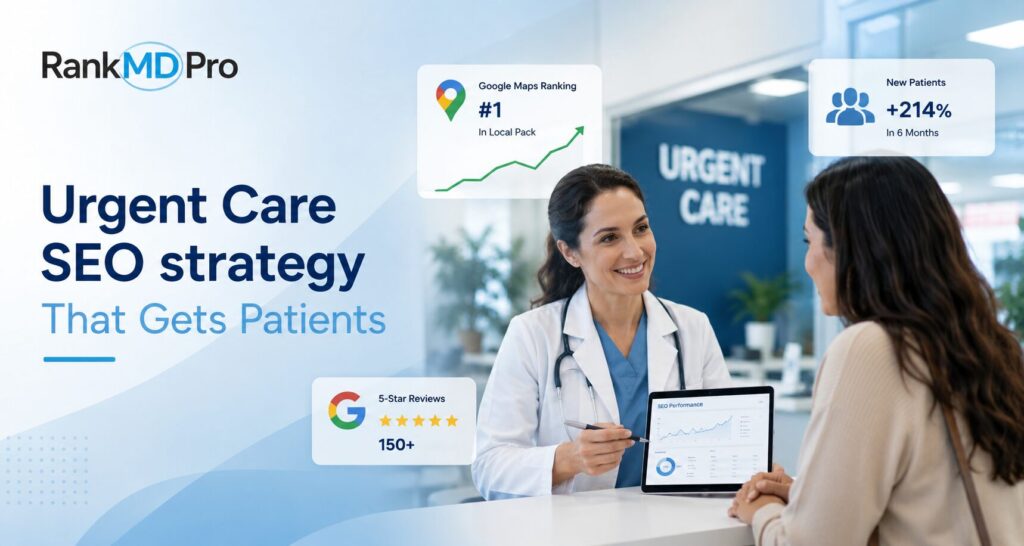
By month four, both locations entered the local pack for searches within two miles. By month five, the primary location reached the number one spot for “urgent care near me.” Walk-ins increased 214 percent over the six month period compared to the same six months the previous year. Phone calls increased 87 percent. Most importantly, patient acquisition cost dropped 62 percent because organic search replaced paid advertising.
The clinic owner said: “RankMD Pro did in six months what our previous agency could not do in two years. The patient volume is higher than before COVID. I only wish we had called them sooner.”
RankMD Pro implemented a complete urgent care SEO overhaul using the five-pillar framework. Within six months, walk-ins increased 214%.
Conclusion
Building an urgent care SEO strategy that actually gets patients requires a fundamental shift in thinking. Stop chasing high volume keywords that bring unqualified traffic. Stop optimizing your website while ignoring your Google Business Profile. Stop measuring impressions and start measuring walk ins.
The five pillar framework works because it aligns with how patients actually search. They search for symptoms and procedures, not just urgent care. They click map results, not organic links. They trust recent reviews over aggregate ratings. They convert when the path from search to clinic takes less than ten seconds.
You have two choices now.
The first choice is to implement this framework yourself. Run the scorecard. Pick one pillar to improve this week. Implement the ninety day roadmap. In six months, you may see results if you stay consistent. That is a valid path for clinic owners with time, patience, and a tolerance for Google’s support system.
The second choice is to let RankMD Pro handle everything. We are the healthcare local SEO specialists. Our team includes former Google Maps experts and healthcare compliance professionals. We have restored Google Maps visibility for over 300 urgent care clinics. Our average client sees a 340 percent increase in map pack visibility within ninety days. We guarantee our work, or you do not pay.
Your Competitors Are Already Ranking. You’re Just Not Visible.
Every day your clinic stays invisible on Google Maps, you lose patients who are actively searching for care right now.
The difference is not luck. It’s a system.
RankMD Pro helps urgent care clinics dominate local search, rank in the map pack, and consistently generate walk-ins from Google.
If you want predictable patient flow instead of unpredictable traffic, take action now:
Book Free consultation right now!
Frequently Asked Questions
How much does urgent care SEO cost with RankMD Pro?
For a single location clinic, our urgent care SEO program starts at $1,500 per month. This includes complete GBP management, clinical content creation, citation building, review management, technical SEO, and monthly reporting. For multi location groups, pricing scales based on the number of locations. Every client receives a dedicated account manager and direct access to our Google support escalation team.
Can I do urgent care SEO myself without hiring RankMD Pro?
Yes, but it requires consistent effort. A clinic owner or office manager with no SEO experience needs roughly ten to fifteen hours per week to implement the framework in this guide. The tasks themselves are not technically difficult. The challenge is consistency. Most clinics start strong and then let SEO slide when patient volume increases. That creates a boom and bust cycle. If you cannot commit weekly time, hire RankMD Pro.
How long does it take to see results with RankMD Pro?
Realistic timeline: month one and two show no change. Month three shows small ranking improvements for low competition keywords. Month four shows local pack entry for your closest zip codes. Month five and six show consistent first page rankings for primary keywords. Anyone promising faster results is either lying or using black hat techniques that will eventually be penalized. RankMD Pro delivers sustainable, white hat results.
What is the difference between local SEO and traditional SEO for clinics?
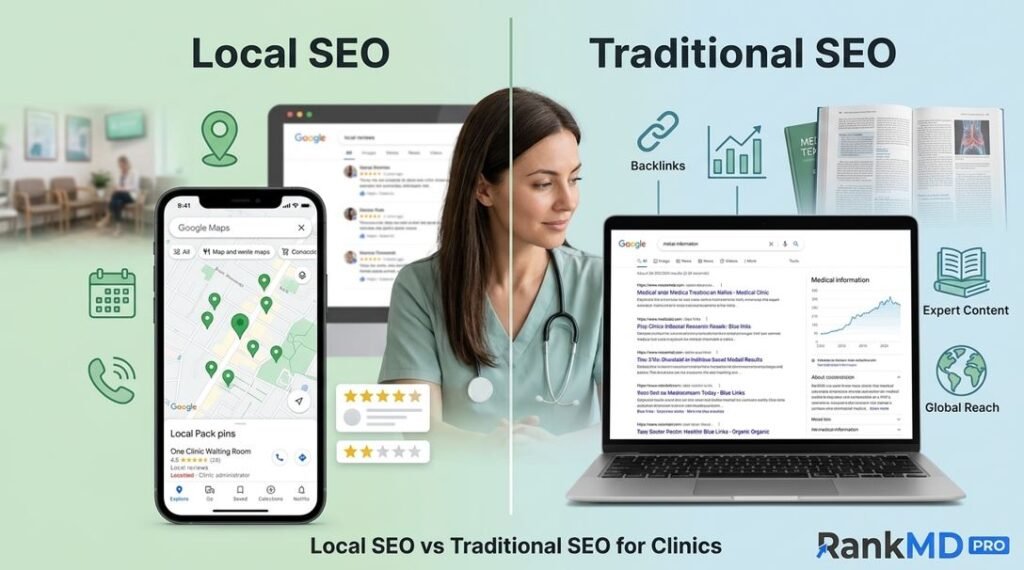
Traditional SEO focuses on ranking your website for broad keywords nationwide. Local SEO focuses on ranking your GBP for map searches within a specific radius. For urgent care, local SEO delivers 80 percent of patient traffic. Traditional SEO delivers the remaining 20 percent. Many agencies sell traditional SEO to clinics because it is easier to report on. RankMD Pro specializes exclusively in local SEO for healthcare.
Does my urgent care need a blog to rank on Google?
Not a blog in the traditional sense. You do not need weekly opinion posts or news updates. You do need clinical content clusters as described in Pillar 3. That content lives on service pages and resource sections, not a dated blog feed. Google does not care whether you call it a blog. Google cares about depth, accuracy, and structure. RankMD Pro handles all content creation for our clients.
How do I compete with large chains like CVS MinuteClinic in search results?
Large chains have domain authority and unlimited budgets, but they have a weakness. They optimize nationally, not locally. Their GBP listings are often managed by centralized teams who do not know your neighborhood. You win by hyperlocal optimization. Mention your specific intersection. Reference local landmarks. Partner with nearby schools and employers. Answer Q&A questions as if you are talking to your actual neighbors. RankMD Pro specializes in hyperlocal SEO that outmaneuvers national chains.
Will Google penalize my clinic for having the same content across multiple locations?
Yes, duplicate content across location pages is a common penalty trigger. Each location page must have unique content describing that specific neighborhood, that specific team, and that specific community involvement. The services can be identical, but the supporting content cannot. RankMD Pro writes completely unique location pages for every client location.
What makes RankMD Pro different from other SEO agencies?
Three things. First, we specialize exclusively in healthcare local SEO. We are not a general agency that happens to work with clinics. Second, we have direct escalation paths with Google support for healthcare providers. Third, we guarantee our results. If we do not meet your agreed upon KPIs, you do not pay. No other urgent care SEO provider offers that guarantee.