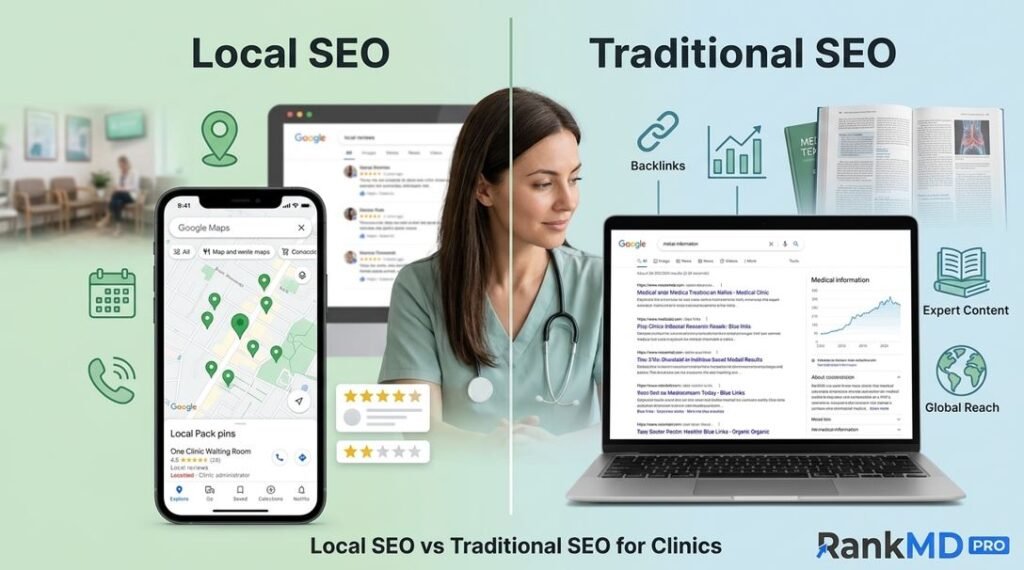
Opening a new medical practice comes with a steep learning curve. Between clinical operations, staffing, compliance, and patient care, local marketing often becomes an afterthought. However, relying solely on word-of-mouth or traditional print advertising leaves your examination rooms empty. Modern healthcare decisions start with a search bar: over 77% of patients use search engines like Google to find local physicians, specialists, and clinics before scheduling an appointment.
Establishing high local visibility requires an intent-driven strategy centered on Healthcare SEO for New Medical Practices: 10 Steps to Get Found Locally. Implementing targeted healthcare SEO services ensures your new practice ranks at the top of local map packs, answers high-intent search queries, and builds trust with prospective patients. Below is your 10-step blueprint to dominate local search results and drive appointments from day one.
Step 1: Claim, Verify, and Fully Optimize Your Google Business Profile
Your Google Business Profile (GBP) is the cornerstone of local patient acquisition. When patients search for “physician near me” or “urgent care in [City]”, Google displays the Local 3-Pack the map section featuring three top-rated clinics. Winning a spot in this section requires an optimized GBP.
- Claim and Verify Immediate Ownership: Request your verification postcard or complete video verification as soon as your physical site lease is signed.
- Standardize Your NAP Data: Ensure your Name, Address, and Phone number match exactly across all official documents, footers, and online directories.
- Select Specific Categories: Choose your primary category precisely (e.g., “Pediatrician”, “Dermatologist”, “Medical Clinic”). Add relevant secondary categories to capture broader patient searches.
- Upload High-Resolution Media: Add professional photos of your clinic interior, exterior signage, reception desk, and medical team to reduce patient anxiety.
Executing a flawless GBP setup as part of specialized healthcare SEO services at RankMDPro maximizes your chances of landing in the coveted Local 3-Pack.
Step 2: Conduct Local Keyword Research Targeting High-Intent Patient Queries
New medical practices cannot compete immediately for broad national terms like “heart disease symptoms.” Instead, your strategy must target localized, high-intent queries that indicate a patient is ready to book a consultation today.
| Keyword Category | Search Query Example | Patient Intent Level | Conversion Potential |
| Geo-Targeted Direct | “Dermatologist in Austin TX” | Extremely High | Immediate Phone Call / Booking |
| Symptom + Location | “Back pain clinic near me” | High | Appointment Scheduling |
| Insurance Specific | “Primary care doctor accepting Aetna in [City]” | Extremely High | Direct Patient Acquisition |
| Procedure + City | “Knee replacement surgeon in [City]” | High | Specialty Consultation Request |
Integrating these localized terms naturally across your website’s primary headers ensures search engines index your practice for immediate local needs.
Step 3: Build a High-Converting, Mobile-First Website Architecture
Over 65% of local medical searches take place on mobile devices. If a prospective patient visits your website on a smartphone and encounters slow load times, overlapping text, or hidden phone numbers, they will instantly return to the search results and choose a competitor.
[ Ideal Mobile Site Navigation ]
Sticky Header ──► “Call Now” Button + “Book Appointment”
Hero Section ──► Value Proposition + Insurance Logos
Body Content ──► Localized Treatment Details + Provider Credentials
Footer Content ──► Embedded Google Map + NAP Details + Disclaimers
Mobile speed directly influences rankings and conversions. Ensure your site scores high on Google Core Web Vitals (LCP under 2.5 seconds, INP under 200ms) by partnering with web engineering teams dedicated to healthcare SEO services on RankMDPro.
Step 4: Establish E-E-A-T and YMYL Medical Content Authority
Google classifies medical and health websites under “Your Money or Your Life” (YMYL) guidelines. Because health information directly affects physical well-being, search algorithms enforce strict Experience, Expertise, Authoritativeness, and Trustworthiness (E-E-A-T) standards.
- Physician Profiles: Create comprehensive bio pages for every practicing physician. Highlight medical school education, board certifications, residency programs, hospital affiliations, and published research.
- Medical Review Badges: Ensure all educational articles state clearly: “Medically Reviewed by [Doctor Name, MD]” with direct links back to their provider profile.
- Clear Disclaimers: Include standard medical disclaimers on every page explaining that online content does not substitute for direct clinical medical advice.
Building medical trust signals early prevents algorithmic ranking penalties and reassures new patients that your clinic provides top-tier care.
Step 5: Publish Comprehensive Dedicated Treatment and Service Pages
A common mistake made by new clinics is grouping all treatments onto a single “Our Services” page. Search engines struggle to rank generic summary pages for specific local searches.
Instead, build individual 1,200+ word landing pages for each treatment or specialty offered. For example, a sports medicine practice should create distinct pages for:
- Physical Therapy & Rehabilitation
- PRP Therapy & Injections
- ACL Injury Treatment
- Rotator Cuff Surgery Consultations
Each dedicated service page must outline treatment procedure steps, expected recovery timelines, candidacy criteria, and local insurance information while linking internally back to your main practice pages at RankMDPro.
Step 6: Create Localized Location Pages for Multi-Clinic or Regional Reach
If your new practice serves multiple surrounding suburbs, towns, or neighborhoods, dedicated location pages are essential. These pages bridge the gap between your physical office and patients searching nearby.
- Unique Localized Content: Never copy and paste text across location pages. Write custom content highlighting localized landmarks, nearby transit access, and parking details.
- Embedded Maps: Embed your Google Business Profile map directly on the page to send strong geographic signals to search algorithms.
- Local Community Focus: Mention community involvement, local health fairs, or partnerships with regional hospitals.
Step 7: Implement Advanced Medical Schema Markup (Structured Data)
Search engines read code faster than text. Schema markup is a specialized code language added to your site’s backend that tells search engines exactly what your business is, where you operate, and who your doctors are.
JSON
{
“@context”: “https://schema.org”,
“@type”: “MedicalClinic”,
“name”: “New Practice Name”,
“address”: {
“@type”: “PostalAddress”,
“streetAddress”: “123 Medical Parkway”,
“addressLocality”: “City”,
“addressRegion”: “ST”,
“postalCode”: “12345”
},
“telephone”: “+1-800-555-0199”,
“openingHours”: “Mo-Fr 08:00-17:00”
}
Deploying MedicalClinic, Physician, and FAQPage schema ensures your clinic displays rich snippet details such as star ratings, clinic hours, and addresses directly in search results.
Step 8: Build Local Citations and Healthcare Directory Profiles
Search algorithms verify your clinic’s legitimacy by scanning external web directories for matching Name, Address, and Phone (NAP) data. Inconsistent information damages local rankings.
- Tier 1 Aggregators: Ensure your practice is submitted to core data aggregators including Neustar, Data Axle, and Foursquare.
- Medical Specific Directories: Claim your business profiles on healthcare platforms such as Healthgrades, Vitals, WebMD, Zocdoc, and RateMDs.
- Local Business Directories: Submit listings to your local Chamber of Commerce, regional business coalitions, and local news business indices.
Maintaining uniform directory data across the web reinforces your physical geographic presence to search platforms.
Step 9: Optimize for Answer Engine Optimization (AEO) and AI Search (GEO)
Search behavior is shifting toward conversational AI tools like Google AI Overviews, ChatGPT, and Perplexity. Patients increasingly ask complex questions such as “What should I expect during my first visit to a cardiologist?”
To win AI summary features, incorporate Answer Engine Optimization (AEO) principles into your content strategy:
- Direct Q&A Headers: Use H2 or H3 tags phrased as clear questions.
- Concise 40-Word Answers: Place a direct, 40-to-50-word answer block immediately beneath the question header before expanding into detailed paragraphs.
- Bullet Points and Tables: Structure step-by-step care processes using clean, bulleted lists or comparison tables that AI crawlers can easily parse.
Step 10: Systematically Collect and Manage Online Patient Reviews
Reviews are a primary ranking factor for local search and the #1 decision-making factor for patients evaluating new doctors. A new practice must implement a review generation workflow from day one.
- Automate Post-Visit Requests: Send automated SMS or email follow-ups within 24 hours of an appointment asking patients to share feedback on Google.
- Respond to Every Review: Craft HIPAA-compliant responses to positive and negative reviews. Never acknowledge specific health details or confirm patient identities online.
- Display Reviews on Site: Embed verified patient feedback blocks on core landing pages to increase conversion rates.
Frequently Asked Questions
How fast can a new medical practice expect to rank on Google locally?
Initial local visibility improvements often appear within 60 to 90 days following profile verification, local citation building, and website launch. Achieving consistent top-3 local map rankings in competitive metropolitan areas generally takes 6 to 12 months of sustained search optimization.
Should a new clinic focus on organic SEO or Google Pay-Per-Click (PPC) ads first?
A balanced strategy works best. Google Ads provide immediate traffic and patient calls while your organic presence builds. However, investing early in organic search infrastructure ensures sustainable long-term patient acquisition without ongoing ad costs.
How does HIPAA compliance affect medical SEO content writing?
HIPAA prohibits disclosing Protected Health Information (PHI) without explicit written consent. In content marketing, this means never publishing real patient stories, photos, or treatment specifics without proper release documentation, and ensuring website contact forms use encrypted, HIPAA-compliant databases.