Healthcare SEO services help medical practices appear in Google search results, the Map Pack, and AI-generated answers when patients look for care, then turn those visits into booked appointments. The work covers local search, technical SEO, clinically reviewed content, AI search visibility, and conversion optimization. Rankings matter only if they lead to calls, forms, and new patients.
This guide explains what a healthcare SEO agency actually does, how patients search, what to expect month by month, and how to tell a specialist from a generalist. If you’d rather see where your practice stands now, request a free growth audit.
Key takeaways
- Healthcare SEO is not general SEO with medical keywords added. It carries higher trust standards, compliance constraints, and local competition.
- A complete program covers six areas: local/Map Pack, technical, content, AI search (GEO), conversion, and the website itself.
- Most practices see early movement in a few months. Booked-appointment growth usually takes longer, and anyone promising a guaranteed #1 ranking is overselling.
- Judge an agency by calls, form fills, and booked appointments, not impressions.
Why medical practices need specialized SEO
Health searches fall under what Google calls “Your Money or Your Life” (YMYL) topics, where inaccurate or untrustworthy content can harm people. Google holds these pages to a higher standard of experience, expertise, authoritativeness, and trust (E-E-A-T). A generic agency that publishes thin, unreviewed condition pages can hurt your visibility rather than help it.
Three things set healthcare apart:
- Trust is the ranking currency. Provider credentials, clinical review, accurate information, and real patient reviews all count.
- Local intent dominates. Searches like “urgent care near me” or “dentist accepting new patients” are decided in the Map Pack, often before a patient reaches your website.
- Privacy rules apply. If your site collects or tracks anything tied to a patient’s health, your marketing stack needs compliance review (more on this below).
What healthcare SEO services include
Here is what a full-scope program covers and what each piece should do for your schedule. You can see every service on our What We Do page.
| Service | What it covers | Patient-acquisition outcome |
|---|---|---|
| SEO audit & growth strategy | Visibility, competitor, topical-authority, and conversion-gap analysis; a prioritized roadmap | Focus on the changes most likely to bring patients, not a generic checklist |
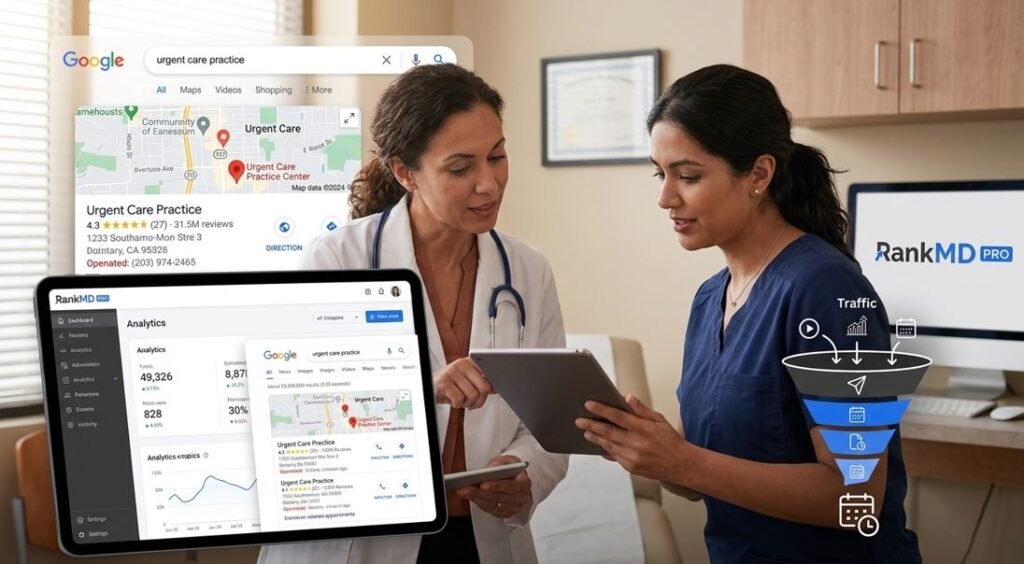
| Local search & Map Pack | Google Business Profile, citations, reviews, location signals | More visibility for “near me” and “best [specialty] in [city]” searches |
| Technical SEO | Site speed, mobile usability, indexing, structured data | A site search engines and AI systems can crawl, understand, and cite |
| Content & topical authority | Service, condition, and procedure pages; clinically reviewed articles | Patients and search engines see you as a credible source |
| Multi-location SEO | Location page architecture, entity consistency across clinics | Each location ranks without cannibalizing the others |
| AI search / GEO | Structured answers, entity clarity, citation-ready content | Presence in Google AI Overviews, ChatGPT, and Perplexity answers |
| Conversion optimization | Page layout, calls to action, forms, click-to-call, booking paths | More of your existing traffic becomes appointments |
| Website design and development | Patient-focused design; fast, secure builds | A site that earns trust and doesn’t hold SEO back |
How patients search (and what your content must answer)
Patients move from vague worry to a booking decision through several kinds of search. Strong healthcare SEO covers each stage:
| Search type | Example | What the page should do |
|---|---|---|
| Symptom or condition | “why does my lower back hurt in the morning” | Give accurate, reviewed information; show when to seek care; link to the relevant service |
| Treatment or procedure | “what is a root canal like” | Explain the process, risks, and recovery in plain language |
| Provider or service | “pediatric dentist [city]” | Show credentials, services, insurance, and a clear booking path |
| Local / “near me” | “urgent care near me open now” | Hours, address, wait information, directions, click-to-call |
| Comparison / best | “best med spa in [city]” | Reviews, results, differentiators, and trust signals |
| Insurance & logistics | “walk-in clinic that takes [insurer]” | Plain answers on accepted plans and what to bring |
The highest-value searches are usually the bottom three. That’s where a patient is choosing a provider, so those pages need the strongest calls to action.
Local SEO: winning the Map Pack
For most practices, the Map Pack is the front door. A solid local program includes:
- A fully built Google Business Profile with accurate categories, services, hours, and photos
- Consistent name, address, and phone details across directories
- A steady, compliant review process and timely responses
- Location and service pages written for the neighborhoods you actually serve
- Local schema and internal links connecting each location to its services
Practices with several clinics need a structure that keeps location pages distinct. Duplicate content across locations is a common reason multi-site groups under-perform.
AI search: being the practice AI answers cite
Patients now ask questions in Google AI Overviews, ChatGPT, and Perplexity, and many of those answers never produce a click. Generative engine optimization (GEO) helps your practice be named or cited when they do.
What helps:
- Direct, structured answers. Short, accurate responses placed right under clear headings.
- Clear entities. Consistent practice name, providers, specialties, locations, and credentials across your site and profiles.
- Structured data. Schema that states plainly who you are and what you offer.
- Verifiable expertise. Named, credentialed authors and medical reviewers.
- Content AI can quote. Specific, factual sections rather than marketing language.
The foundations of good SEO and good AI visibility largely overlap. Neither works without credible, well-structured content.
Compliance, trust, and what SEO can’t promise
Be cautious with agencies that sell “HIPAA-compliant SEO” as a blanket guarantee. SEO work doesn’t make a practice HIPAA compliant. Compliance depends on how your organization handles protected health information (PHI).
Regulators have scrutinized tracking technologies on healthcare sites, including analytics tools and advertising pixels that can pass identifiable health-related data to third parties. A responsible agency will:
- Audit which tracking tools run on your site, especially on appointment, patient-portal, and condition-specific pages
- Avoid passing health details through URLs, form fields, or event names
- Flag items for your compliance officer or counsel instead of making legal calls itself
Your counsel decides what’s permissible for your practice. A good SEO partner raises the question before launch instead of after a problem.
Conversion: turning visits into appointments
Traffic is only useful when it becomes a call, form, or booking. High-converting practice pages typically have:
- A visible phone number and tap-to-call button on mobile
- A booking or inquiry form with as few fields as possible
- Provider credentials and real photos near the call to action
- Insurance and “what to expect” details near the top
- Fast load times and a clean mobile layout
- Reviews and trust signals close to the decision point
- Calls to action matched to the visitor’s stage, such as “Book now” for service pages and “Learn more” for educational ones
What the process looks like
RankMD Pro works in four phases:
- Discovery: audit visibility, competitors, and conversion gaps.
- Strategy: target the high-intent searches that signal a patient ready to book.
- Authority: build presence across search engines, maps, and healthcare directories.
- Growth: convert organic traffic into qualified inquiries, then keep improving.
In the first 90 days, expect foundation work: audit findings, technical fixes, profile cleanup, and the first priority pages. The compounding results come after that.
What results look like, and how long they take
SEO is a long-term channel. Published agency timelines commonly describe early movement in the first few months, more noticeable ranking gains between roughly months four and nine, and stronger patient-acquisition results over a year or more. The pace depends on your competition, your starting point, and how quickly changes go live.
Here is one example. In RankMD Pro’s case study for Sahara West Urgent Care & Wellness Center in Las Vegas, the practice reported a 500% increase in Google Search Console clicks, a 550% increase in Google Business Profile actions, a #1 ranking for “Walk In Clinic Las Vegas,” and 1,000+ new inquiries in six months. Results vary by market and specialty, and no agency can guarantee a specific ranking. Browse more results on our case studies page.
Specialty-specific healthcare SEO
Search behavior differs by specialty, so the strategy should too:
- Urgent care SEO: immediate-intent, “near me,” and walk-in searches
- Mental health SEO: condition-specific content that builds trust and handles sensitive topics carefully
- Dental SEO: from emergency dentist to higher-value cosmetic procedures
- Aesthetic and med spa SEO: treatment-specific searches and visual proof
- Chiropractor SEO: pain-relief and condition-based searches
How to choose a healthcare SEO agency
Ask these questions before you sign:
| Question | What a good answer sounds like |
|---|---|
| What healthcare work have you done in my specialty? | Specific examples and case studies, not general claims |
| How do you handle medical accuracy? | Clinical review process; named reviewers or sign-off on sensitive content |
| How do you approach tracking and privacy? | A plan to audit tags and loop in your compliance team |
| What will you report on? | Calls, form fills, and booked appointments, not only rankings and impressions |
| How will you cover AI search? | Specific tactics for structured answers, entities, and citations |
| What does the first 90 days include? | A concrete roadmap, not “we’ll start with an audit” and nothing more |
| Do you guarantee rankings? | No. Honest agencies talk about process and leading indicators |
Red flags: guaranteed #1 rankings, “HIPAA compliant” claims with no explanation, mass-produced content, no clinical review, vague reporting, or long contracts without clear deliverables.
Frequently asked questions
What are healthcare SEO services?
Healthcare SEO services optimize a medical practice’s website, local listings, and content so patients can find it in search and AI answers, then convert into appointments. They typically include local SEO, technical optimization, medical content, AI search work, and conversion improvements.
How much do healthcare SEO services cost?
Published benchmarks vary widely, often from a few hundred to several thousand dollars per month, depending on competition, number of locations, and scope. Multi-location groups and competitive specialties sit at the higher end. Ask any agency for a scoped proposal tied to your market.
How long does medical SEO take to work?
Most practices see early movement within a few months, with more noticeable ranking gains over the following months. Appointment growth typically builds over six months to a year or longer. Local and branded searches tend to improve before broader treatment keywords.
Is healthcare SEO different from regular SEO?
Yes. Health content is held to stricter trust standards, local search drives most patient decisions, and privacy considerations affect tracking and forms. Content needs clinical accuracy, credentialed authorship, and careful handling of sensitive topics.
Do I need local SEO or regular SEO for my practice?
Most practices need both. Local SEO wins “near me” and Map Pack visibility, while on-site SEO and content build the authority that supports those rankings and captures research-stage searches.
Can SEO help my practice show up in AI search?
It can improve your chances. AI systems tend to cite sources that are clear, accurate, well-structured, and consistent about who you are and what you do. GEO builds on strong SEO fundamentals.
Is SEO better than paid ads for medical practices?
They serve different purposes. Ads deliver faster visibility but stop when spend stops. SEO takes longer but builds an asset that keeps working. Many practices use ads for short-term volume while SEO matures.
What should I look for in a healthcare SEO agency?
Look for healthcare case studies, a clinical review process, a privacy-aware approach to tracking, reporting based on patient inquiries, and honesty about timelines. Avoid guarantees.
Does SEO make my website HIPAA compliant?
No. HIPAA compliance depends on how your organization handles PHI. A good agency reviews tracking and forms with you and defers legal questions to your counsel.
Ready to find out what’s holding your practice back?
Every practice starts from a different place. Our team will review your visibility, your competitors, and your conversion gaps, then map out a prioritized plan.
- Get your free growth audit for a review of your search visibility and competitors
- Book a free consultation to talk through your goals
- See our case studies for results from other practices
- Contact RankMD Pro with questions