Healthcare SEO and general SEO share the same foundations: crawlable sites, useful content and earned authority. Healthcare SEO adds stricter trust standards, patient-privacy and advertising compliance, local-first visibility, medical entity markup and conversion goals built around appointments instead of traffic. A tactic that works for a software company or an online store can underperform, or create risk, on a medical website.
This guide breaks down the differences, shows where general SEO still applies, and helps you decide what your practice needs.
Short on time? Get a free healthcare SEO audit and we’ll show you where your practice stands against the clinics patients are choosing today.
Healthcare SEO vs General SEO at a Glance
| Factor | General SEO | Healthcare SEO |
|---|---|---|
| Content standard | Helpful, well-written, on-brand | Medically accurate, reviewed, attributed to credentialed providers |
| Trust bar | Important | Very high (YMYL) |
| Compliance | Advertising basics, privacy law | HIPAA considerations, patient-privacy rules, state and federal advertising rules |
| Geography | Often national or regional | Usually hyper-local; Map Pack is central |
| Keyword intent | Product, brand and how-to queries | Symptoms, conditions, treatments, insurance, “near me” and “open now” |
| Structured data | Organization, product, article | Adds LocalBusiness, Physician, MedicalClinic, MedicalProcedure, MedicalCondition |
| Reputation | Reviews help | Reviews are a primary ranking and decision factor, with privacy limits on replies |
| Success metric | Traffic, leads, sales | Calls, bookings, direction requests, new-patient inquiries |
| Risk of getting it wrong | Lost rankings | Lost rankings, loss of patient trust, potential regulatory exposure |
What Is General SEO?
General SEO is the practice of improving a website so it earns visibility in search engines for the queries that matter to a business. It typically covers technical health, keyword and content strategy, on-page optimization and link building. Its goal is to attract qualified visitors and turn them into customers.
Those fundamentals still matter in healthcare. Your site still needs to load fast, work on mobile and be easy for search engines to crawl.
What Is Healthcare SEO?
Healthcare SEO, also called medical SEO, applies those fundamentals to hospitals, clinics and medical practices. It adds the layers that medical search demands: clinical accuracy, provider credibility, patient-privacy awareness, local map visibility and structured data that helps search engines and AI systems understand who you are, what you treat and where you practice.
9 Key Differences Between Healthcare SEO and General SEO
1. Search engines hold medical content to a higher trust standard
Health content falls under what Google calls YMYL, or “Your Money or Your Life.” These are topics that can affect a person’s health, safety or finances. Google’s quality rater guidelines treat trust as the center of E-E-A-T. A page that looks expert but isn’t trustworthy still rates poorly.
For a general business, a thin “about” page is a missed opportunity. For a medical practice, it’s a trust problem. Healthcare pages need:
- named authors and medical reviewers with credentials
- accurate, sourced information
- clear practice details (address, phone, licensing, who is responsible for the content)
- a reputation that supports what the page claims
Learn more in our guide to E-E-A-T strategies for medical websites.
2. Content needs clinical accuracy, not just good writing
General SEO content can be written by a skilled generalist. Medical content can’t. A page on “signs of anxiety disorder” or “what to expect after a filler appointment” must be accurate, current and appropriately cautious. Overpromising outcomes or giving advice that belongs in an exam room can hurt patients and your rankings.
Best practice is a workflow in which a qualified clinician reviews medical content and the page shows the review date. That is slower than a typical content process, and it is also what separates content that earns trust from content that doesn’t.
3. Compliance shapes how you can market, track and respond
General SEO rarely needs a compliance lead. Healthcare SEO often does. Areas to plan around:
- Patient privacy: Never reveal patient information in review responses, testimonials, case studies or forms.
- Tracking technologies: Pixels, session-replay tools and analytics on pages that touch patient data deserve legal review. A federal court in Texas narrowed part of HHS’s guidance on tracking on public, unauthenticated pages, but guidance covering authenticated areas such as patient portals remains, and privacy litigation over pixels continues. Have counsel review your setup.
- Advertising claims: Outcomes, “best” claims, before-and-after content and testimonials are regulated at the state and federal level.
- Forms and call tracking: Collect only what you need and make sure vendors fit your compliance requirements.
This is general information, not legal advice. Your compliance lead or attorney should review anything patient-facing.
Want SEO that respects these boundaries? Our technical SEO and content services are built for healthcare constraints. Book a free consultation.
4. Local visibility matters more, and moves faster
Most patients choose care they can reach. That makes the Google Map Pack, Google Business Profile and “near me” searches far more important than they are for many national businesses. Local results depend on relevance, distance and prominence, and small clinics with strong local signals can outrank much larger networks in the Map Pack.
A healthcare local strategy typically includes an accurate Google Business Profile, consistent listings, unique location pages, review generation and local schema. See how this works in local SEO vs traditional SEO for clinics and how healthcare SEO helps you rank in Google Maps.
5. Patient search intent is different from customer search intent
Patients don’t search like shoppers. Their queries cluster into patterns:
- Symptom and condition research: “why does my jaw hurt,” “signs of burnout”
- Treatment research: “how long does Botox last,” “is TMS therapy covered”
- Provider selection: “family dentist accepting new patients,” “psychiatrist near me”
- Urgent need: “urgent care open now,” “emergency dentist”
- Insurance and logistics: “walk-in clinic that takes my insurance”
Each stage needs a different page type and a different call to action. An informational guide should educate and build trust. An urgent-care page should put a phone number, hours and directions above the fold. General SEO frameworks that treat all keywords as one funnel miss this.
6. Structured data and entities carry more weight
Search engines and AI systems need to understand who your providers are, what procedures you perform, what conditions you treat and where you operate. Healthcare sites use LocalBusiness, MedicalClinic, Physician, MedicalProcedure and MedicalCondition markup, along with consistent provider and location information across the web. See our explainer on what clinical schema is and how it helps your clinic.
7. AI search raises the stakes on credibility
Google AI Overviews, ChatGPT and Perplexity now answer health-related questions directly. These systems tend to favor clear, attributed and consistent sources. For healthcare, that means:
- direct answers near the top of the page
- named, credentialed authors and reviewers
- consistent practice details everywhere you appear
- structured data and well-organized FAQs
- reviews and third-party mentions that support your expertise
This is the focus of our AI search and answer engine optimization service. For context on where search is heading, read Will SEO get replaced by AI?
8. Reputation is a ranking factor and a decision factor
Reviews influence both local rankings and the patient’s final choice. In healthcare, you also have to manage them carefully. Replies must not confirm that someone is a patient or disclose any treatment detail, even to correct a false claim. A review process built for general retail can create privacy problems here.
9. Success is measured in appointments, not visits
A general website may count a lead form or purchase as the win. A practice needs calls, booking requests, direction taps and new-patient inquiries, tracked by location and service. Traffic from outside your service area, or from people researching a condition they’ll never treat with you, doesn’t fill your schedule. That’s why conversion rate optimization (CRO) belongs inside the SEO plan, not after it.
Our behavioral CRO service focuses on shortening the path from search to booked appointment.
How the Differences Show Up by Specialty
| Specialty | What changes most | Where to start |
|---|---|---|
| Urgent care | Speed, hours, wait-time and “near me” intent | Urgent care SEO |
| Mental health | Sensitivity, trust and condition-specific content | Mental health SEO |
| Dental | Emergency vs. cosmetic intent, high local competition | Dental SEO |
| Aesthetics and med spa | Long research cycles, visual proof, compliance on claims | Aesthetic SEO |
| Chiropractic | Pain-relief and condition-based queries | Chiropractor SEO |
When Is General SEO Enough?
General SEO skills can be enough for the basics: fixing site speed, cleaning up broken links, setting up analytics or improving page titles. They are not enough once you are:
- publishing medical or symptom-related content
- competing in the Map Pack
- running multiple locations
- handling forms, tracking or patient data
- trying to appear in AI-generated answers about your specialty
If any of these apply, you need a team that understands both search and healthcare. Still weighing options? Read Is it worth hiring an SEO agency? and How much does SEO typically cost?
How to Choose a Healthcare SEO Partner
Ask any agency you’re considering:
- How do you handle medical review and author credentials?
- How do you approach tracking pixels and analytics on a healthcare site?
- What is your local and multi-location strategy?
- Which metrics do you report: rankings, or calls and bookings?
- How do you structure schema for providers, services and locations?
- What is your approach to AI search visibility?
- Can you show healthcare-specific results?
Vague answers on questions 1 through 3 are a warning sign.
How RankMD Pro Approaches Healthcare SEO
RankMD Pro is a healthcare SEO agency, and our work is built around patient acquisition rather than rankings alone. That includes healthcare SEO audits and growth strategy, local search and Maps, technical SEO and medical schema, authority content and AI search optimization.
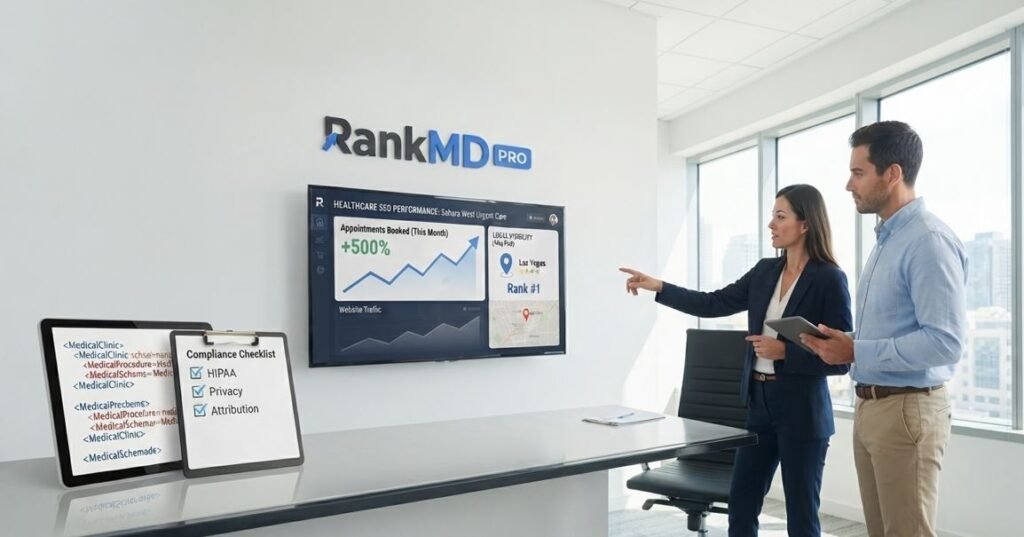
For example, our work with Sahara West Urgent Care & Wellness Center in Las Vegas produced +500% GSC clicks, +550% GMB actions and a #1 ranking for “Walk In Clinic Las Vegas.” See the details in our case studies. Results vary by market, starting point and competition.
FAQs
What is the difference between healthcare SEO and general SEO?
Healthcare SEO adds medical accuracy, credentialed authorship, patient-privacy and advertising compliance, local-first strategy and medical schema to standard SEO. It is also measured by calls and bookings instead of traffic alone.
Why is healthcare SEO harder than regular SEO?
Search engines apply stricter quality standards to health content, local competition is intense and compliance limits what you can publish, track and say. Each of these adds steps that general SEO doesn’t require.
What is YMYL in healthcare SEO?
YMYL, or “Your Money or Your Life,” describes topics that can affect a person’s health, safety or finances. Medical content falls into this group, so Google holds it to a higher standard of accuracy and trust.
Does HIPAA apply to SEO?
HIPAA doesn’t regulate rankings, but it affects how you handle patient information on forms, in tracking tools, in review replies and in case studies. Have your compliance lead or attorney review your setup.
Can a general SEO agency handle a medical practice?
Sometimes for basic technical work. For content, compliance, local visibility and schema, a healthcare specialist is usually the safer choice.
Is local SEO more important for healthcare?
For most practices, yes. Patients usually choose nearby providers, so Map Pack visibility often drives more calls and bookings than national rankings.
How does AI search change healthcare SEO?
AI tools favor clear, attributed and consistent sources. Credentialed authors, structured data, consistent practice details and strong reviews improve your chances of being cited.
How long does healthcare SEO take to work?
It depends on competition, your starting point and the work required. Local improvements often show up sooner than authority-driven gains, and no reputable agency can promise a fixed timeline.
Ready to See Where Your Practice Stands?
If your site was built or optimized using general SEO tactics, there may be quick wins in your local presence, content trust signals and conversion path. RankMD Pro will review your visibility and send back a tailored audit with a 90-day roadmap.
Get your free healthcare SEO audit · Book a free consultation · Contact us · Call (708) 497-9659