If your urgent care center is not showing up in the Google Map Pack in 2026, you are not just missing clicks. You are losing patients to competitors who may not even be as good as you, they just understand one thing you don’t: Google’s local ranking algorithm has fundamentally changed, and most clinics have not kept up.
Our urgent care SEO services are designed specifically to help you dominate local search in 2026.
This guide breaks down exactly how Google’s local algorithm works for urgent care centers in 2026, what signals actually move the needle, and the proven framework that turns local search visibility into a full appointment calendar.
Why Google’s Local Algorithm Treats Urgent Care Differently
Not all local businesses are equal in Google’s eyes. Urgent care sits at the intersection of high urgency, high trust, and hyper-local intent. When someone types “urgent care near me open now,” Google knows the searcher needs help within the next 30 minutes not next week. This changes everything about how the algorithm weighs ranking signals.
Google’s local ranking system for healthcare in 2026 is built on three foundational pillars: Relevance, Distance, and Prominence. But each of these has evolved significantly compared to even two years ago.
Relevance is no longer just about matching keywords on your website or Google Business Profile (GBP). Google now uses Natural Language Processing (NLP) and entity recognition to understand whether your clinic is semantically associated with the full cluster of conditions, services, and urgency signals that define “urgent care.”
If your content only says “urgent care” ten times but never mentions strep throat, X-ray services, occupational health, or walk-in availability, Google’s entity model sees you as thin.
Our urgent care SEO services ensure your content builds proper entity associations that Google rewards.
Distance is still the most non-negotiable factor, Google will almost always prioritize proximity for urgent queries. But “distance” in 2026 is calculated dynamically based on the user’s real-time GPS location, not just their billing address. Your GBP service area, verified address, and location page signals all feed into this calculation.
Prominence is where the real competitive battle is fought. It now incorporates review velocity, review sentiment analysis, structured citation authority, backlink quality from healthcare-adjacent domains, and AI Overview appearances. In short: prominence is your digital reputation score, calculated across dozens of interconnected signals.
The 2026 Google Local Ranking Factors: A Data-Driven Breakdown
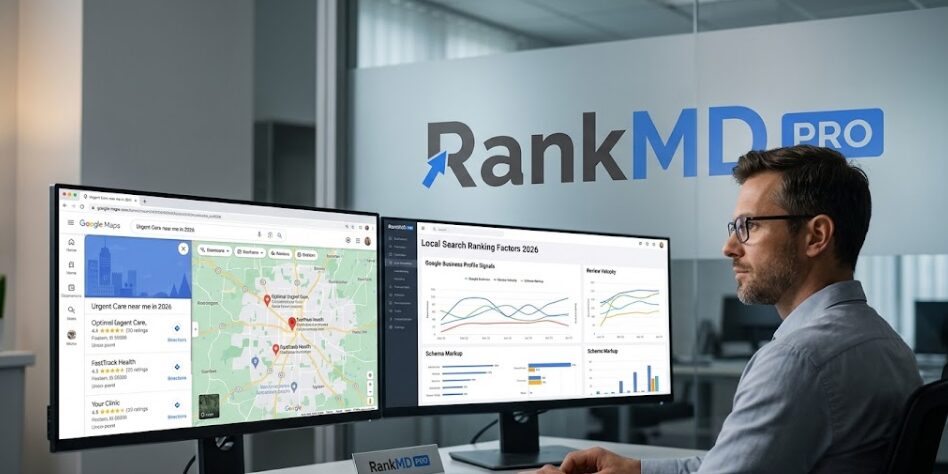
Based on industry research and observed ranking patterns across urgent care markets in 2026, here is how the primary local ranking factors break down in terms of estimated influence:
| Ranking Factor | Estimated Weight | Key Sub-Signals |
| Google Business Profile Optimization | 32% | Category selection, services, posts, photos, Q&A |
| On-Page Local SEO & Schema | 19% | NAP consistency, LocalBusiness schema, service pages |
| Review Signals | 17% | Quantity, recency, sentiment, response rate |
| Link Authority (Local & Healthcare) | 13% | .gov/.edu backlinks, local news, medical directories |
| Behavioral Signals | 11% | Click-through rate, direction requests, call actions |
| Citation Consistency | 8% | Yelp, Healthgrades, Zocdoc, WebMD, Vitals |
This is not a static picture. Google’s 2025 “Vicinity Update” successors have progressively increased the weight of behavioral signals, meaning a clinic that gets more clicks, calls, and direction requests from its Map Pack listing tends to climb higher, creating a compounding advantage for early movers.
How Google’s AI Overviews Are Reshaping Urgent Care Local Search
One of the most consequential shifts in 2026 is the expansion of Google AI Overviews (formerly SGE) into local healthcare queries. When a patient asks “what urgent care is open near me on Sunday,” Google now frequently surfaces an AI-generated summary at the top of results, before the traditional Map Pack.
These AI Overviews pull from:
- Your Google Business Profile attributes (hours, wait times, services)
- Your website’s structured content (FAQ schema, service schema, About Us)
- Third-party health directories (Healthgrades, WebMD, Zocdoc profiles)
- Recent review excerpts that mention specific services or conditions
Clinics that appear in AI Overviews report 2–3x more organic impressions than those ranking only in the traditional Map Pack. This makes Generative Engine Optimization (GEO) optimizing for AI answer systems not optional for urgent care centers in 2026. It is a primary acquisition channel.
To appear in AI Overviews, your digital presence needs to answer the patient’s full question across multiple authoritative sources simultaneously. This is why a single-page website with a basic GBP no longer competes.
The 5 Local Algorithm Signals Urgent Care Centers Are Getting Wrong
1. Incomplete Google Business Profile Category Strategy
Most urgent care centers select “Urgent Care Center” as their primary GBP category and stop there. This is leaving visibility on the table. Google allows up to ten secondary categories, and clinics that add relevant secondaries such as “Walk-In Clinic,” “Occupational Health,” “Medical Clinic,” “STD Testing Service,” and “X-Ray Lab”consistently rank across a broader set of high-intent queries.
Our urgent care SEO services include complete GBP category optimization across all relevant secondary categories.
The missed opportunity here is substantial. A clinic optimized only for “urgent care” misses patients searching for “walk-in flu shot near me,” “occupational health clinic,” “drug testing near me,” or “X-ray near me open today”, all of which represent real revenue.
2. Review Velocity Has Stalled
Google’s algorithm does not just reward clinics with the most reviews it rewards clinics with a consistent, ongoing flow of new reviews. A clinic with 400 reviews but none in the last 90 days is algorithmically treated as less active and less trustworthy than a clinic with 150 reviews and 15 in the last 30 days.
The benchmark for 2026: Urgent care centers in competitive markets (top 3 Map Pack) average 8–12 new reviews per month. If your clinic is under that number, review velocity is likely suppressing your visibility.
Additionally, Google’s sentiment analysis now reads review content for specific keywords and entities. Reviews that mention “quick,” “no wait,” “helpful staff,” “strep,” “X-ray,” “sports physical,” or other service-related terms add semantic richness to your GBP that influences ranking, not just reputation.
3. No Dedicated Service-Area Landing Pages
For urgent care centers with multiple locations or even single locations serving a wide radius, individual city and neighborhood landing pages are one of the highest-ROI investments in local SEO. These pages signal to Google’s local algorithm that your clinic specifically serves those geographic areas.
A proper urgent care location landing page includes:
- Unique, locally-relevant content (neighborhood references, nearby landmarks, local health statistics)
- Embedded Google Maps iframe with the specific location pinned
- LocalBusiness schema markup with precise coordinates
- Location-specific patient reviews embedded on the page
- Internal links to condition-specific service pages
Our urgent care SEO services build location-specific pages that extend your ranking radius by 20-40%.
4. Schema Markup Is Missing or Broken
Structured data (schema markup) is the bridge between your website and Google’s knowledge graph. For urgent care centers, the following schema types are non-negotiable:
| Schema Type | What It Communicates to Google |
| MedicalClinic | Business type, specialty, accepted insurance |
| LocalBusiness | NAP, hours, geo-coordinates |
| FAQPage | Answers to high-intent patient questions |
| MedicalCondition | Conditions you treat (expands entity association) |
| OpeningHoursSpecification | Exact hours including holidays/weekends |
| AggregateRating | Review summary pulled from structured data |
A 2024 study by BrightLocal found that healthcare businesses using complete schema markup were 36% more likely to appear in the Local 3-Pack than those with no schema. In 2026, that gap has only widened as AI parsing of structured data has become more central to Google’s local ranking process.
5. Ignoring Behavioral Click Signals
This is the most overlooked factor in urgent care local SEO. Google’s algorithm tracks what users do after seeing your listing in the Map Pack. If patients consistently choose your listing over competitors’ clicking through, tapping “Get Directions,” or calling directly, Google interprets this as a relevance signal and rewards you with higher placement.
This means your GBP listing itself is a conversion asset. Clinics with high-quality photos (minimum 20–30 current photos), accurate wait-time information, active Q&A sections, and regular GBP Posts drive significantly higher CTR from the Map Pack which in turn drives higher rankings. It is a flywheel that most urgent care operators have not started spinning.
The RankMD Pro Framework: Turning Algorithm Knowledge Into Patient Appointments
Understanding how the algorithm works is only half the equation. The other half is execution and this is where most urgent care centers fall short not because they lack effort, but because they lack a system.
At RankMD Pro, we have developed a patient acquisition framework specifically for urgent care centers that integrates every signal Google’s local algorithm rewards in 2026:
Step 1 — GBP Authority Build:
We audit and fully optimize your Google Business Profile, including category architecture, service menu build-out, photo optimization, and a 90-day posting calendar that keeps your listing algorithmically fresh.
Step 2 — Review Velocity Engine:
We implement a frictionless, HIPAA-compliant review generation system that consistently drives 10–15 new reviews per month from verified patients without violating Google’s review policies.
Step 3 — Topical Authority Content:
We build a cluster of condition-specific and service-specific content pages that expand your semantic entity footprint, making your clinic the definitive local resource for urgent care information in your market.
Step 4 — Local Citation & Schema Fortress:
We audit and correct your citations across 40+ directories, implement complete healthcare schema markup, and build location-specific landing pages for every service area you want to dominate.
Step 5 — AI Overview Optimization:
We engineer your content and GBP to appear in Google AI Overviews for your highest-value queries capturing the AI layer of search that is increasingly the first thing patients see.
The results are measurable. Urgent care centers we work with typically see a 40–65% increase in Map Pack visibility within 90 days, and a 30–50% increase in new patient inquiries within six months.
What the Top-Ranked Urgent Care Centers Have in Common in 2026
Across hundreds of competitive urgent care markets analyzed, the clinics consistently ranking in position 1–3 of the Google Map Pack share a predictable profile:
- 200+ Google reviews with a 4.6+ average and an average of 10+ new reviews per month
- GBP fully optimized with 8+ secondary categories, 30+ photos, and weekly posts
- A website with complete MedicalClinic and LocalBusiness schema, loading in under 2.5 seconds on mobile
- Minimum 3–5 location or neighborhood landing pages per service area
- Active Healthgrades, Zocdoc, and WebMD profiles with consistent NAP data
- At least 2–3 local backlinks from news sites, hospital systems, or community organizations
- Presence in Google AI Overview results for at least 5 high-intent queries
This is not an accident. These clinics have either invested in building this infrastructure themselves or partnered with a healthcare SEO specialist who understands the algorithm at this level of depth.
Partner with us through our urgent care SEO services to build this infrastructure without the guesswork.
The Bottom Line: The Algorithm Rewards Systems, Not Sporadic Effort
Google’s local algorithm in 2026 is sophisticated, multi-layered, and increasingly driven by AI but it is also predictable. It rewards urgent care centers that consistently signal relevance, trustworthiness, and patient satisfaction across every touchpoint it can measure.
The clinics that dominate local search are not necessarily the largest or the best-funded. They are the ones operating with a deliberate, ongoing system for building and maintaining local authority. Every week your clinic goes without that system is a week of appointments going to the clinic below you on the map.
If you want to see exactly where your urgent care center stands and what it would take to move into the Map Pack’s top three, RankMD Pro offers a free Local SEO Growth Audit, a comprehensive analysis of your current GBP health, review profile, schema markup, and competitive gap against the top-ranking clinics in your market.
See exactly where your clinic stands with a free audit from our urgent care SEO services team.
There is no obligation. Just a clear picture of where you are, where you need to be, and the fastest path to get there.
Get Your Free Urgent Care SEO Audit!
Frequently Asked Questions
How long does it take for an urgent care center to rank in Google’s Map Pack?
For clinics starting from scratch, 60–120 days is a realistic timeline to see meaningful Map Pack movement in moderately competitive markets. Highly competitive urban markets may require 4–6 months. The fastest results come from GBP optimization and review generation, these can produce movement in 30–45 days.
Does having a new urgent care clinic hurt my local rankings?
Yes, initially. Google applies a “sandbox” effect to newer GBP listings, limiting early visibility until trust signals accumulate. Aggressive early action on reviews, citations, and GBP completeness significantly shortens this period.
How important are reviews compared to website SEO for urgent care?
Both are critical, but reviews have a disproportionately high short-term impact on Map Pack rankings. A clinic with strong reviews and a basic website will often outrank a clinic with an excellent website but weak reviews. Long-term dominance requires both.
What is the difference between organic search rankings and Map Pack rankings for urgent care?
Map Pack rankings (the Google Maps 3-Pack) are driven primarily by your Google Business Profile and local signals. Organic rankings (the blue links below the map) are driven by your website’s content, technical SEO, and backlink authority. The best strategy targets both simultaneously, as they reinforce each other.
Do urgent care centers need to optimize for voice search in 2026?
Yes. An estimated 35–40% of urgent care searches are now initiated via voice on mobile devices or smart speakers. Voice search optimization requires conversational FAQ content, complete GBP data (especially hours and phone number), and fast mobile load speeds, all of which are already best practices.
Can multiple locations of the same urgent care brand compete against each other in the Map Pack?
Google generally shows only one listing per brand per Map Pack result for the same query. This means multi-location groups need location-specific GBP optimization and unique content for each location to maximize the brand’s aggregate visibility.
How do I know if my urgent care center’s local SEO is underperforming?
The clearest indicators are: declining or flat Google Business Profile impressions, fewer than 5 new reviews per month, your clinic not appearing in the Map Pack for “urgent care near me” searches from your own address, and low call/direction-request volumes from your GBP.