
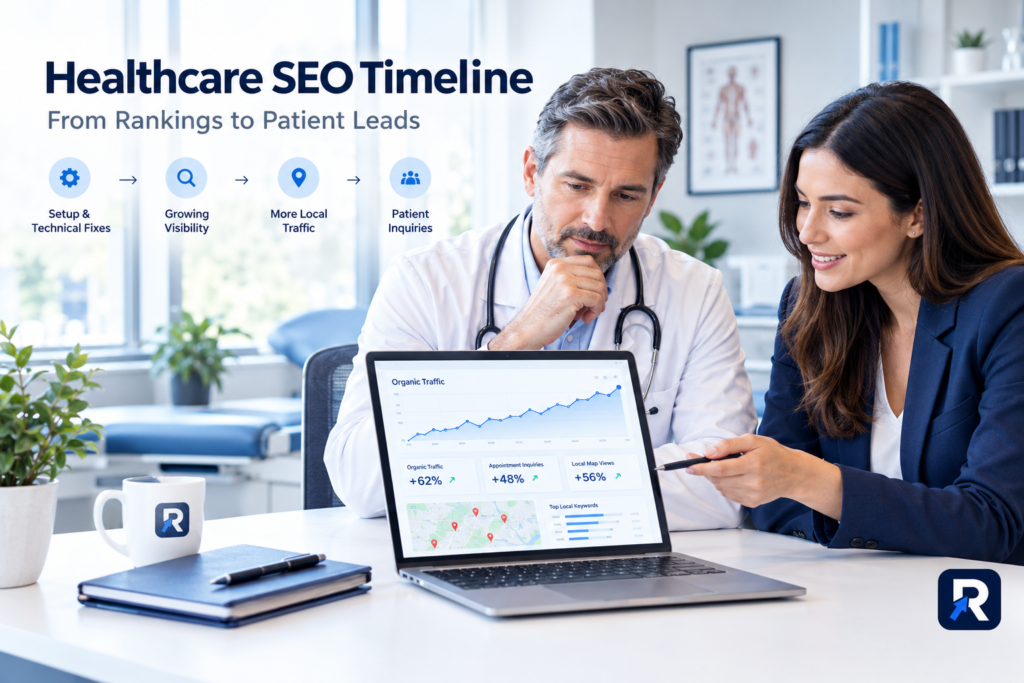
Healthcare SEO Timeline at a Glance
| Timeframe | What typically happens | Lead impact |
|---|---|---|
| Month 1 | Audit, technical fixes, Google Business Profile cleanup, keyword and competitor mapping | Little to none |
| Months 2–4 | Pages get indexed, impressions rise, early local movement, review and profile engagement improve | First calls, direction requests and form fills, usually modest |
| Months 4–6 | Service and condition pages gain rankings, Map Pack visibility improves for less competitive terms | Leads become more regular |
| Months 6–12 | Authority compounds, competitive terms move up, conversion improvements add up | Steady patient inquiries |
| Months 12+ | Strong positions in competitive markets, growing AI-search citations, lower marginal cost per lead | Predictable, scalable flow |
These are planning ranges, not guarantees. Your timeline depends on the factors below.
Why “Leads” Arrive Later Than “Rankings”
A patient lead needs three things to happen in sequence:
- Visibility. Google can find, understand and trust your pages and profile.
- Clicks and actions. Your listing earns the click, call or direction request.
- Conversion. Your site or profile persuades the visitor to book.
Rankings come first. Leads depend on all three. A page ranking #8 gets little attention, and a #2 ranking on a slow, unclear website still loses patients. That is why a good healthcare SEO strategy treats conversion optimization as part of the timeline, not an afterthought.
Why Healthcare SEO Takes Longer Than Many Industries
Healthcare is classified as YMYL (“Your Money or Your Life”) content, so Google applies stricter quality standards to medical information. Several things follow from that:
- Trust has to be earned. Google looks for experience, expertise, authoritativeness and trust (E-E-A-T). Physician-reviewed content, credentials, citations and reputation signals take time to build.
- Competition is intense. Hospital systems, franchises, directories and review platforms occupy the results for many medical searches.
- The Map Pack is crowded. Proximity, reviews, categories and profile completeness all affect who appears in the top three local results.
- Compliance slows production. Medical content needs accuracy review, and healthcare sites need privacy-conscious design and tracking.
- AI search adds a layer. Patients now get answers from Google AI Overviews, ChatGPT and Perplexity, and these systems favor clear, verifiable, well-structured sources.
7 Factors That Speed Up or Slow Down Results
| Factor | Faster results | Slower results |
|---|---|---|
| Website age and authority | Established site with a clean history | New domain or past penalties |
| Technical health | Fast, mobile-friendly, well-indexed | Crawl errors, slow pages, thin architecture |
| Google Business Profile | Verified, complete, active, strong reviews | Unclaimed, inconsistent or few reviews |
| Content depth | Dedicated pages for each service and condition | One generic “services” page |
| Competition | Smaller market or niche specialty | Dense metro with big health systems |
| Keyword targets | Specific, high-intent local terms | Broad, high-volume terms |
| Conversion experience | Clear CTAs, click-to-call, simple booking | Slow forms, buried phone number |
A practice with an established website, a strong profile and a clear gap in its local market can move faster than a new practice entering a saturated city.
How Long Does Local SEO Take for Medical Practices?
Local SEO for a Map Pack listing often moves faster than broad organic rankings, because profile, review and citation improvements can affect visibility sooner. Typical patterns:
- Weeks 1–4: Profile corrections, category fixes and review requests can start lifting calls and direction requests.
- Months 2–4: Local visibility improves for lower-competition and neighborhood-level searches.
- Months 4–12: Competitive “near me” and “[specialty] + [city]” terms become realistic targets, especially in dense markets.
If you want the local mechanics, read our guide on how to get your clinic into the Google Map Pack and our breakdown of how a medical practice can rank higher on Google Maps.
Timeline by Specialty
Search behavior differs by specialty, which affects how quickly leads show up.
- Urgent care: Patients search at the moment of need (“urgent care near me”, “walk-in clinic”), so Map Pack visibility and mobile speed matter most. Local gains can translate to calls quickly once visibility improves. See our urgent care SEO approach.
- Dental: Emergency and general searches are highly local and competitive, while cosmetic and implant terms are higher value and slower to win. Learn more about dental SEO.
- Mental health: Patients research carefully and compare providers, so trust-building content and credibility signals carry weight. Explore mental health SEO.
- Aesthetics and med spas: Treatment keywords are competitive and image-driven, and strong reviews, before-and-after proof and brand search matter. See aesthetic SEO.
- Chiropractors: Condition-specific searches such as back pain and sciatica often combine local and informational intent. View chiropractor SEO.
What to Track Before Leads Arrive (Leading Indicators)
If you only watch lead volume, month three can look like failure. These signals usually move first:
- Impressions and average position in Google Search Console
- Number of pages indexed and ranking for target terms
- Google Business Profile views, calls, website clicks and direction requests
- Review count, rating and review recency
- Organic click-through rate on service pages
- Form submissions, click-to-call taps and booking-page visits
- Mentions or citations in AI-generated answers
A solid monthly report ties these to patient inquiries. Here is what healthcare SEO reporting should include each month.
Month-by-Month: What a Healthy Campaign Looks Like
Month 1: Foundation. Technical audit, tracking setup, profile optimization, competitor and keyword research, and a prioritized roadmap. Nothing here is flashy, but everything after it depends on it.
Months 2–3: Implementation. Priority fixes go live, service and location pages are built or improved, schema is added, and review generation starts. Expect impressions to rise.
Months 4–6: Early traction. Rankings start to move, local visibility improves and inquiries become more regular. This is the stage where lead tracking becomes meaningful.
Months 6–12: Compounding. Authority content, links and conversion improvements stack on each other. Leads typically become steadier and cost per lead falls compared with early months.
Year 2 and beyond. You defend and expand your position, add new services or locations, and build visibility in AI search.
Can You Speed Up Healthcare SEO Results?
You can’t force Google, but you can remove delays:
- Fix the basics first. Indexing, speed, mobile usability and broken pages hold back everything else.
- Start with high-intent pages. Service, location and insurance-specific pages often convert better than broad blog content.
- Complete and maintain your Google Business Profile. Accurate categories, services, hours, photos and consistent reviews help.
- Build review velocity. A steady flow of genuine reviews supports both rankings and trust.
- Target winnable terms first. Specific local and treatment-level searches typically move faster than the biggest head terms.
- Remove friction. Click-to-call, short forms, clear next steps and fast mobile pages turn existing traffic into bookings.
- Approve changes quickly. Slow approvals and development queues delay results more than most practices expect.
- Pair SEO with a short-term channel if you need volume now. Paid ads can fill the gap while SEO builds. SEO also doesn’t depend on ads, as we explain in can healthcare SEO work without paid ads.
Not sure which of these gaps is slowing you down? Request your free growth audit for a competitor comparison and a prioritized 90-day roadmap.
SEO vs. Paid Ads: Different Clocks
| Healthcare SEO | Paid search ads | |
|---|---|---|
| Time to first leads | Months | Days to weeks |
| Cost behavior | Higher effort up front, lower marginal cost later | Cost continues with every click |
| Stops when you stop? | Rankings often persist | Traffic ends when spend ends |
| Best for | Durable, compounding patient acquisition | Immediate volume and testing |
Many practices use both. Ads cover the early gap, and SEO gradually reduces dependence on paid traffic. For budget planning, see how much local SEO costs for a medical practice.
Does AI Search Change the Timeline?
Patients increasingly start with Google AI Overviews, ChatGPT and Perplexity. These systems tend to cite sources that are clear, consistent and credible: accurate practice information, physician-reviewed pages, structured data and strong reputation signals. Many of those foundations overlap with traditional SEO, so work done now supports both. Because AI-search behavior changes quickly, treat it as an added layer rather than a replacement for local and organic fundamentals. Read our guides to healthcare GEO strategies and AI SEO for healthcare providers.
Red Flags: Be Careful With These Promises
- “Guaranteed #1 in 30 days.” Nobody controls Google’s rankings.
- No leading indicators or reporting. You should see what is being done and what moved.
- Only traffic metrics. Traffic without calls or bookings isn’t a patient acquisition result.
- No compliance awareness. Healthcare sites need accuracy and privacy-conscious practices.
- One-size-fits-all packages. A single-location dentist and a multi-clinic group need different plans.
If you’re weighing outside help, compare agency vs. in-house SEO for healthcare.
Quick Self-Check: How Soon Might You See Leads?
You may see results sooner if most of these are true:
- Your website is a year or more old and technically healthy
- Your Google Business Profile is verified, complete and actively reviewed
- You have a dedicated page for each core service
- Your market has a visible gap in local competitors’ content or reviews
- You can implement recommendations quickly
You may need a longer runway if you are launching a new site, entering a dense metro, competing against hospital systems, or starting with limited reviews and thin content. A longer runway is not a reason to skip SEO. It is a reason to plan for it and to measure the right early signals.
How RankMD Pro Approaches Healthcare SEO Timelines
We build for booked appointments, not just rankings. Every engagement starts with an audit of your visibility, competitors and conversion gaps, then moves through strategy, authority building and ongoing growth. You can see how this works in practice across our healthcare SEO services and in our case studies, including timelines and outcomes for urgent care, mental health and other practices.
Ready for a realistic timeline? Book your free consultation or get your free growth audit. We’ll show you where your practice stands, what to fix first and what to expect.
FAQs
How long does it take for healthcare SEO to work?
Most practices see early signals in 2–4 months and more consistent results in 6–12 months. Competitive specialties and markets can take longer.
How long does it take to get patient leads from SEO?
Some leads can appear within the first few months, especially from Google Business Profile improvements and local searches. Steady, predictable lead flow usually takes 6–12 months to build.
How long does local SEO take for a medical practice?
Profile and review improvements can lift engagement within weeks. Stronger Map Pack visibility for competitive terms often takes several months to a year, depending on the market.
Why does healthcare SEO take longer than other industries?
Medical content falls under Google’s YMYL standards, so trust, expertise and reputation signals matter more. Competition from hospital systems and directories also raises the bar.
Can healthcare SEO deliver results in 30 days?
You can see early improvements, such as fixed technical issues, a cleaner profile and more impressions, but consistent patient leads in 30 days are unlikely. Be cautious of anyone guaranteeing it.
What should I expect in the first three months?
Expect audit and setup work, technical and profile fixes, new or improved service pages and rising impressions. Lead volume is usually modest at this stage.
How do I know if my healthcare SEO is working?
Look for rising impressions, better rankings for target terms, more profile calls and direction requests, and more form fills or bookings from organic search. Your report should connect these to patient inquiries.
Is SEO or paid advertising better for getting patients quickly?
Paid ads can generate leads faster, while SEO builds a durable, lower-marginal-cost channel over time. Many practices use both.
Does SEO still matter with AI search?
Yes. AI search tools draw on credible, well-structured sources, and many of the same foundations apply: accurate information, strong content, reviews and technical clarity.
What can slow down healthcare SEO results?
Common causes are technical problems, thin content, an incomplete Google Business Profile, few reviews, intense competition, slow implementation and a poor conversion experience.
The Bottom Line
Healthcare SEO is a compounding investment, not an overnight switch. Expect early signals within a few months, steadier patient leads over 6–12 months, and growing returns after that. The practices that win are the ones that build the right foundation, track the right indicators and keep improving the path from search to appointment.
Want to know how long it would take in your market? Get your free healthcare SEO audit or talk with our team.