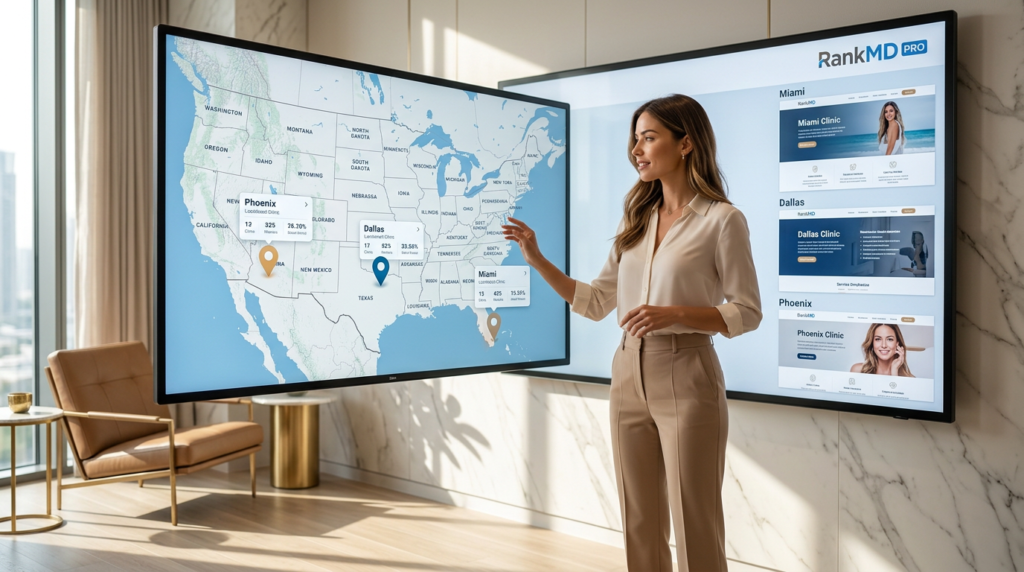
When an aesthetic practice scales quickly, growing from one med spa to five, ten, or twenty locations, business expansion creates unique technical challenges. While multi-location growth accelerates revenue, it often triggers duplicate content issues if managed incorrectly. Each individual clinic requires its own dedicated location page that is unique, localized, and genuinely helpful. This guide outlines how to build high-performing location pages for multi-location aesthetic practices while optimizing your medical SEO and search engine visibility.
What Is a Location Page?
A location page is a specialized web page designed for a single physical clinic. For instance, a growing national aesthetic brand might operate med spas in Miami, Dallas, Phoenix, Chicago, and Los Angeles.
Each facility needs its own distinct URL to showcase essential details, including the clinic address, phone number, operating hours, available aesthetic procedures, on-site providers, parking details, nearby neighborhoods, patient testimonials, facility photos, driving directions, and booking links. Implementing a robust local search engine optimization framework for every branch ensures prospective patients can easily find your local services.
Why Duplicate Content Is a Problem:
Duplicate content occurs when multiple URLs feature identical or near-identical text blocks. For example, if a multi-location med spa publishes fifteen clinic pages stating, “We offer Botox, dermal fillers, laser skin treatments, and customized care. Our expert team delivers safe results,” while only swapping out the city name, search engines will flag the pages as low quality.
A Miami clinic page must feel tailored specifically to Miami patients, just as Dallas and Phoenix pages require unique local depth. Relying on simple automated city-swapping scripts undermines your aesthetic practice SEO performance and weakens organic rankings.
Create a Unique Page Structure:
While maintaining a consistent web design layout across all location pages improves user experience and branding, the underlying text must remain distinct. Utilize a standardized structural template while populating every section with authentic, location-specific data.
1. Write a Local Introduction:
Begin each location page with a customized introductory summary rather than generic corporate copy.
-
Weak version: “We are a leading aesthetic clinic offering advanced cosmetic treatments.” (This generic sentence can appear anywhere.)
-
Better version: “Our Miami aesthetic clinic serves patients from Brickell, Coral Gables, Coconut Grove, and surrounding South Florida communities, offering specialized skin rejuvenation in a private, modern setting.”
Integrating targeted phrases like aesthetic practice SEO and medical website optimization naturally into these introductions strengthens your overall digital marketing strategy.
2. Add Real Location Details:
Every location page must feature verified, real-world data to support local search visibility. Include the exact street address, suite numbers, direct phone numbers, business hours, building names, parking directions, and nearby landmarks.
These precise operational details are impossible for competitors to duplicate, anchoring your local map pack rankings while helping prospective patients navigate to your facility smoothly.
3. Show Treatments Available at Each Clinic:
Never assume that every branch offers the exact same menu of services. While one med spa might provide advanced laser skin resurfacing and body contouring, another might focus primarily on injectables and chemical peels.
List only the specific cosmetic treatments truly available at that physical address, and pair them with location-specific descriptions to boost your targeted search engine presence.
4. Introduce Local Providers:
Highlighting the specific doctors, nurse practitioners, physician assistants, and master injectors working at each clinic builds instant trust and satisfies medical SEO E-E-A-T signals.
Include individual provider bios detailing their professional roles, clinical training, board certifications, areas of clinical focus, and years of experience. Never copy identical staff bios across multiple branch pages, and ensure you only list providers physically stationed at that specific facility.
5. Add Local Patient Reviews:
Testimonials drive high-intent conversion actions and supply valuable unique content. Display verified reviews written by patients who actually visited that specific branch, adhering strictly to patient privacy regulations.
Adding short qualitative review summaries such as noting that patients frequently praise the friendly front desk staff, spotless treatment rooms, and thorough consultations enhances your local optimization footprint.
6. Use Real Clinic Photos:
Visual media elevates engagement and reduces bounce rates. Feature high-resolution, authentic photographs of the actual facility, including the exterior entrance, reception waiting area, specialized treatment rooms, and local staff members. Authentic imagery reassures patients and signals authenticity to search engines.
7. Create Local FAQs:
Avoid copying the exact same ten generic questions across every branch page. Instead, craft hyper-local FAQs that answer region-specific inquiries.
For example, a Miami clinic FAQ might address parking access near Brickell, while a Chicago FAQ explains how to reach the clinic via local transit stops. This strategy captures valuable long-tail search traffic.
8. Mention Nearby Areas Naturally:
Incorporate surrounding neighborhoods, suburbs, and regional landmarks into natural conversational sentences. Avoid aggressive keyword stuffing or robotic lists of city names.
A natural sentence reads: “We proudly welcome patients traveling from Scottsdale, Paradise Valley, and nearby Phoenix metro communities.”
9. Add A Local Travel Guide:
Including a short transportation and accessibility guide adds immense value for patients visiting your med spa for the first time. Outline the best driving routes from major highways, proximity to public transit stops, parking garage instructions, and building entrance guidelines.
Detailed travel instructions improve local user engagement metrics, supporting long-term healthcare SEO growth.
10. Create Location-Specific Service Content:
Instead of publishing one monolithic national page for every procedure, ground your service offerings in local context. Build dedicated sections such as “Botox in Los Angeles“ or “Laser Resurfacing in Dallas.”
Discuss who performs the treatment at that branch, what patients can expect during their consultation, and how the local clinic environment ensures comfort.
11. Avoid Automatic City Swapping:
Relying on low-effort automated scripts to swap out city names across identical templates creates thin content that search engines penalize.
Instead, develop a flexible content template where each branch manager or local marketing team provides authentic regional data for their respective URL.
12. Build a Local Content Checklist:
Before pushing any new branch page live, run through a rigorous quality assurance checklist to ensure zero duplicate content:
-
Is the physical street address accurate?
-
Is the local phone number correct?
-
Are operating hours up to date?
-
Are listed treatments verified for this facility?
-
Are local providers assigned correctly?
-
Are images pulled from the actual clinic location?
-
Is the introductory paragraph completely unique?
-
Are local neighborhoods mentioned naturally?
-
Are location-specific FAQs included?
-
Are reviews authentic to this branch?
-
Is the booking link fully functional?
13. Use a Consistent URL Structure:
Maintain clean, user-friendly URL paths across your multi-location domain architecture. Clear URL structures help search engine crawlers index your pages efficiently. Exemplary URL formats include:
-
/locations/miami-fl/ -
/locations/dallas-tx/ -
/locations/phoenix-az/
Avoid messy, keyword-stuffed directory strings.
14. Link Location Pages Together:
Establish a cohesive internal linking hierarchy by creating a main directory hub page (e.g., /locations/) that links out to every individual clinic.
Furthermore, every location page should link directly back to core educational service pages (such as Botox, fillers, and laser treatments), establishing powerful topical authority across your entire medical website.
15. Keep National and Local Content Separate:
Maintain a clear distinction between broad national service educational guides and hyper-local conversion pages. National pages can focus deeply on explaining the science behind a procedure, while local pages emphasize provider expertise, clinic ambiance, and geographic convenience. This separation prevents internal keyword cannibalization and reduces duplicate content risks.
16. Add Local Business Information:
Ensure your Name, Address, and Phone Number (NAP data) remain 100% consistent across your website code, Google Business Profile listings, local citations, and healthcare directories. Accurate NAP data builds foundational trust with both search algorithms and prospective patients.
17. Use Local Schema Markup:
Implement valid Local Business Structured Data (LocalBusiness or MedicalClinic schema) on every location page.
Ensure your JSON-LD markup accurately reflects real operational details, working hours, and physical addresses without making false claims about unverified services or ratings.
18. Update Pages Often:
Branch operations evolve over time. Providers relocate, operating hours shift, clinic suites expand, and treatment menus change.
Audit and refresh your location pages on a recurring schedule to maintain absolute data accuracy, which protects user trust and supports sustained search engine rankings.
Conclusion
Scaling a multi-location aesthetic practice requires far more than simply swapping out city names across cookie-cutter web pages. Successful digital expansion demands authentic, localized content that highlights your physical facilities, expert providers, real patient reviews, and regional details. By keeping your page structures unique, avoiding duplicate text, and aligning your digital presence with professional medical SEO strategies, your brand will dominate local search results across the USA. For aesthetic practices seeking expert guidance, partnering with specialized agencies like Rank MD Pro delivers comprehensive aesthetic SEO services designed to maximize multi-location growth.
Frequently Asked Questions:
-
Should every clinic location have its own page?
}Yes. Every active, physical clinic location requires a unique, dedicated web page to capture local search traffic effectively. -
Can I use the same page design for every location?
Yes. A consistent, unified web design template is entirely acceptable as long as the textual content, provider bios, photos, and local details remain completely unique. -
Should I add local neighborhoods?
Yes, when relevant. Mention surrounding communities naturally within conversational sentences rather than resorting to unnatural keyword stuffing. -
Are patient reviews useful on location pages?
Yes. Genuine, location-specific patient testimonials build immense social proof and strengthen local search context. -
Should I add photos to location pages?
Yes. Real photographs of your actual clinic facility help prospective patients feel comfortable and familiar before booking their first visit.