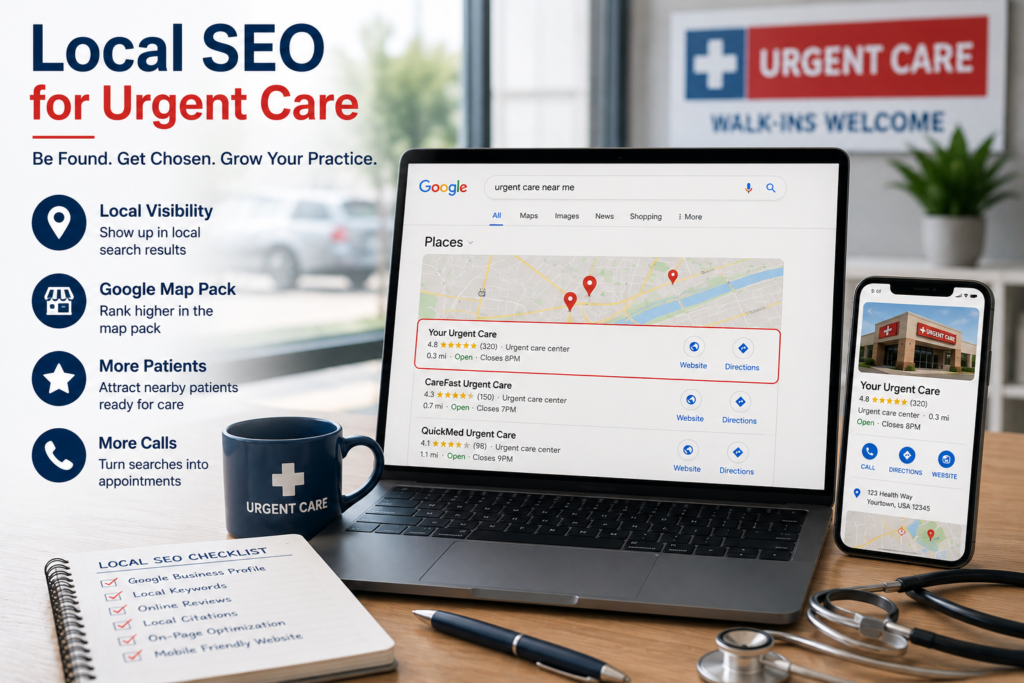
Local SEO for Urgent Care has a very specific objective: get your clinic in front of nearby patients when they are actively looking for immediate medical care.
Someone searching “urgent care near me” usually isn’t conducting months of research. They may need treatment after work, have a minor injury, need a same-day visit, or be looking for a clinic that is open right now.
That makes the Google Map Pack one of the most valuable search surfaces for an urgent care practice.
The problem is that simply having an urgent care website doesn’t guarantee visibility there.
A clinic can have a modern website and still lose the local search to a competitor because the competitor has stronger local relevance, a better-established Google Business Profile, more prominent reviews, stronger location signals, or a better match for the searcher’s location.
Google identifies local results largely around relevance, distance, and prominence.
For Local SEO for Urgent Care, those factors have to be translated into a very practical question:
When a nearby patient searches for Local SEO for Urgent Care, does Google have enough evidence to choose your clinic and does your listing give that patient a reason to call?
Why “Urgent Care Near Me” Is More Valuable Than a Broad “Urgent Care” Ranking
A ranking for “urgent care” doesn’t necessarily tell you much about patient acquisition.
The searcher could be anywhere.
But when someone searches:
“urgent care near me”
the intent is different.
The user has already identified the type of facility they want and is asking Google to narrow the choices geographically. They actually searches for Local SEO for Urgent Care patients.
The same applies to searches such as:
- urgent care near me
- urgent care open now
- urgent care open today
- walk-in clinic near me
- urgent care clinic near me
- same-day urgent care
- after-hours urgent care
- pediatric urgent care near me
- urgent care for minor injuries
- urgent care near [neighborhood]
These searches reveal location + healthcare need + immediate intent.
That combination should determine how an urgent care SEO campaign is structured.
Instead of producing dozens of broad medical articles, the strategy should first make sure Google can clearly understand:
Who you are → where you are → what you treat → when you’re available → why you’re relevant to this searcher.
The Map Pack Problem: Why a Nearby Competitor Can Beat You
Consider two urgent care clinics located within the same city.
Clinic A
- Strong Google Business Profile
- Accurate hours
- Hundreds of legitimate reviews
- Consistent local information
- Strong location page
- Clear service information
- Good local authority
Clinic B
- Similar services
- Modern website
- Fewer reviews
- Weak location information
- Outdated Business Profile details
- Little local authority
Clinic B may still rank organically for some healthcare searches.
But that doesn’t mean it will dominate the Map Pack.
Local search isn’t simply a contest over who has the most website content.
Google’s local systems consider factors including relevance, distance, and prominence.
This is why Local SEO for Urgent Care needs to be diagnosed at the local-entity level rather than through keyword density alone.
Start With the Searcher’s Location, Not a List of Cities
One of the biggest mistakes urgent care practices make is assuming that one location should rank equally across an entire metropolitan area.
It won’t.
If an urgent care clinic is located in one part of a city, Google can consider the searcher’s proximity to that clinic. Distance is one of the primary local-ranking factors Google identifies.
So instead of creating pages for every nearby city, identify the clinic’s actual patient catchment area.
Look at:
- Neighborhoods generating patients
- Nearby suburbs
- Major roads
- Residential developments
- Apartment communities
- Universities
- Schools
- Business districts
- Shopping centers
- High-traffic corridors
Then compare those areas against actual search visibility.
For example, an urgent care located near a major highway may have a different local opportunity than one located inside a residential neighborhood.
This strategy should reflect the real-world location for Local SEO for Urgent Care patients.
Your Google Business Profile Is the Front Door of Local Search
For an urgent care clinic, the Google Business Profile often does something the website cannot do as quickly:
It puts the essential decision-making information directly in front of the patient.
A searcher can immediately see:
Clinic name
Location
Hours
Reviews
Phone
Directions
Website
Photos
That information can determine whether the person contacts your clinic or chooses another result.
Google recommends keeping Business Profile information complete and accurate, including business hours and other key business details.
What should an urgent care Business Profile communicate?
Correct primary category
The primary category should accurately represent the actual business.
Don’t select a category simply because you believe it has more searches.
Accurate operating hours
For urgent care, this deserves special attention.
A patient searching at 9 PM may specifically be trying to solve:
“Where can I go right now?”
If your listing incorrectly shows that you’re closed, the patient may never visit your website.
Accurate phone number
The patient should be able to reach the correct clinic without navigating through unnecessary steps.
Correct location
The address must correspond to the real physical facility.
Relevant services
Services should reflect what the urgent care actually provides.
Authentic photos
Patients should be able to recognize the facility when they arrive.
These aren’t cosmetic profile updates.
They’re part of the local patient decision process. so we help to provide doctors Local SEO for Urgent Care.
Build the Website Around Urgent-Care Search Intent
A strong urgent care website shouldn’t force every search into a blog article.
Different searches need different landing pages.
“Urgent care in [city]”
→ Location page
“Pediatric urgent care”
→ Service page
“Minor injury treatment”
→ Service page
“Flu treatment near me”
→ Relevant treatment/service page
“Urgent care open now”
→ Business Profile + accurate hours + location page
“Urgent care vs ER”
→ Educational comparison page
This structure allows each page to answer a specific patient need.
The objective of Local SEO for Urgent Care isn’t to repeat the same keyword throughout the website.
It is to create a website where every major local search has an appropriate destination.
Location Pages Need Real Local Information
A page titled:
Urgent Care in Dallas
shouldn’t simply contain the words “Dallas” twenty times.
That does not tell the patient anything useful.
A strong location page should explain the actual clinic’s presence in that market.
Include information such as:
- Exact clinic location
- Nearby neighborhoods
- Access and directions
- Hours
- Walk-in availability
- Services offered
- Conditions treated
- Patient groups served
- Parking information where relevant
- Insurance information
- Phone/contact options
- Links to important services
For example, if an urgent care is located near a major commercial corridor, the page can explain how patients from nearby neighborhoods can reach the clinic.
That is local content.
Changing the city name in a template is not.
Connect Location Pages With Service Pages
Local pages become more useful when they connect naturally with the clinic’s actual services.
Suppose a clinic offers:
- Pediatric urgent care
- Minor injury treatment
- Flu treatment
- Physical exams
- Diagnostic testing
- Vaccinations
A location page can link users to the services that matter to them.
For example:
Urgent Care in [City]
→ Pediatric Urgent Care
→ Minor Injury Treatment
→ Flu Treatment
→ Physical Exams
→ Diagnostic Testing
This creates a clear relationship between location and service.
It also answers the patient’s next question:
“Okay, you’re nearby but can you actually treat my problem?”
That’s a much stronger user journey than sending every visitor to a generic homepage.
Reviews Can Strengthen Both Trust and Local Visibility
Urgent care patients frequently compare several clinics before choosing one.
When two facilities are similarly located, reviews can become an important differentiator.
Patients may look at:
- Overall rating
- Number of reviews
- Recent reviews
- Waiting-time experiences
- Staff interactions
- Cleanliness
- Registration experience
- Provider communication
Google states that review count and positive ratings can contribute to local ranking.
But the goal shouldn’t be to manufacture five-star reviews.
Build a legitimate process for requesting feedback from real patients.
More importantly, look at what patients repeatedly mention.
If reviews consistently say:
“The staff explained everything clearly.”
or
“I was able to walk in after work.”
those experiences can become valuable trust signals for future patients.
Respond to reviews professionally, including negative ones, while respecting patient privacy.
“Urgent Care Open Now” Is a Different Search Problem
Urgent care practices should not treat every local search as identical.
Someone searching at 10 AM and someone searching at 10 PM may have very different expectations.
During the day:
urgent care near me
may be sufficient.
Later:
urgent care open now
becomes much more important.
That makes operating hours a real conversion factor.
Check:
- Regular hours
- Weekend hours
- Holiday hours
- Special hours
- Seasonal changes
- Website hours
- Business Profile hours
A mismatch creates a particularly frustrating experience.
Imagine seeing a clinic listed as open on Google, driving there, and finding the doors locked.
That doesn’t just lose one patient.
It damages trust.
Optimize for the “Near Me” Intent Without Keyword Stuffing
You don’t need to write unnatural sentences like:
“Our urgent care near me is the best urgent care near me for patients looking for urgent care near me.”
That doesn’t help patients.
Instead, use natural variations that reflect the underlying intent:
- Urgent care in [city]
- Walk-in medical care near [area]
- Same-day care
- After-hours care
- Local urgent care clinic
- Urgent care open today
- Walk-in treatment
- Minor injury care
Google’s systems can understand local context without requiring exact-match repetition in every paragraph.
The focus should be on semantic relevance + geographic relevance + actual usefulness.
Compare Your Map Pack Competitors Not Just Their Websites
A normal competitor analysis can miss the reason an urgent care is losing local search.
For Local SEO for Urgent Care, compare the businesses appearing in the Map Pack for your highest-value searches.
Look at:
Google Business Profile
- Primary category
- Services
- Hours
- Photos
- Review count
- Review recency
- Rating
- Profile completeness
Local website signals
- Location page
- City targeting
- Service pages
- Internal links
- Address consistency
- Location-specific content
Authority
- Local mentions
- Healthcare directories
- Local publications
- Relevant backlinks
- Community involvement
Conversion
- Phone visibility
- Directions
- Hours
- Appointment options
- Mobile usability
You may discover that the clinic outranking you doesn’t actually have a “better SEO website.”
It may simply have stronger local signals.
That changes what you should fix.
Don’t Treat Local Citations as a Numbers Game
An urgent care business may have dozens or hundreds of online listings.
But quantity isn’t the useful metric.
The important questions are:
Is the information accurate?
Is the clinic represented consistently?
Are important healthcare and local platforms correct?
Are duplicate or outdated listings creating confusion?
Check:
- Business name
- Address
- Phone
- Website
- Hours
An old phone number or previous address can create unnecessary inconsistency.
Prioritize relevant, trustworthy sources rather than creating a large number of low-value listings simply to increase a citation count.
Local Authority Should Reflect the Clinic’s Real Community Presence
An urgent care clinic is a local business, not simply a website.
That means local authority opportunities should make sense in the real world.
Potential sources include:
- Local healthcare organizations
- Community organizations
- Local news publications
- Regional business organizations
- Community events
- Relevant healthcare directories
- Local partnerships
- Regional publications
For example, if a clinic participates in a local health event, sponsors a community initiative, or contributes healthcare expertise to a regional publication, those relationships can create legitimate local visibility.
The objective isn’t:
“Get any backlink.”
The objective is:
“Make the clinic more recognized as a legitimate healthcare provider in its local market.”
Mobile Conversion Is Critical for Urgent Care
This is not simply about having a responsive website.
Think about the situation in which the search happens.
The patient may be:
- Driving with a passenger
- Sitting at work
- Standing in a pharmacy
- Looking for care after an injury
- Searching after regular physician hours
They need information quickly.
Your mobile page should make these actions obvious:
Call
Get Directions
View Hours
Walk In
Find Location
View Services
If the patient has to scroll through a long introduction before finding the phone number, the website is making the decision harder.
A strong Local SEO for Urgent Care strategy therefore connects rankings to the actions that matter after the click.
Use Structured Data to Clarify the Location
Structured data can help search engines interpret information about a local business.
Google recommends appropriate Local Business structured data with information such as the business name and physical address.
Depending on the implementation, an urgent care location may provide information such as:
- Name
- Address
- Telephone
- Website
- Hours
- Geographic information
But don’t treat schema as a Map Pack hack.
Google notes that structured data can make pages eligible for certain search features but doesn’t guarantee that those features will appear.
The markup needs to accurately represent the visible business information.
The Biggest Local SEO Mistake: Measuring Traffic Instead of Patient Actions
Suppose your urgent care website receives 30% more organic traffic.
That sounds impressive.
But what if:
- Calls haven’t increased?
- Direction requests haven’t increased?
- Appointment requests haven’t increased?
- Local visibility hasn’t improved?
Then the SEO growth may not be reaching the business outcome.
For an urgent care clinic, monitor actions closer to revenue.
Google Business Profile
Track:
- Calls
- Website clicks
- Direction requests
- Search discovery
- Profile interactions
Search Console
Look for:
- Urgent care near me variations
- City + urgent care
- Neighborhood + urgent care
- Service + location
- Urgent care open now
Website
Track:
- Click-to-call
- Direction clicks
- Appointment actions
- Location-page engagement
- Mobile conversions
The meaningful funnel is:
Search → Map Pack → Profile → Call/Directions → Visit
That’s what the SEO campaign should ultimately improve.
Why an Urgent Care Can Rank Organically but Lose in Maps
This is an important distinction.
A clinic might rank well for:
“urgent care in [city]”
but not appear prominently when someone searches:
“urgent care near me.”
That isn’t necessarily a contradiction.
Organic search and local Map Pack visibility involve different signals and contexts.
The Map Pack is particularly sensitive to local relevance and the searcher’s location.
So if an urgent care is experiencing this problem, don’t automatically respond by publishing more blogs.
Investigate:
Business Profile
Distance
Local relevance
Reviews
Prominence
Location page
Business information consistency
Local authority
Competitor strength
The answer is usually found in the gap between the clinic’s local signals and those of the businesses appearing above it.
A Better 90-Day Plan for Winning the Urgent Care Map Pack
Instead of throwing dozens of SEO activities at the website, organize the campaign around the actual Map Pack problem.
First 30 Days: Identify the Local Ranking Gap
Audit:
- Google Business Profile
- Primary category
- Hours
- Services
- Location information
- Reviews
- Competitor profiles
- Website location page
- Local citations
- Mobile experience
- Search Console data
Then establish a baseline for the clinic’s most valuable local searches.
Days 31–60: Improve Relevance
Build the pages and signals that answer the searches patients are actually making.
Prioritize:
- Location page
- Service pages
- Local internal links
- Local keyword mapping
- Business Profile optimization
- Review process
- Local content gaps
Every page should have a specific purpose.
Days 61–90: Improve Prominence and Conversions
Once the foundation is correct, strengthen:
- Relevant local authority
- Healthcare mentions
- Local citations
- Reputation
- GBP activity
- Mobile conversion paths
- Call tracking
- Direction tracking
Then compare the clinic against the same businesses that consistently appear in the Map Pack.
That is where the strategy becomes measurable.
How RankMD Pro Should Approach Urgent Care Local Search
RankMD Pro shouldn’t position urgent care SEO as simply “more content and more keywords.”
The stronger proposition is to solve the Local SEO for Urgent Care for patient problem.
That means examining:
Where does the clinic currently appear?
Which “near me” searches trigger competitors?
What does the winning Map Pack competitor have that the clinic doesn’t?
Is the Business Profile sending the right relevance signals?
Are location pages genuinely useful?
Are reviews competitive and current?
Does the website make calling or getting directions easy?
Is the clinic building legitimate local prominence?
This approach turns Local SEO for Urgent Care into a competitive local-search program instead of a generic content campaign.
The Goal Isn’t Just to Rank. It’s to Be Chosen.
When someone searches “urgent care near me,” there may be several clinics within a few miles.
The winning clinic isn’t necessarily the one with the longest website.
It is the one that Google can confidently associate with the search and the one that looks like the easiest, most relevant option for the patient.
The complete journey should look like this:
Patient searches “urgent care near me”
↓
Your clinic appears in the Map Pack
↓
Patient sees location, hours, reviews, and services
↓
Patient clicks Call or Directions
↓
Patient reaches the clinic
That’s the outcome local search should be designed around.
Local SEO for Urgent Care works best when every optimization decision supports that journey from the Business Profile and location page to reviews, local authority, mobile UX, and conversion tracking.
If your urgent care clinic isn’t appearing when nearby patients are searching, don’t simply publish another generic healthcare article.
Find the local-ranking gap between your clinic and the businesses already winning the Map Pack.
Explore RankMD Pro’s Healthcare SEO Services
FAQs About Local SEO for Urgent Care
How does Local SEO for Urgent Care help a clinic rank for “urgent care near me”?
It strengthens the clinic’s local relevance and prominence while ensuring its Business Profile and website provide accurate information about its location, services, hours, and patient access.
Why does another urgent care rank above mine even though it is farther away?
Distance is important, but it is not the only factor. Google also considers relevance and prominence when generating local results.
Should I create a separate page for every nearby city?
Not automatically. A location page should represent a genuine market or location and provide useful information specific to that area. Creating near-identical pages with only the city name changed is unlikely to create strong local value.
Do reviews affect urgent care Map Pack visibility?
Google states that review count and positive ratings can contribute to local ranking. Reviews also provide patients with information they may use when comparing nearby clinics.
Does adding “near me” repeatedly help an urgent care rank?
No. Repeating the exact phrase unnaturally is not a sound strategy. Build genuine geographic and service relevance around searches such as “urgent care in [city],” “walk-in clinic near [area],” and “urgent care open now.”
Can an urgent care guarantee a top-three Google Maps position?
No. Local rankings depend on multiple factors, including relevance, distance, prominence, competition, and the search context. A responsible SEO provider should identify opportunities and measure progress rather than promise a guaranteed Map P