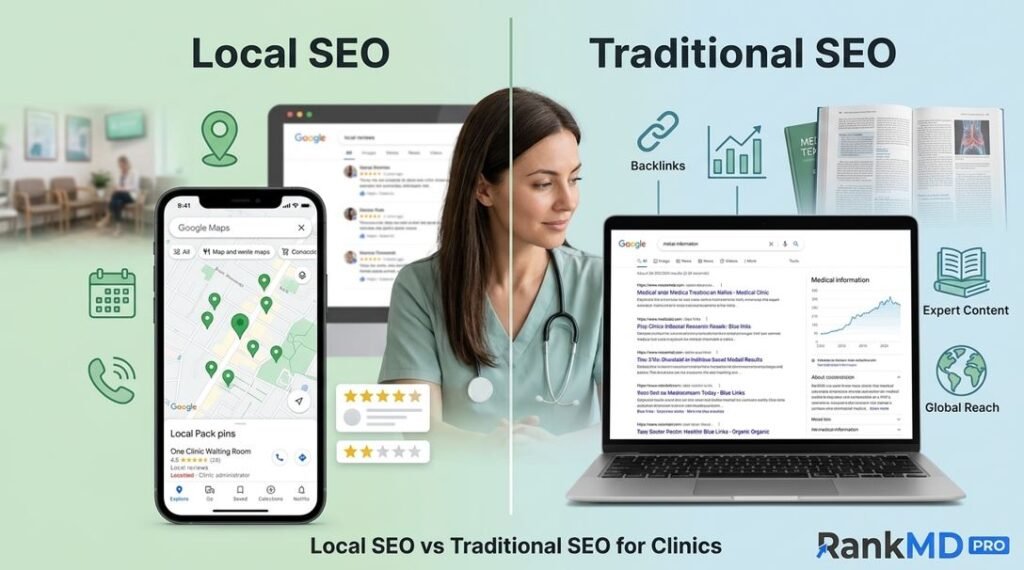
If your medical practice is not appearing in Google’s Map Pack, the problem is rarely solved by simply adding more keywords to your website. Local visibility depends on how well Google can connect your practice, services, location, reputation, and website with the searcher’s query.
For example, a practice may have a verified Google Business Profile and still fail to appear when someone searches “cardiologist near me” or “urgent care in [city].”
Google states that local results are primarily influenced by relevance, distance, and prominence. Complete business information, reviews, website signals, and other sources of business information can all contribute to how Google understands and displays a local business.
So if your medical practice not showing in the Google Map Pack, the first step is finding out which local ranking signal is limiting your visibility.
Why Isn’t My Medical Practice in the Google Map Pack?
A medical practice may not appear in the Google Map Pack because its Business Profile is incomplete, its services don’t closely match the search query, the practice is outside the searcher’s relevant proximity, competitors have stronger local prominence, or the website and profile provide weak supporting signals. Google does not guarantee Map Pack placement, and paying for higher local rankings is not an option.
1. Your Google Business Profile May Not Clearly Represent Your Practice
Start with the profile itself.
Google uses information from your Business Profile as well as other sources to understand a local business. Your profile should accurately communicate what your practice is, where it operates, and what patients can expect there.
Check:
- Primary business category
- Practice name
- Physical address
- Phone number
- Website
- Hours
- Services
- Business description
- Photos
- Reviews
If critical information is missing or inaccurate, Google has less reliable information to match your practice with relevant searches.
For a medical practice, this is particularly important because “family medicine,” “urgent care,” “psychiatry,” “dermatology,” and “cardiology” represent different search intents.
Your profile needs to accurately represent the actual practice—not simply contain as many healthcare keywords as possible.
2. Your Primary Category May Not Match What Patients Search For
Your Google Business Profile category is not a field to fill with every service you offer.
A primary care practice, for example, shouldn’t try to make its category represent cardiology, pediatrics, urgent care, physical therapy, and every other service mentioned on its website.
Google specifically advises businesses to use categories that accurately represent the business rather than treating categories as keyword fields.
If your practice category doesn’t accurately reflect your core business, review it against:
What is the practice?
What service do patients primarily seek from it?
How do comparable practices categorize themselves?
The answer should come from the actual business not from whichever keyword has the highest search volume.
3. Your Practice May Be Too Far From the Searcher
This is one of the most important realities of Google Maps SEO.
You cannot expect one medical office to rank equally across an entire metropolitan area.
Google’s local ranking system considers distance between the searcher and the business. If the searcher doesn’t specify a location, Google estimates their location using available signals.
That means your practice could:
Rank #1 from one neighborhood
but
not appear in the Map Pack from another part of the city.
This is not necessarily a technical SEO failure.
Test your important searches from multiple legitimate locations around your service area instead of checking only from the practice’s office.
For example, compare:
- “orthopedic surgeon near me”
- “orthopedic surgeon [city]”
- “knee specialist [neighborhood]”
- “sports medicine doctor [city]”
Different queries and search locations can produce different local results.
4. Your Competitors Have Stronger Local Prominence
Two medical practices can offer similar services and be located within the same area, yet one can consistently appear above the other.
One reason is prominence.
Google explains that prominence reflects how well-known a business is and can be influenced by information across the web, including links and reviews. Review count and review score can also contribute to local ranking.
Look beyond your star rating.
Compare your practice with the competitors appearing in the Map Pack:
- Number of reviews
- Review quality
- Review recency
- Website authority
- Local mentions
- Relevant backlinks
- Practice information across the web
- Organic search visibility
Don’t respond by buying reviews or creating artificial listings.
Build prominence through legitimate patient feedback, relevant healthcare references, authoritative content, and genuine local recognition.
5. Your Website Isn’t Supporting the Google Business Profile
Your Google Business Profile and website should not operate as separate SEO projects.
Google can use publicly available website information when compiling information about businesses and local search results.
If your profile represents a cardiology practice in one location but the website barely explains:
- Cardiology services
- Conditions treated
- Provider expertise
- Practice location
- Appointment information
then the website is providing limited context around the local listing.
A stronger connection looks like:
Google Business Profile → Location Page → Specialty Page → Provider Information → Appointment Path
The website doesn’t need to repeat the same city keyword dozens of times.
It needs to provide accurate, useful information that reinforces what the practice actually does and where it operates.
6. Your Location Information May Be Inconsistent
Check your practice information across:
- Google Business Profile
- Website
- Healthcare directories
- Professional associations
- Local directories
- Social profiles
- Medical listing platforms
Look for discrepancies in:
Practice name
Address
Suite number
Phone number
Website
Hours
Google says business information can come from multiple sources, including websites, third-party data, users, and business owners.
That makes accuracy important.
If one directory lists an old office address while another lists a new one, review the discrepancy rather than assuming Google will automatically interpret which information is correct.
7. Your Practice May Have a Service-Area Problem
A common mistake is creating a Google Business Profile for every city a practice wants to target.
That’s not how local SEO should work.
If your medical practice has one physical location in Tampa, you cannot create separate Google Business Profiles simply because you want to rank in Orlando, Clearwater, Sarasota, and other cities.
Google’s guidelines require businesses to represent their real-world location accurately and prohibit inappropriate location setups such as virtual offices that don’t meet its eligibility requirements.
Instead, use your actual location and build legitimate website content around the communities you genuinely serve.
8. Your Reviews May Not Reflect Your Actual Patient Experience
Reviews matter for both patients and local visibility.
But the objective shouldn’t be:
“Get as many five-star reviews as possible.”
A stronger approach is to create a legitimate process that makes it easy for patients to provide feedback after receiving care.
Your practice should also respond appropriately to reviews while protecting patient privacy.
Avoid revealing protected health information in responses, even when a reviewer mentions personal medical details.
The review profile should reflect genuine patient experiences—not scripted or manufactured testimonials.
Google itself recommends responding to reviews and notes that positive ratings and reviews can help local ranking.
9. Your Google Business Profile May Be Verified but Still Not Competitive
Verification doesn’t mean automatic Map Pack visibility.
Google states that verification helps establish that you’re authorized to represent the business, but local ranking still depends on relevance, distance, and prominence.
Think of verification as establishing eligibility to manage the profile—not as a ranking shortcut.
If your profile is verified but invisible for important searches, examine:
Query relevance
Searcher’s location
Competitor prominence
Website relevance
Reviews
Practice information
Local authority
This gives you a much more useful diagnosis than simply asking whether the profile is “verified.”
10. You’re Checking Rankings From Only One Location
This creates misleading reports.
Suppose your office is in downtown Chicago.
You search:
“dermatologist near me.”
Your practice appears.
You conclude that your Map Pack SEO is working.
A prospective patient 12 miles away performs the same search and sees three completely different practices.
Google’s local results are location-sensitive because distance is part of its ranking system.
For healthcare practices, local rank tracking should therefore evaluate meaningful geographic areas rather than relying on one search performed from the office.
11. Your Service Pages Don’t Match the Searches You Want to Rank For
Your Google Business Profile might say:
Medical Clinic
while your website targets:
Cardiology
and patients search:
“cardiologist near me.”
That mismatch creates a relevance problem.
If cardiology is a major service, your website should provide a genuinely useful cardiology section explaining:
- Cardiology services
- Conditions treated
- Providers
- Office location
- Relevant patient information
- Appointment process
Likewise, a physical therapy practice targeting sports injury rehabilitation needs content that actually addresses that service rather than relying on a generic “healthcare services” page.
12. Keyword Stuffing Can Make Your Profile Worse, Not Better
Adding:
“Best Cardiologist in Miami | Cardiologist Near Me | Miami Cardiologist | Top Cardiologist”
to your business name is not a legitimate local SEO strategy.
Google’s guidelines require businesses to represent themselves as they are recognized in the real world and prohibit adding unnecessary information to the business name.
Use the actual practice name.
Put relevant service and location information in the appropriate fields and website content.
Local SEO works better when the underlying business information is accurate than when every available field is treated as a keyword placement opportunity.
How to Diagnose a Medical Practice Not Showing in the Google Map Pack
If your medical practice not showing in the Google Map Pack, use this checklist before changing everything at once.
Step 1: Check Profile Eligibility
Confirm that the practice has a legitimate, eligible physical location and an appropriately verified Business Profile.
Step 2: Check the Primary Category
Make sure it accurately represents the core practice.
Step 3: Test Multiple Queries
Search for:
- Practice name
- Core specialty
- Core service
- Specialty + city
- Service + city
- Service + “near me”
Step 4: Test Multiple Locations
Check results from relevant neighborhoods and communities—not just beside your office.
Step 5: Compare the Three Map Pack Competitors
Record:
- Categories
- Reviews
- Website quality
- Services
- Location
- Local mentions
- Organic rankings
Step 6: Audit Your Website
Make sure the website clearly supports the services, providers, and location represented by your profile.
Step 7: Audit Local Citations
Find outdated addresses, phone numbers, duplicate listings, and inconsistent practice information.
Step 8: Review Your Reputation
Look at review volume, quality, recency, responses, and whether the review-generation process is legitimate.
What Actually Helps a Medical Practice Improve Map Pack Visibility?
| Problem | Practical Response |
| Incomplete profile | Complete accurate business information |
| Wrong category | Select the category that accurately represents the practice |
| Weak service relevance | Improve relevant service and specialty pages |
| Limited local prominence | Earn legitimate reviews, links, and local mentions |
| Inconsistent information | Correct outdated business details |
| Poor location relevance | Focus on the actual practice location and legitimate service area |
| Weak website support | Build useful location, provider, and service content |
| No visibility outside the office area | Analyze geographic ranking patterns rather than expecting universal rankings |
There is no legitimate method to pay Google for a better organic Map Pack position. Google explicitly states that businesses cannot request or pay for better local ranking.
Frequently Asked Questions
Why is my medical practice not showing on Google Maps?
Check your Business Profile verification, category, address, business information, service relevance, reviews, website support, and geographic proximity. Local visibility also depends on how your practice compares with competing businesses.
How long does it take to rank in the Google Map Pack?
There is no fixed timeframe. Local ranking depends on relevance, distance, prominence, competition, and the quality and consistency of available business information. Google does not provide a guaranteed ranking timeline.
Does getting more Google reviews guarantee Map Pack rankings?
No. Reviews are one local ranking signal, not a guarantee. Google considers relevance, distance, and prominence together.
Should I add keywords to my Google Business Profile name?
No, unless those words are genuinely part of the practice’s real-world name. Google requires businesses to represent themselves accurately and does not permit unnecessary information in the business name.
Why do I rank on Google Maps sometimes but disappear at other times?
Local results can change based on the searcher’s location and query. A practice may appear for one neighborhood or search phrase but not another because distance and relevance affect local results.
Can my medical practice rank in multiple cities?
Your website can target legitimate service areas, but your Google Business Profile should represent an eligible real-world location. Don’t create fake or virtual locations simply to obtain additional Map Pack listings.
Your Google Maps Problem May Not Be a Google Business Profile Problem
If your medical practice not showing in the Google Map Pack, don’t start by stuffing more keywords into your profile.
Find the actual limitation.
Is Google unclear about your specialty?
Is your practice too far from the searcher?
Do competitors have substantially stronger prominence?
Is your website providing enough evidence about your services and location?
Are your business details inconsistent?
Are you measuring rankings from only one location?
Those questions produce a much more useful local SEO diagnosis.
RankMD Pro can audit the Google Business Profile, local competitors, website architecture, service pages, location signals, reviews, citations, and organic search presence to identify the factors limiting a medical practice’s local visibility.
If your practice is missing from the Map Pack for searches that matter to your business, start with a local SEO audit that identifies the specific ranking gaps not a generic list of SEO recommendations.
Get Your Healthcare Local SEO Audit →