A medical practice cannot force Google AI Overviews or ChatGPT to mention its website. What it can control is whether search systems can identify the practice, understand its services, verify its expertise, connect it to a location, and access its content.
For healthcare organizations, the strongest foundation combines technical accessibility, medically trustworthy content, local search signals, provider information, structured data, and a clear relationship between practice → specialty → service → provider → location.
Google says its AI search experiences rely on the same fundamental principles as traditional Search: accessible pages, useful content, and strong page experience. Google also recommends creating unique content that satisfies users rather than content created specifically to manipulate AI search features.
How Can a Medical Practice Appear in Google AI Overviews and ChatGPT?
To improve AI-search visibility, make your practice information easy to verify and retrieve. Publish authoritative specialty and service pages, identify qualified providers, answer specific patient questions, strengthen local SEO, use accurate structured data, connect related pages through internal links, and ensure search crawlers can access your website. No schema, keyword, or GEO tactic guarantees an AI citation.
1. Build a Clear Medical Entity Around Your Practice
AI search needs to distinguish your practice from thousands of other healthcare websites.
Your website should consistently connect:
Practice → Specialty → Provider → Service → Location
For example:
ABC Cardiology
→ Cardiology
→ Dr. Jane Smith, MD
→ Arrhythmia Care
→ Chicago, Illinois
If these relationships are scattered across disconnected pages, search systems have less context for understanding what your organization actually provides.
Your practice’s About, provider, specialty, service, and location pages should therefore use consistent factual information.
RankMD Pro’s healthcare SEO strategy is built around specialty-specific search intent rather than generic SEO campaigns. Its site specifically describes healthcare-focused SEO, local search, authority building, and technical SEO as core services.
2. Make Physician Expertise Verifiable
For medical content, don’t rely on phrases such as:
“Our trusted experts provide exceptional care.”
Identify the actual expertise.
A physician profile can include:
- Full name
- Degree and credentials
- Specialty
- Clinical focus
- Relevant certifications
- Professional affiliations
- Practice location
- Services provided
Medical articles should also identify authors or qualified reviewers when appropriate.
For example:
Medical reviewer: Dr. [Name], MD
Specialty: Cardiology
Clinical focus: [Actual specialty]
Only publish credentials and affiliations that can be verified.
Google’s guidance recommends making it clear who created content and providing appropriate author information. This is particularly relevant for healthcare content because health information falls within topics where trust and expertise matter substantially.
3. Answer Specific Patient Questions Instead of Publishing Generic Blogs
A medical practice trying to appear in AI search should identify questions that patients actually ask.
Examples:
- What does a cardiologist treat?
- When should I see a cardiologist?
- What does a pain management doctor do?
- What should I expect during my first psychiatric appointment?
- Which doctor treats chronic back pain?
- What services does this medical practice provide?
- Does this clinic treat [condition]?
- Where can I find [specialist] in [city]?
Answer the question directly.
Example
What does a pain management doctor treat?
A pain management physician evaluates and treats acute and chronic pain using appropriate diagnostic, medication, interventional, rehabilitative, or multidisciplinary approaches based on the patient’s condition.
Then provide the supporting information.
This answer-first structure is useful for both patients and search systems because the primary answer is immediately identifiable.
4. Build Separate Pages for Different Search Intent
Don’t create five pages simply because five keyword variations exist.
For example:
- Best cardiologist
- Top cardiologist
- Expert cardiologist
- Leading cardiologist
- Professional cardiologist
These may all represent essentially the same intent.
Instead, create pages with distinct purposes:
Cardiology Services
Explains the services the practice actually provides.
Cardiologist Provider Page
Explains who provides the care.
Arrhythmia Treatment
Addresses a specific condition/service.
Cardiology Location Page
Provides legitimate location-specific information.
What Does a Cardiologist Treat?
Answers a patient education question.
This architecture creates meaningful topical relationships instead of keyword-swapped pages.
RankMD Pro’s own healthcare strategy emphasizes high-intent semantic targeting and content structures built around specialty-specific patient searches.
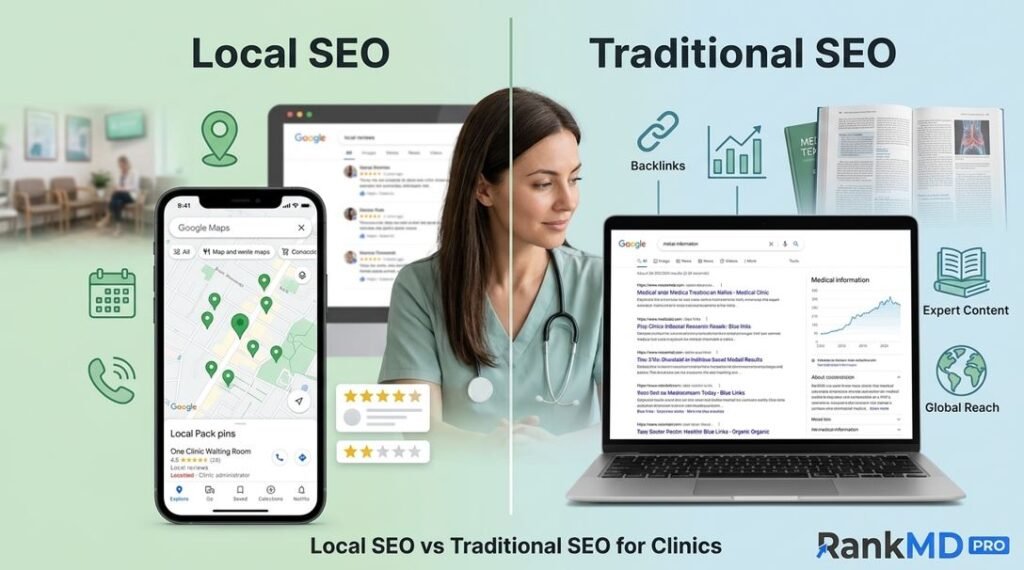
5. Strengthen Your Local Search Signals
A patient asking:
“Who is a cardiologist near me?”
needs more than a nationally optimized cardiology article.
Your website should establish where the practice actually operates.
For legitimate locations, provide:
- Practice name
- Physical address
- Phone number
- Services available
- Providers practicing there
- Office hours
- Appointment information
- Location-specific details
For multi-location practices, each location should have a genuine reason to exist.
Don’t publish:
“Our cardiology practice proudly serves Miami.”
and then replace “Miami” with Tampa, Orlando, Jacksonville, and Fort Lauderdale.
That creates location pages without meaningful local information.
RankMD Pro specifically offers Local Search & Maps Dominance, including Google Business Profile and local-signal optimization.
6. Optimize Your Google Business Profile
Website content alone doesn’t establish the complete local presence of a medical practice.
Review your Google Business Profile for:
- Correct business category
- Accurate address
- Phone number
- Website
- Hours
- Services
- Photos
- Reviews
- Location consistency
Google says local search visibility is influenced by factors including relevance, distance, and prominence.
The website and Google Business Profile should describe the same legitimate practice.
Don’t add specialties, services, or locations that the practice does not actually provide.
For healthcare organizations competing in local search, RankMD Pro identifies Google Maps visibility and local signals as part of its patient-acquisition strategy.
7. Check Whether ChatGPT Can Crawl Your Website
If you want your content to be discoverable through ChatGPT Search, check whether your site permits OAI-SearchBot.
Review:
robots.txt
and verify that important public pages aren’t unnecessarily blocked.
Also check:
- noindex
- Canonical tags
- HTTP status codes
- JavaScript-rendered content
- XML sitemap
- Internal links
- Login restrictions
Allowing OAI-SearchBot does not guarantee that ChatGPT will cite your website.
It simply removes a technical obstacle to discovery.
The same principle applies to Google: if important pages cannot be crawled or indexed properly, improving the copy won’t solve the underlying visibility problem.
8. Use Structured Data to Clarify Your Medical Organization
Structured data can help search engines interpret information about entities represented on a page.
Depending on the website, relevant structured data may include:
- Physician
- MedicalClinic
- LocalBusiness
- Organization
- Article
- Breadcrumb
The markup must accurately represent information visible on the page.
Don’t add structured data simply because a schema type contains a desirable keyword.
For example, don’t mark a practice as providing a service that isn’t actually offered.
RankMD Pro specifically includes advanced schema markup and technical SEO within its healthcare SEO approach.
9. Create Medical Content With Evidence and Attribution
AI systems can encounter thousands of healthcare pages making the same unsupported claims.
Avoid:
- “Best doctor in the city”
- “Leading healthcare provider”
- “Number-one clinic”
- “World-class treatment”
unless there is legitimate evidence supporting the claim and the wording is appropriate.
Instead, provide factual information:
Physician: Dr. [Name], MD
Specialty: [Specialty]
Services: [Actual services]
Location: [Actual location]
For educational content, use appropriate authoritative references when making clinical claims.
A medical article explaining treatment, symptoms, risks, or diagnostic information should be held to a higher editorial standard than a generic marketing page.
RankMD Pro describes its content strategy as building healthcare-focused topical authority and clinically reviewed content hubs.
10. Connect Your Medical Content Into Topic Clusters
A single service page rarely provides enough context to establish an entire specialty.
For example, a psychiatry website could structure content around:
Psychiatry Services
→ Psychiatrist Provider Pages
→ Anxiety Treatment
→ Depression Treatment
→ ADHD Evaluation
→ Medication Management
→ Therapy Services
→ Psychiatry Location Pages
→ Patient FAQs
Each page should serve a distinct purpose and link to related resources.
This gives users a logical route through the website and establishes relationships between the practice’s services, specialties, conditions, providers, and locations.
RankMD Pro’s current service model specifically promotes content fortresses and topical authority rather than isolated blog publishing.
11. Build External Authority Around the Practice
Your website shouldn’t be the only place where the practice’s expertise exists.
Relevant authority signals can include legitimate:
- Medical organization profiles
- Professional associations
- Hospital affiliations
- Physician profiles
- Academic references
- Healthcare publications
- Local healthcare organizations
- Professional directories
The objective isn’t to manufacture backlinks.
It is to make the practice’s professional identity consistent across credible sources.
RankMD Pro’s broader approach includes authority building as one component of its healthcare growth system.
How to Optimize a Medical Practice for AI Search
Use this implementation sequence:
1. Audit Existing Visibility
Identify which specialty, service, provider, and location queries already generate impressions.
2. Map Search Intent
Assign each important query to the correct page type.
3. Strengthen Entity Information
Connect the practice, providers, specialties, services, and locations.
4. Improve Medical E-E-A-T
Add legitimate authorship, credentials, medical review, sourcing, and factual practice information.
5. Build Topic Clusters
Connect service, condition, provider, specialty, and location content.
6. Strengthen Local SEO
Optimize the website and Google Business Profile around actual locations.
7. Fix Technical Accessibility
Check Googlebot and OAI-SearchBot access, indexing, canonicals, robots.txt, and rendering.
8. Add Appropriate Structured Data
Use accurate schema that represents the visible content.
9. Build Legitimate Authority
Earn relevant mentions and references from credible healthcare and professional sources.
10. Monitor AI Visibility
Track whether your practice is being mentioned or cited for real patient queries.
How Do You Know Whether AI Search Is Finding Your Practice?
Create a fixed set of patient-style queries.
For a cardiology practice in Chicago, for example:
- “Who are the cardiologists in Chicago?”
- “Which cardiologist treats arrhythmia in Chicago?”
- “What cardiology services are available in Chicago?”
- “Where can I find a cardiologist near downtown Chicago?”
- “Which Chicago cardiology clinics treat heart failure?”
Record:
| Query | AI Platform | Practice Mentioned? | Website Cited? | Competitors Cited? |
| Cardiologist Chicago | Yes/No | Yes/No | — | |
| Arrhythmia doctor Chicago | ChatGPT | Yes/No | Yes/No | — |
| Cardiology services Chicago | Perplexity | Yes/No | Yes/No | — |
Repeat the same query set over time rather than judging performance from one AI response.
What Will Not Guarantee AI Visibility?
Don’t sell or implement these as guaranteed shortcuts:
- AI Overview schema
- “ChatGPT ranking tags”
- GEO meta tags
- Keyword stuffing
- Hundreds of AI-generated pages
- Fake physician reviews
- Fake citations
- Manufactured medical credentials
- Guaranteed ChatGPT recommendations
Google’s guidance focuses on useful, original content and strong search fundamentals rather than a special “AI ranking trick.”
Frequently Asked Questions
Can a medical practice appear in ChatGPT Search?
Yes. A publicly accessible medical website can potentially be surfaced in ChatGPT Search. The website must be discoverable and accessible to the relevant search systems, but crawling does not guarantee citation or recommendation.
Can I guarantee that my practice will appear in Google AI Overviews?
No. AI Overview inclusion is determined by Google’s systems and varies by query. SEO can improve eligibility and visibility but cannot guarantee a specific AI citation.
Does healthcare SEO still matter for AI search?
Yes. Technical accessibility, useful content, local relevance, entity information, and authority remain important foundations for AI-search visibility.
Does adding medical schema make ChatGPT recommend my practice?
No. Structured data helps communicate information to search systems but doesn’t guarantee an AI citation.
Should I create a separate page for every patient question?
Only when the question represents a meaningful search intent that deserves its own resource. Creating near-identical pages for every keyword variation can weaken the site’s content architecture.
Is Your Medical Practice Ready for AI Search?
If your practice isn’t appearing when patients ask Google or AI platforms about your specialty, location, or services, start with the evidence that search systems can actually retrieve:
Who are you?
→ Practice and provider identity
What do you provide?
→ Specific medical services
Where do you provide it?
→ Legitimate locations
Why should the information be trusted?
→ Expertise, authorship, sourcing, and professional authority
Can search systems access it?
→ Technical SEO and crawler accessibility
Are the pages connected?
→ Internal linking and topical architecture
RankMD Pro’s healthcare SEO model combines technical SEO, local search, content authority, GEO, and conversion optimization rather than treating AI visibility as a standalone tactic.
Want to identify the AI-search gaps on your medical website? Get a free healthcare SEO audit from RankMD Pro.