If your Medical Practice Website Not Ranking on Google, publishing more blog posts is not necessarily the answer.
A website can have dozens of pages and still struggle to appear when prospective patients search for services, conditions, specialists, or providers in their area. The problem may be technical SEO, weak search intent alignment, poor local signals, thin specialty content, insufficient authority, weak internal linking, or a website that does not clearly demonstrate expertise and trust.
For healthcare organizations, the stakes are even higher. Medical content falls within Google’s YMYL (Your Money or Your Life) category, where Google says its systems place greater emphasis on signals aligned with strong E-E-A-T experience, expertise, authoritativeness, and trustworthiness.
So, if you are searching “why is my medical practice not ranking?”, “why is my doctor website not ranking?”, or “why isn’t my medical website showing on Google?”, start with these 12 problems.
1. Your Website Is Targeting the Wrong Search Intent
One of the most common medical SEO problems is targeting keywords without understanding what the searcher actually wants.
For example, someone searching:
- “cardiologist near me”
- “cardiology practice in Dallas”
- “heart failure treatment”
- “cardiologist accepting new patients”
has a different intent for each query.
A generic “About Our Cardiology Practice” page is unlikely to satisfy all four.
Your website should have dedicated pages for important services, conditions, specialties, and locations. A strong healthcare SEO strategy maps each page to a specific search intent instead of forcing every keyword onto the homepage.
This also helps Google understand what your practice actually offers and which searches each page should satisfy.
2. Your Medical Service Pages Are Too Thin
A medical practice cannot expect a 300-word service page to compete consistently against established healthcare websites with comprehensive, useful resources.
If your practice offers:
- Primary care
- Cardiology
- Orthopedics
- Urgent care
- Dermatology
- Mental health
- Women’s health
each important service should have enough useful information to answer the questions patients actually have.
That does not mean adding unnecessary words simply to reach a target word count. Google specifically says there is no preferred word count and recommends people-first content rather than content created primarily to manipulate rankings.
Instead, strengthen pages with relevant information, provider expertise, treatment context, FAQs, locations, appointment information, and appropriate supporting resources.
3. Your Content Doesn’t Demonstrate Medical E-E-A-T
Healthcare SEO is not simply about inserting “doctor,” “clinic,” and location keywords into a page.
Patients and search systems need reasons to trust the information.
Your website should make it clear:
Who created the content?
Show qualified authors, medical reviewers, providers, or subject-matter experts where appropriate.
What expertise supports it?
Include provider credentials, specialties, professional experience, and relevant qualifications.
Why should patients trust the organization?
Make your practice information, affiliations, locations, contact details, policies, and reputation easy to verify.
Google’s guidance specifically recommends making authorship clear and emphasizing who created content, how it was created, and why it exists. It also notes that stronger E-E-A-T is particularly important for topics affecting health and well-being.
For a medical website, E-E-A-T should be built into the entire site, not added as a small paragraph at the bottom of a blog post.
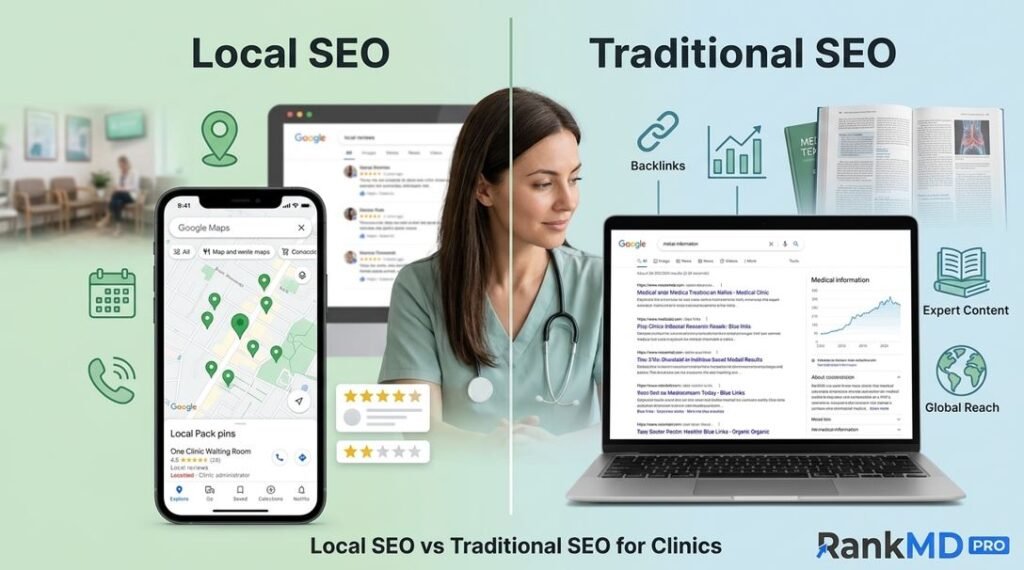
4. Your Website Has No Strong Local SEO Foundation
A medical practice usually depends heavily on local visibility.
If patients search for:
“urgent care near me”
or
“pediatrician in Phoenix”
your website needs more than a city name in the footer.
Your local SEO strategy should connect your:
Google Business Profile + website + location pages + service pages + reviews + relevant third-party mentions + internal links.
Google states that local results are primarily influenced by relevance, distance, and prominence. Complete and accurate Business Profile information can help Google understand how relevant a business is to searches.
This means a medical practice should not treat its Google Business Profile as a separate marketing activity. Local SEO and website SEO should work together.
5. Your Google Business Profile Is Weak or Incomplete
Your website might be technically strong but still struggle in local search if your Google Business Profile is poorly managed.
Check whether your profile has:
- Correct practice name
- Accurate address
- Correct phone number
- Current hours
- Appropriate primary category
- Relevant services
- Updated photos
- Complete business information
- Genuine patient reviews
- Responses to reviews
Google says complete and accurate Business Profile information helps businesses appear for relevant local searches, while local visibility is also influenced by relevance, distance, and prominence.
Do not expect profile optimization alone to solve every ranking problem. Your website and wider online presence also contribute to local relevance and prominence.
6. Your Location Pages Are Weak or Duplicated
Multi-location practices often create pages such as:
/locations/dallas/
/locations/austin/
/locations/houston/
and then copy the same content while changing the city name.
That is not a strong local SEO strategy.
Each location page should provide genuinely useful information about that location, including relevant services, providers, address, appointment information, local patient needs, and unique supporting content.
The objective isn’t to create hundreds of nearly identical pages.
The objective is to make each location page genuinely useful to someone searching for healthcare in that specific area.
7. Your Internal Linking Is Not Building Topical Authority
A common mistake is publishing dozens of medical blogs without connecting them strategically.
Imagine a cardiology practice publishes:
- What Is High Blood Pressure?
- Signs of Heart Disease
- What Causes Chest Pain?
- When Should You See a Cardiologist?
- Heart Disease Risk Factors
But none of these articles links naturally to the cardiology service page.
You have created content, but you haven’t created a content system.
A better structure is:
Cardiology Service Page
↓
Heart Disease
↓
Chest Pain
↓
Hypertension
↓
Heart Failure
↓
Diagnostic Testing
These supporting pages can then link back to the main specialty/service page where appropriate.
This creates a deeper topical cluster and helps users and search engines understand the relationship between your content.
8. You’re Publishing Blogs Instead of Building Specialty Content
One of the biggest mistakes in healthcare SEO is believing that more blog posts automatically equal more rankings.
They don’t.
A medical website needs a combination of:
Commercial pages
→ Services
→ Treatments
→ Specialties
→ Locations
Informational pages
→ Conditions
→ Symptoms
→ Treatment questions
→ Patient education
Authority content
→ Provider expertise
→ Medical reviews
→ Credentials
→ Research-informed resources
This creates a specialty content ecosystem instead of a random collection of blog posts.
For example, an orthopedic practice could build a cluster around knee pain:
Knee Pain Treatment
→ Knee Pain Causes
→ ACL Injury
→ Meniscus Tear
→ Arthritis
→ Knee Replacement
→ Physical Therapy
→ When to See an Orthopedic Specialist
That structure gives the practice opportunities to rank across different stages of the patient search journey.
9. Your Website Has Technical SEO Problems
Sometimes the content is good but Google cannot properly access, understand, or index it.
Common issues include:
- Pages blocked from crawling
- Incorrect noindex directives
- Broken internal links
- Poor URL structures
- Duplicate pages
- Incorrect canonical tags
- Missing or outdated XML sitemap
- Redirect chains
- Slow-loading pages
- Mobile usability problems
- Indexing inconsistencies
Google notes that relatively few technical requirements are necessary for a page to qualify for Search, but following Search Essentials and making content accessible to search engines remain important foundations.
A technical SEO audit should therefore happen before assuming that publishing more content will fix the problem.
10. Your Competitors Have Stronger Authority
Sometimes your website is not doing everything wrong.
Your competitors may simply have stronger signals.
Look at the websites ranking above you.
Compare:
- Domain authority and referring domains
- Relevant backlinks
- Content depth
- Provider expertise
- Reviews
- Local visibility
- Service coverage
- Location coverage
- Internal linking
- Brand mentions
- Content quality
The important question isn’t:
“How many backlinks does my competitor have?”
Ask:
“What evidence of expertise, relevance, authority, and trust does the competitor have that my website lacks?”
That produces a much more actionable SEO strategy.
11. Your Website Doesn’t Convert Ranking Traffic Into Patients
Ranking is not the final objective.
Imagine your website ranks for:
“urgent care near me.”
A patient lands on the page but cannot immediately find:
- Phone number
- Location
- Hours
- Appointment option
- Services
- Insurance information
- Directions
The SEO campaign may generate visibility, but the website fails to convert that visibility into patient action.
Healthcare SEO should therefore connect search visibility with conversion optimization.
Your important pages should make the next step obvious.
Depending on the practice, that may be:
Call Now → Book Appointment → Request Appointment → Get Directions → Contact Practice
This is where healthcare SEO becomes patient acquisition rather than simply a ranking exercise.
12. You’re Not Optimizing for AI Search
Google is no longer the only search environment where patients can discover healthcare information.
Patients increasingly encounter information through AI-powered search experiences and conversational systems.
That creates a new opportunity: Generative Engine Optimization (GEO).
The goal isn’t to stuff content with phrases like “ChatGPT” or “AI search.”
Instead, create content that is:
- Clear
- Authoritative
- Well structured
- Supported by credible information
- Easy to understand
- Specific to the practice
- Consistent across the web
- Connected to identifiable experts
Strong E-E-A-T matters here because healthcare information requires a higher level of trust.
The foundation remains the same: create useful, reliable, people-first content. Google explicitly recommends original, comprehensive content that demonstrates real expertise rather than content created primarily to capture search traffic.
What Should You Do If Your Medical Practice Isn’t Ranking?
Don’t immediately order 50 new blog posts.
Start with a healthcare SEO audit.
Evaluate your website across five layers:
1. Technical SEO
Check indexing, crawling, redirects, canonicalization, sitemap, mobile experience, performance, and internal links.
2. Search Intent
Determine whether every important service, specialty, condition, and location has the right page targeting the right intent.
3. Local SEO
Review your Google Business Profile, location pages, reviews, local relevance, citations, and website signals. Google confirms that relevance, distance, and prominence are central to local ranking.
4. E-E-A-T
Make expertise, authorship, credentials, medical review, organizational information, and trust signals visible throughout the website.
5. Content Architecture
Build interconnected topical clusters instead of publishing unrelated articles.
This is where commercial SEO and content strategy should meet.
A strong healthcare SEO campaign doesn’t simply ask:
“What keyword should we target?”
It asks:
“What does a patient search before choosing this practice, and what does Google need to see before trusting this website as a useful result?”
Build a Medical SEO Strategy That Goes Beyond Rankings
If your Medical Practice Website Not Ranking on Google, the solution may not be one isolated SEO tactic.
Your practice may need a combination of technical SEO, local SEO, specialty content, E-E-A-T, internal linking, competitor analysis, conversion optimization, and AI-search visibility.
That is why a healthcare SEO audit should examine the entire search ecosystem rather than only checking keyword positions.
At RankMD Pro, the opportunity is to approach SEO as a patient-acquisition system: identify why a medical website is underperforming, uncover the gaps preventing visibility, build authoritative specialty and location content, strengthen local search signals, and connect organic visibility with patient actions.
If your website is not ranking for the services and locations that matter to your practice, start with an audit before investing in more content.
Find the problem first. Then build the SEO strategy around what your practice actually needs.
Frequently Asked Questions
Why is my medical practice website not ranking on Google?
Common causes include weak search intent targeting, thin service content, technical indexing problems, weak local SEO, limited authority, poor internal linking, and insufficient E-E-A-T signals.
Why is my doctor website not showing on Google?
First check whether important pages are indexed and technically accessible. Then evaluate content quality, search intent, local relevance, authority, and competition.
How long does medical SEO take to improve rankings?
There is no universal timeline. Results depend on competition, website condition, authority, content quality, location, and the amount of SEO work required.
Can a Google Business Profile improve medical practice visibility?
Yes, particularly for local searches. Google says local results are primarily influenced by relevance, distance, and prominence, with complete Business Profile information helping Google understand the business.
Should a medical practice publish more blog posts if it isn’t ranking?
Not necessarily. First identify the underlying problem. Improving important service, specialty, location, technical, authority, and conversion pages may be more valuable than simply increasing blog volume.
Final Thoughts
A medical website that isn’t ranking usually needs a diagnosis, not more random content. A comprehensive healthcare SEO audit can reveal whether the real bottleneck is technical SEO, local visibility, content depth, E-E-A-T, topical authority, competition, or conversion and that diagnosis should determine what gets fixed first.