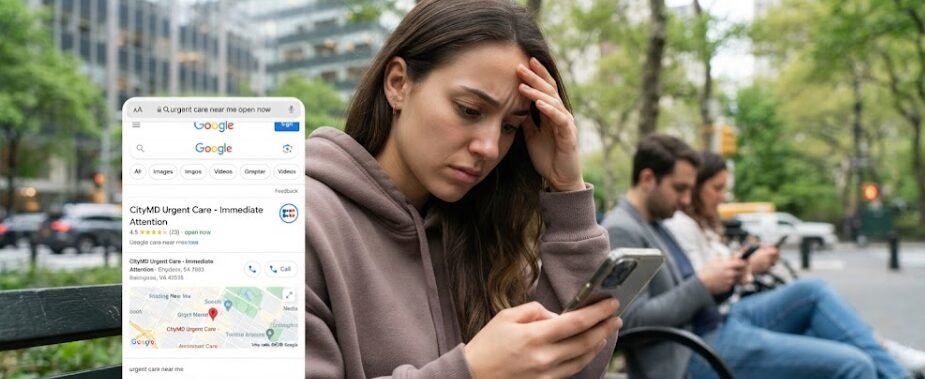
When patients need urgent medical attention, they require fast solutions. Someone might experience a sudden high fever, a persistent cough, an unexpected injury, or require a rapid diagnostic test. During these stressful moments, individuals immediately reach for their mobile phones and search for terms like urgent care near me, walk-in clinic near me, urgent care open now, and urgent care near me open today. This consumer behavior proves why executing a powerful digital growth framework through Rank MD Pro is critical for modern medical clinics. This article highlights that mobile search patterns vary across markets, meaning clinics should review their own analytics to understand traffic behavior.
Why Mobile Search Matters for Urgent Care
Urgent care searches are intensely local. A patient might look up services from home, a workplace parking lot, or while traveling in a car, making their mobile device the closest and fastest gateway to help. Patients expect instant details, such as operating hours, exact location, walk-in availability, contact numbers, and specific services. To capture these high-intent local patients, clinics rely heavily on specialized urgent care SEO services to secure top map and mobile visibility.
10 Key Mobile-First SEO Tips for Urgent Care Clinics
1. Use a Responsive Website
Your clinic’s digital platform must adapt fluidly to any screen size. A fully responsive design ensures seamless performance whether a patient visits via a smartphone, tablet, laptop, or desktop computer. Implementing a mobile-optimized framework backed by medical SEO strategies guarantees that mobile visitors never encounter broken layouts or frustrating navigation errors.
2. Make Your Phone Number Easy to Tap
Urgent care patients frequently want to call a clinic immediately to check wait times. Never hide your contact details; instead, place your phone number near the top of every mobile page with a tap-to-call button labeled “Call Now”. Utilizing targeted healthcare search engine optimization practices ensures your primary conversion elements turn search traffic into active phone calls efficiently.
3. Add Clear “Get Directions” Buttons
Geographic proximity drives emergency and walk-in choices. Your mobile pages must immediately present the clinic address, nearby landmarks, service coverage zones, parking instructions, interactive maps, and straightforward driving directions. Partnering with experts in local SEO for urgent care helps ensure these critical location cues appear prominently on small screens.
4. Improve Mobile Page Speed
Speed dictates user retention because slow-loading pages cause frustrated patients to bounce before seeing your medical info. Heavy images and excessive scripts ruin mobile performance. To fix this, compress image sizes, adopt modern file formats, remove unused code, limit heavy scripts, and utilize browser caching while tracking metrics through professional urgent care digital marketing audits.
5. Keep the Main Information Above the Fold
Mobile visitors refuse to scroll through long introductory paragraphs when they need immediate medical assistance. Place core details right at the top of the screen, including current operational hours, walk-in status, click-to-call buttons, driving directions, and instant service links. Structuring layout hierarchy properly is a cornerstone of effective medical website optimization.
6. Use Short and Simple Content
Mobile users scan text rather than reading dense blocks of information. Utilize brief paragraphs, short sentences, clean headings, and bullet points to outline treatments for issues like colds, flu, fevers, cuts, sprains, allergies, and sore throats. Delivering easily digestible medical copy is a core component of expert urgent care content marketing.
7. Target “Near Me” Searches
Local search terms dominate mobile healthcare queries. Patients constantly type phrases such as urgent care near me, walk-in clinic near me, urgent care open now, and location-specific queries like urgent care near Las Vegas. Integrating these location-based modifiers through a robust local search optimization campaign ensures your clinic captures high-intent traffic.
8. Optimize Your Google Business Profile
Your website represents only part of your local visibility puzzle; your Google Business Profile requires equal attention. Keep your business name, physical address, phone number, operating hours, website link, service list, photos, and patient reviews entirely up to date. Managing these local assets is streamlined when working with a specialized medical practice growth agency.
9. Make Forms Easy to Use
While intake or contact forms are valuable, overly complex mobile forms cause users to abandon the page. Keep fields minimal, use large input boxes with clear labels, and design tap-friendly buttons that streamline mobile interactions. Streamlining user experience forms is an essential part of modern healthcare web design and SEO.
10. Make Every Important Page Mobile-Friendly
Do not limit your optimization efforts strictly to your homepage. Every vital section including urgent care landing pages, service directories, location pages, contact hubs, insurance information, appointment portals, FAQ pages, and blog posts must function perfectly on mobile devices. Comprehensive site audits via professional healthcare SEO experts ensure complete cross-page mobile compatibility.
Mobile SEO Elements That Matter Most
| Mobile SEO Element | Why It Matters | What to Do |
| Page speed | Patients want fast answers | Compress images and reduce code |
| Phone button | Patients may want to call | Add a tap-to-call button |
| Directions | Patients need your location | Add a map and directions |
| Simple menu | Helps users find pages | Keep navigation short |
| Readable text | Makes content easy to scan | Use large, clear text |
| Fast forms | Saves patient time | Reduce fields |
| Local keywords | Helps local search | Target real service areas |
| Google profile | Supports local visibility | Keep details current |
| Reviews | Build patient trust | Ask for honest reviews |
| Mobile content | Supports search and users | Keep key content on mobile |
Use Clear Calls to Action
Every major page needs a definitive next step for the user. Common urgent care calls to action include Call Now, Get Directions, Book a Visit, View Services, and Check Hours. Avoid cluttering pages with competing buttons; instead, feature the most practical conversions like Call Now and Get Directions. Implementing clean conversion paths is a standard practice recommended by leading urgent care marketing specialists.
Mobile SEO and Local Keywords
Your keyword targeting must reflect true patient search intent by moving beyond broad terms to incorporate specific local and service modifiers. For example, instead of relying solely on the broad term “urgent care”, target high-intent phrases like “urgent care in Las Vegas”, “urgent care near me is open now”, “flu treatment in Las Vegas”, “sports injury urgent care”, “pediatric urgent care”, “walk-in clinic”, “rapid testing”, and “minor injury treatment”. Structuring keyword maps accurately is a core strength of advanced medical keyword optimization.
Why Mobile-First SEO Is the Future of Urgent Care Marketing
Patients increasingly rely on digital tools to find clinics, compare medical services, check operating hours, read reviews, find directions, and initiate phone calls. Because Google’s mobile-first indexing evaluates the mobile edition of a website for rankings, mobile SEO functions as an absolute necessity rather than a mere design choice. The best-performing medical websites focus on speed, clarity, tap-friendly design, and immediate utility. Clinics looking to dominate digital acquisition can leverage proven frameworks from Rank MD Pro to build sustainable search dominance.
Final Thoughts
Mobile search has completely revolutionized how patients discover and select urgent care clinics. Because mobile phones represent the first point of contact, mobile optimization forms the bedrock of local healthcare marketing. A high-performing mobile web presence drives clinic discovery, service education, phone calls, and foot traffic. Start with the fundamentals by optimizing site speed, streamlining menus, clarifying copy, adding sharp calls to action, and maintaining accurate local listings. Clinics seeking professional assistance can explore specialized services at Rank MD Pro to elevate their search performance.
Frequently Asked Questions:
1. Does Google use mobile content for ranking?
Yes, Google utilizes the mobile version of a website’s content for primary indexing and ranking under its mobile-first indexing protocol.
2. Does page speed matter for mobile SEO?
Yes, fast-loading pages create a superior user experience, and Google explicitly advises site owners to maintain fast, mobile-friendly web architecture.
3. Should urgent care websites have location pages?
Yes, when a medical organization operates across multiple distinct areas, individual location pages provide unique and valuable local information.
4. Should urgent care blogs be mobile-friendly?
Yes, health-related blog articles attract users searching for medical guidance, and they must remain easily readable across small mobile screens.
5. What is the main goal of mobile-first urgent care SEO?
The primary objective is helping patients discover accurate urgent care information swiftly and complete their next healthcare step with absolute ease.