Online reviews play a vital role for modern urgent care clinics. Patients frequently examine reviews before selecting a medical provider because they want fast, safe, and compassionate treatment. A strong online reputation builds immediate trust while enhancing local search visibility. Because Google evaluates numerous signals to rank local businesses, patient feedback acts as a critical piece of the local search puzzle. Consequently, medical clinics should incorporate proactive urgent care SEO services to stand out and convert searchers into patients. This article explores how reputation management works and how reviews influence local rankings and patient growth.
What Is Reputation Management?
Reputation management involves actively monitoring and improving how your clinic is perceived online. This ongoing practice encompasses:
-
Securing regular patient reviews
-
Responding professionally to feedback
-
Resolving poor patient experiences
-
Monitoring digital mentions
-
Ensuring business information remains accurate
-
Handling negative comments with care
-
Building trust through valuable content
Patients also discover your clinic across multiple digital platforms, including Yelp, Healthgrades, Facebook, Bing, Apple Maps, healthcare directories, and local community websites. Implementing comprehensive medical SEO strategies ensures your practice maintains a positive presence across all these channels.
Why Reviews Matter for Urgent Care Clinics
Choosing an urgent care facility is often a rapid decision made during stressful moments. A person searching for immediate help might be dealing with a fever, sore throat, cut, sprain, rash, bad cough, minor burn, flu symptoms, or food poisoning. Searching via mobile devices, patients frequently compare multiple nearby clinics before deciding where to go, making positive reviews a decisive factor in their choice. Utilizing professional healthcare search engine optimization helps ensure your clinic appears prominently during these high-intent moments.
Do Reviews Affect Local Rankings?
Yes, customer reviews directly impact local search performance, though they are not the sole ranking factor. Google assesses a wide array of signals to determine map placement, including relevance, physical distance, business information accuracy, website quality, Google Business Profile details, reviews, inbound links, local signals, and overall user activity. Google has explicitly confirmed that review count and star score influence local rankings, making feedback a core element of any successful local SEO for urgent care campaign.
Reviews and Local Urgent Care SEO: The Connection
Reviews support local urgent care search optimization in several powerful ways. First, they establish authentic trust with prospective patients. Second, they improve your appeal and click-through rates within competitive search engine results pages. Third, they provide compelling reasons for a user to choose your facility over competitors. Finally, review text naturally incorporates service and location keywords. For instance, when a patient writes, “The urgent care team in Las Vegas was fast and friendly,” they provide valuable contextual signals that reinforce your authority through expert urgent care digital marketing efforts.
Star Ratings Can Patient Choices
Star ratings are instantly noticeable and shape immediate consumer perceptions. A high rating creates a strong first impression, whereas a lower score introduces doubt.
| Clinic | Rating | Reviews | First Impression |
| Clinic A | 4.8 | 850 | Very strong |
| Clinic B | 4.4 | 300 | Strong |
| Clinic C | 3.7 | 190 | Mixed |
| Clinic D | 2.9 | 80 | Weak |
Maintaining strong ratings through consistent medical website optimization ensures your practice always puts its best foot forward.
Review Count Matters Too
A clinic with a high volume of reviews appears much more established and reliable than a competitor with only a handful of ratings. For example, a profile with 4.9 stars across 8 reviews looks far less proven than one with 4.8 stars across 850 reviews. A steady, organic influx of real reviews signals to algorithms and patients alike that your practice is active and trusted, which aligns with robust urgent care content marketing and branding goals.
Respond to Positive Reviews
Positive feedback deserves a prompt, appreciative response. Your reply does not need to be lengthy; keeping it warm and simple works best. A standard response might look like: “Thank you for your kind review. We are glad our team could help.” This demonstrates that your clinic values patient opinions, leaving a lasting positive impression on future visitors who browse your profile while evaluating local search optimization results.
Respond to Negative Reviews
Encountering negative reviews can be discouraging, but reacting with anger, blaming the patient, or disclosing private health information will severely damage your brand. Instead, remain calm, professional, and empathetic. An appropriate response should state: “We are sorry to hear about your experience. We take patient feedback seriously. Please contact our office so we can learn more and help.” Always remember that public responses are read by prospective patients, so write every reply with your broader audience in mind, supported by guidance from a professional medical practice growth agency.
Never Argue With Patients Online
Entering into an online argument will only harm your clinic’s professional reputation. Even if you believe the patient is mistaken, never write dismissive phrases like “You are lying,” “That never happened,” “You did not follow our instructions,” or “You were rude to our staff.” Maintaining composure protects your brand integrity as part of a disciplined healthcare web design and SEO strategy.
Turn Feedback Into Better Care
Reputation management extends far beyond crafting polite online replies. Reviews serve as a diagnostic tool that highlights what patients love and what requires operational improvement. Look for recurring themes in patient feedback. Common praises include fast check-ins, friendly staff, short wait times, clean facilities, helpful physicians, and easy scheduling. Conversely, complaints often center around long delays, billing confusion, poor communication, hard-to-navigate websites, unclear pricing, or staff behavior. Addressing these operational insights enhances overall care quality through insights gathered via healthcare SEO experts.
Create a Simple Review Process
| Step | Action | Goal |
| 1. Give good care | Create an exceptional patient experience | Build a strong foundation |
| 2. Ask for feedback | Learn directly from patients | Identify areas for growth |
| 3. Make requests easy | Streamline the review submission process | Increase response rates |
| 4. Monitor reviews | Track incoming feedback across platforms | Stay updated on public sentiment |
| 5. Reply to reviews | Show engagement and care | Build community trust |
| 6. Fix common issues | Resolve recurring operational bottlenecks | Improve patient satisfaction |
| 7. Track results | Measure progress over time | Optimize marketing ROI |
Structuring this workflow effectively complements broader urgent care marketing specialists campaigns.
Ask for Reviews the Right Way
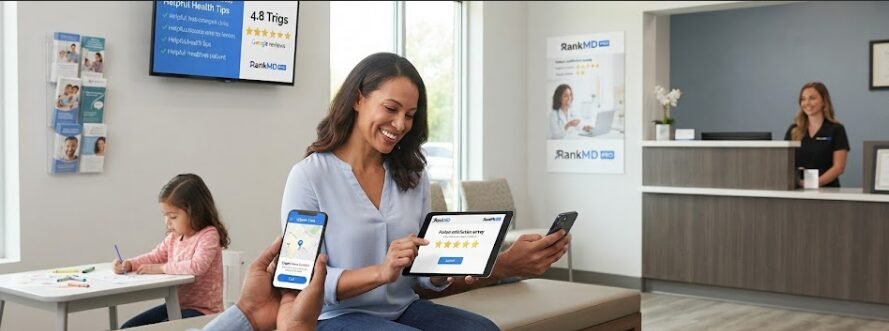
The most effective review requests are polite, direct, and timed appropriately right after a visit. You can send requests via text message, email, secure patient portals, or automated follow-up messages using phrasing such as: “Thank you for visiting us today. If you have a moment, we would appreciate your honest feedback.” Implementing ethical collection methods ensures compliance with digital growth standards promoted through medical keyword optimization.
Do Not Buy Reviews
Purchasing fake reviews is a dangerous practice that can permanently ruin your clinic’s reputation and trigger algorithmic penalties. Clinics should build their online standing strictly through authentic patient experiences, which provide genuine praise alongside actionable clinical feedback supported by expert oversight from Rank MD Pro.
Do Not Review-Gate
Review-gating involves filtering unhappy patients away from public review platforms by directing them to private feedback forms while prompting only happy patients to leave public ratings. This deceptive practice violates platform guidelines and damages long-term credibility. A transparent approach asks all patients for honest feedback and lets them decide where to share their experiences, reinforcing the ethical foundation of professional urgent care SEO services.
Make Your Google Business Profile Strong
Reviews represent only one component of a fully optimized Google Business Profile. Your listing must also feature your exact clinic name, precise physical address, correct phone number, accurate operating hours, direct website link, comprehensive service list, real photos, updated appointment details, and holiday hours. Maintaining complete profile accuracy is essential for maximizing visibility through medical SEO strategies.
Add Real Clinic Photos
Visual content helps patients feel comfortable before they even step through your doors. Utilize clear, authentic photographs showcasing your building exterior, reception area, comfortable waiting room, fully equipped exam rooms, exterior signage, friendly staff members, and accessibility features. High-quality imagery enhances user engagement, a key factor emphasized in modern healthcare search engine optimization.
Reputation and Patient Conversion
Reviews do much more than boost local map visibility; they directly influence patient conversion rates. When a prospective patient finds your clinic via search, they evaluate your reviews before deciding to call, visit your website, or walk through your doors. This creates a predictable consumer journey: Search → Reviews → Trust → Click → Call → Visit. A weak reputation disrupts this path instantly, whereas a stellar reputation accelerates it, driven by effective local SEO for urgent care.
Track Reputation Metrics
Clinics must measure their reputation performance consistently by tracking core metrics each month:
| Metric | Why It Matters |
| Average rating | Reflects overall public sentiment |
| Review count | Demonstrates brand volume and authority |
| New reviews | Indicates active, ongoing engagement |
| Response rate | Shows administrative attentiveness |
| Response time | Measures how quickly your team acts |
| Negative review themes | Highlights recurring operational problems |
| Google profile actions | Measures direct patient interest and intent |
| Calls | Quantifies local conversion success |
| Website visits | Tracks overall digital interest |
Monitoring these KPIs ensures continuous improvement across all urgent care digital marketing initiatives.
Final Thoughts
Reputation management is an indispensable component of modern urgent care marketing. While reviews build vital patient trust and support local search visibility, they do not serve as an instant shortcut to the top of Google. Sustainable success requires a comprehensive local SEO framework. Clinics seeking expert guidance to elevate their digital presence and reputation can explore specialized services at Rank MD Pro.
Frequently Asked Questions (FAQs)
1. Does a 5-star rating guarantee better rankings?
No. Google utilizes numerous local ranking signals, and reviews are merely one part of a complex algorithmic evaluation managed through medical website optimization.
2. Can negative reviews hurt my clinic?
They can temporarily impact patient trust, but a few critical reviews do not define your practice. A professional, empathetic response demonstrates that your clinic cares deeply about patient satisfaction, mirroring best practices in urgent care content marketing.
3. Should each urgent care location have separate review tracking?
Yes. Multi-location healthcare providers must track each facility independently to isolate local service issues and capitalize on localized growth opportunities via local search optimization.
4. What should I do after getting a bad review?
Remain calm, investigate the root cause of the complaint professionally, draft a careful public response offering to resolve the matter offline, and use the feedback constructively to improve patient care standards aligned with a medical practice growth agency.
5. Is reputation management part of local SEO?
Yes. Reputation management works hand-in-hand with local SEO to build absolute community trust and elevate your clinic’s overall web presence, as recommended by leading healthcare web design and SEO professionals.