I. Introduction to Medical Spa SEO Pitfalls
Your treatment rooms are fully booked for the clients who already know your name. But what about the hundreds of high-intent patients in Naperville searching for cosmetic procedures tonight on their smartphones?
If your website fails to appear in those local results, you aren’t just losing digital traffic you are losing profitable patient bookings directly to competing med spas.
A. The Unique Competitive Landscape of Aesthetic and Medical Spa Search
Aesthetic and medical spa marketing is vastly different from traditional retail or standard local business search.
Patients searching for cosmetic treatments are looking for high-trust, high-stakes medical procedures. They are scrutinizing your brand’s credibility, visual proof, safety standards, and convenience before they ever decide to fill out a contact form or pick up the phone.
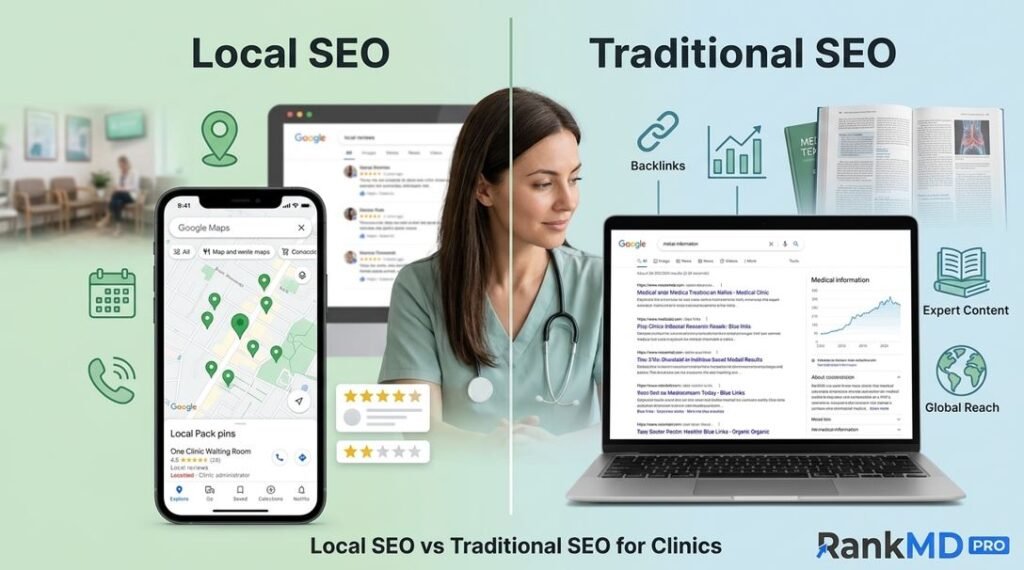
B. Why Standard Local SEO Strategies Fail for Medical Practices
Many general SEO agencies apply cookie-cutter, generic tactics to aesthetic practices. They focus entirely on broad national terms while ignoring the hyper-local nuances of medical search intent.
True AestheticSEO requires a specialized framework that aligns clinical expertise, local map pack positioning, and patient psychology to capture high-converting local demand.
C. The Direct Correlation Between Website Technical/Content Flaws and Lost Appointment Booking
Every second your site takes to load, every broken mobile button, and every thin service page acts as an invisible barrier preventing patient acquisition.
When your website architecture is flawed, prospective patients experience friction, lose confidence instantly, and bounce back to Google to book with a competitor instead.
D. Overview of the Naperville Market Context and High-Stakes Patient Intent
Operating an aesthetic clinic in Naperville, IL means competing in a rapidly growing, image-conscious local economy.
Patients here expect seamless digital experiences, transparent pricing guides, and immediate accessibility. Bridging the gap between technical performance and local intent is the only way to dominate this regional market.
Pro Tip: Fixing foundational structural errors on your domain is the highest ROI marketing investment you can make to lower your patient acquisition cost.
II. Critical Technical SEO Errors Impacting Med Spa Rankings
Technical performance acts as the silent foundation of your entire digital presence. If search engine crawlers cannot easily read your pages, your rankings will stall.
A. Core Web Vitals and Slow-Loading Mobile Booking Widgets
Google’s Core Web Vitals measure real-world user experience metrics like loading speed, visual stability, and interactivity.
If your online booking widget or third-party scheduling software takes more than three seconds to load on a smartphone, prospective patients will abandon your site immediately.
B. Inadequate Mobile Responsiveness and Poor Touch-Target UX on Smartphones
The vast majority of aesthetic searches happen on mobile devices while users are on the go.
- The Problem: Tiny buttons, overlapping text, and unoptimized phone layouts cause high user frustration.
- The Solution: Ensure every button, phone number, and form field has a generous touch target size for effortless mobile navigation.
C. Broken JavaScript Rendering and Indexing Issues for Single-Page Aesthetic Platforms
Many modern med spa websites use heavy JavaScript frameworks that look sleek but hide vital content from search engine crawlers.
If Google cannot crawl your core service text because it is dynamically rendered behind broken scripts, your keyword rankings will plummet.
D. Unoptimized Image Assets (Before/After Galleries Slowing Down Site Speed)
Before-and-after photo galleries are your most powerful conversion tool, but unoptimized high-resolution image files will instantly destroy your site speed.
- Always compress image sizes before uploading.
- Use next-gen formats like WebP.
- Implement lazy loading so images below the fold load only when scrolled into view.
III. On-Page Optimization Failures on Treatment Pages
Your treatment pages must do double-duty: they need to satisfy search engine algorithms while acting as an aggressive, trust-building sales page for prospective patients.
A. Thin Content and Lack of Depth on Core Service Pages (Botox, Fillers, Lasers)
Publishing a generic 150-word paragraph for “Botox” or “Laser Hair Removal” guarantees low search visibility.
Google rewards comprehensive, authoritative content that answers every nuance of a patient’s query including safety, procedural steps, longevity, and candidate suitability.
B. Keyword Cannibalization Across Multiple Aesthetic Procedure Variations
Keyword cannibalization happens when multiple pages on your domain compete for the exact same search terms (e.g., creating five different blog posts targeting “lip filler Naperville” instead of one unified authority page).
This splits your ranking power and confuses search engine crawlers.
C. Missing or Poorly Structured MedicalBusiness and LocalBusiness Schema Markup
Schema markup provides explicit clues about the meaning of a page to search engines.
Implementing proper MedicalBusiness, LocalBusiness, FAQ, and Review schema allows your clinic to capture rich snippets, opening hours, star ratings, and location data directly within search results.
D. Ineffective Meta Titles and Descriptions Failing to Capture Local Click-Through Rates
Your meta tags are your organic ad copy. Writing generic titles like “Home – Aesthetic Clinic” wastes valuable search real estate.
Example of a High-Converting Meta Title:
Botox in Naperville, IL | Board-Certified Injectors | Rank MD Pro
IV. Local SEO Missteps and Google Business Profile Disconnects
For a brick-and-mortar medical spa located at 24117 103rd St Ste L, Naperville, IL 60564, local search visibility is the lifeblood of steady appointment generation.
A. NAP (Name, Address, Phone Number) Inconsistencies Across the Web for the Naperville Location
Even minor discrepancies such as listing “Suite L” on Google but writing “Ste. 12” on directory listings fracture local trust signals.
Audit your business details across the web to ensure absolute uniformity everywhere your clinic is mentioned.
B. Choosing Incorrect or Overly Broad Primary Categories on Google Business Profile
Selecting a generic category like “Health” or “Doctor” will bury your profile in irrelevant competition.
Choose the most precise primary category available, such as “Medical Spa” or “Skin Care Clinic,” followed by relevant secondary categories for specific treatments.
C. Failing to Maintain Active GBP Posting, Q&A, and Direct Scheduling Links
A dormant Google Business Profile signals to search engines that your business may be inactive.
- Publish weekly GBP posts featuring seasonal specials or new aesthetic treatments.
- Populate the Q&A section with real patient inquiries.
- Attach a direct, friction-free booking link directly to your profile.
D. Neglecting Localized Landing Page Optimization for Surrounding Service Areas
If you want to capture patients driving in from neighboring areas like Aurora, Plainfield, or Warrenville, your homepage alone won’t rank for those hyper-local modifiers.
Build dedicated, highly optimized location landing pages tailored to each surrounding community.
V. Content Strategy and E-E-A-T Deficiencies in Aesthetics
Google’s E-E-A-T (Experience, Expertise, Authoritativeness, and Trustworthiness) guidelines are heavily enforced for medical and aesthetic websites because treatments directly impact human health and appearance.
A. Lack of Medical Expert Authorship, Credentials, and Board Certifications on Content
An anonymous blog post about cosmetic injections carries zero medical authority.
- Explicitly display the medical director, board-certified dermatologists, plastic surgeons, or master injectors who author and review your clinical content.
- Link author bios directly to professional credentials and medical board verifications.
B. Ignoring Patient Hesitations (Safety, Downtime, Cost, Real Recovery Timelines)
First-time aesthetic patients are naturally anxious about pain, unnatural results, or hidden costs.
Content that glosses over recovery timelines or hides pricing structures creates immediate distrust. Address these friction points transparently to convert skeptical readers.
C. Overly Promotional Copywriting That Triggers Low Trust and High Bounce Rates
If every sentence on your website screams “Best cheap Botox deals!”, visitors will perceive your clinic as low-end or unsafe.
Balance persuasive marketing copy with educational, patient-first insights that establish genuine clinical authority.
D. Missing Semantic Content Silos (Failing to Cluster Related Aesthetic Treatments Logically)
Organize your website content into clean semantic silos.
Group all injectable treatments under one topical cluster, laser technologies under another, and skin rejuvenation under a third, linking them together logically to build comprehensive topical authority.
VI. Reputation Management and Review Blind Spots
Patient reviews are the modern word-of-mouth. They directly influence local map pack rankings and dictate whether a browsing user chooses your clinic over a competitor.
A. Slow or Non-Existent Response Framework for Patient Reviews (Positive and Negative)
Ignoring reviews signals indifference to prospective patients reading your profile.
- Reply to positive reviews promptly with personalized appreciation.
- Address negative feedback with empathy, professionalism, and an offline contact channel to resolve concerns.
B. Lack of Ethical, Automated Post-Appointment Review Collection Workflows
Relying on manual staff reminders to collect reviews results in inconsistent feedback generation.
Implement an automated, HIPAA-compliant post-appointment SMS or email sequence triggered immediately after a successful treatment while patient satisfaction is at its peak.
C. Failure to Integrate Review and Rating Schema Markup Into Search Results
Adding review schema markup to your website allows aggregate star ratings to display right inside organic Google search snippets, dramatically boosting your click-through rate.
D. Ignoring Secondary Authority Platforms (Yelp, Healthgrades, Local Naperville Directories)
Patients frequently cross-reference medical spas on external third-party networks before booking.
Claim, optimize, and actively monitor profiles on Yelp, Healthgrades, WebMD, and the Naperville Chamber of Commerce directory.
VII. Conversion Rate Optimization (CRO) Bottlenecks
Driving thousands of visitors to your domain is useless if your website fails to convert them into scheduled appointments.
A. Burying Clear Appointment Booking CTAs Below the Fold
Prospective patients should never have to hunt for a way to book a consultation.
Place clear, high-contrast “Book Now” and “Schedule Consultation” call-to-action buttons above the fold on every single service page and mobile screen.
B. Long, High-Friction Mobile Intake Forms Causing High Drop-Off Rates
Demanding a 15-field medical history questionnaire for an initial consultation inquiry will cause prospective patients to abandon the form entirely.
Keep initial intake forms minimal requiring only name, phone number, email, and treatment interest. Collect deeper details later in the booking funnel.
C. Disconnected User Journeys from Organic Search Results to the Final Scheduling Portal
If a user searches for “lip filler cost,” lands on an informational blog post, but finds no direct pathway or link to book a lip filler consultation, the conversion journey breaks down.
Map out seamless internal linking pathways from every blog post directly to corresponding transactional booking pages.
D. Failing to Track Mobile Click-to-Call and Widget Completion Metrics in GA4
Without proper event tracking configured in Google Analytics 4, you are flying blind.
Ensure you accurately measure:
- Mobile click-to-call interactions
- Booking widget completions
- Contact form submissions
VIII. Conclusion and Strategic Remediation Plan
A. Summary of How Compounded SEO Errors Destroy Local Map Pack and Organic Visibility
When technical errors, missing schema markup, unoptimized mobile layouts, and thin content compound over time, Google’s algorithm loses trust in your domain.
The result? Invisible rankings, zero map pack presence, and an empty appointment calendar.
B. Prioritized Roadmap for Fixing Technical, Local, and Content Flaws to Drive Consistent Patient Bookings
Fixing your digital presence requires a structured, multi-phase approach:
- Phase 1 (Technical Audit): Fix mobile site speed, clean up Core Web Vitals, and compress heavy image assets.
- Phase 2 (Local Alignment): Standardize your Naperville NAP data and fully optimize your Google Business Profile.
- Phase 3 (Content & Authority): Expand thin service pages with comprehensive medical insights and E-E-A-T signals.
- Phase 4 (CRO & Conversion): Streamline mobile booking forms and implement clear, frictionless CTAs across all pages.
Ready to transform your med spa’s website into a predictable, 24/7 patient-booking machine? Get in touch with our experts today to audit your medical spa’s digital presence and dominate your local Naperville market.
Frequently Asked Questions
- Q: How long does it take to fix technical SEO issues and see improved med spa rankings?
Technical fixes often yield initial indexing and crawling improvements within weeks, while substantial local map pack and organic booking growth typically compounds consistently over a 3 to 6-month window. - Q: Why are standard SEO strategies ineffective for aesthetic clinics?
Standard agencies lack the expertise to address medical E-E-A-T guidelines, patient trust signals, and high-intent local conversion nuances required specifically for cosmetic and med spa practices. - Q: What is the single most important local SEO factor for a Naperville medical spa?
A fully optimized, verified Google Business Profile combined with consistent NAP data, active posting, and an automated five-star review acquisition workflow is the primary driver of local map pack visibility. - Q: Should each aesthetic treatment have its own dedicated landing page?
Yes. Separate, deep pages for treatments like Botox, dermal fillers, and laser hair removal prevent keyword cannibalization and allow you to precisely target specific patient queries. - Q: How can I improve mobile conversion rates on my clinic’s booking page?
Simplify your intake forms to require only essential contact details, ensure your scheduling widget loads in under three seconds, and place prominent “Book Now” buttons above the fold.