You are spending money every single month trying to fill your urgent care schedule. Maybe it is Google Ads, maybe it is SEO, maybe it is both and you honestly are not sure which one is actually working. This question matters more than ever in 2026 because patient acquisition costs are rising, competition in local healthcare markets is intensifying, and the margin between a full schedule and an empty waiting room often comes down to one decision: where you put your marketing budget. This guide gives you the complete, data-backed answer so you can stop guessing and start growing.
Understanding the Two Channels: What SEO and Google Ads Actually Do
Before comparing them, it is worth being precise about what each channel is doing for your urgent care clinic.
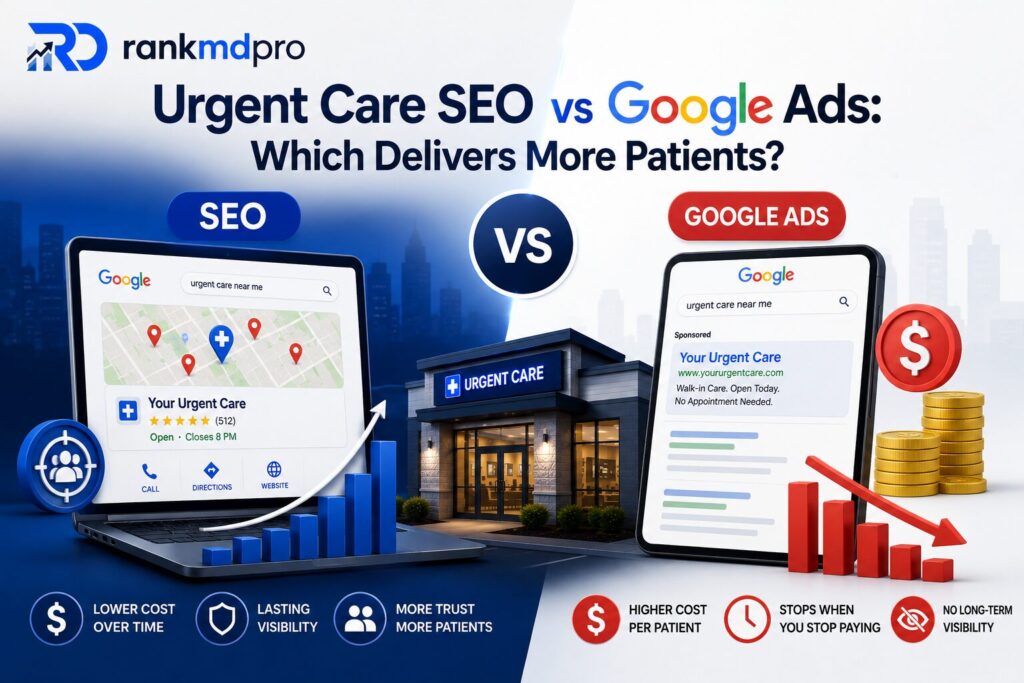
Urgent care SEO is the process of building your clinic’s organic visibility on Google both in the standard blue-link results and in the Google Map Pack so that patients searching for care find your practice without you paying per click. It includes technical website optimization, local citation building, Google Business Profile management, and content authority development.
Google Ads for urgent care is a paid advertising system where your clinic bids on high-intent search terms like “urgent care open now” or “walk-in clinic near me.” You pay each time a user clicks your ad. The moment your budget runs out or your campaigns pause, your visibility disappears.
Both channels reach patients at the moment of need. But they work completely differently in terms of cost structure, timeline, longevity, and return on investment.
The Cost Reality: What You Are Actually Paying Per Patient
This is where most urgent care operators get surprised.
| Channel | Average CPC (Healthcare) | Avg. Conversion Rate | Estimated Cost Per Booked Patient |
|---|---|---|---|
| Google Ads (Urgent Care) | $12 — $28 per click | 4% — 8% | $150 — $700 per patient |
| Organic SEO (6–12 months) | $0 per click | 6% — 14% | $15 — $60 per patient |
| Google Map Pack (SEO) | $0 per click | 8% — 18% | $10 — $40 per patient |
Source: WordStream Healthcare Benchmarks 2025, BrightLocal Local Search Report 2025
The numbers are not subtle. Google Ads in the healthcare vertical carries some of the highest cost-per-click rates in the entire advertising ecosystem. Urgent care keywords compete with hospital systems, national chains like CityMD and MedExpress, and insurance-backed telehealth platforms all bidding aggressively on the same terms.
SEO, by contrast, builds an asset. Once your clinic ranks organically or dominates the Map Pack, each click costs you nothing incrementally. The compounding effect of SEO means that month 12 of your campaign delivers far more value per dollar than month one.
Speed vs Longevity: The Trade-Off Every Practice Must Understand
Google Ads wins on speed. You can be visible on page one for “urgent care near me” within 24 hours of launching a campaign. For a brand-new clinic that needs patients immediately, this matters enormously. Ads bridge the gap between opening day and the point where organic authority matures.
SEO wins on longevity. A well-executed urgent care SEO strategy typically begins delivering meaningful organic traffic between months four and eight. But unlike ads, it does not evaporate when you stop paying. Practices that invested in SEO two years ago are now receiving organic traffic that would cost them $8,000 to $20,000 per month in ad spend to replicate.
| Metric | Google Ads | Urgent Care SEO |
|---|---|---|
| Time to First Visibility | 1–3 days | 3–8 months |
| Monthly Cost (Mid-Size Market) | $3,000–$12,000 | $1,200–$4,000 |
| Visibility When Budget Stops | Immediate loss | Sustained |
| Compounding Returns Over Time | None | High |
| Trust Signal to Patients | Low (marked “Sponsored”) | High (organic credibility) |
| AI Overview & GEO Visibility | No | Yes |
The trust gap is a significant and underappreciated factor. A 2024 study by Edelman found that 72% of healthcare consumers express more trust in organic search results than in paid ads when selecting a medical provider. Patients know what a sponsored tag means and many scroll past it deliberately.
Where Urgent Care Patients Are Actually Clicking in 2026
The search landscape for urgent care has shifted dramatically. In 2026, three placement types dominate patient acquisition from Google:
The Google Map Pack (the top three local results with a map) captures 44% of all local healthcare clicks. This is owned entirely by SEO specifically, Google Business Profile optimization combined with local citation authority and on-site local signals.
AI Overviews (Google’s generative answer summaries at the top of search results) are now appearing for 65% of health-related queries, according to Semrush’s 2025 AI Search Impact Report. These summaries pull from authoritative, well-structured content on healthcare websites not from Google Ads.
Organic blue-link results capture 28% of clicks for local healthcare searches.
Paid ads capture approximately 15% of total clicks in healthcare local search and that number has been declining year over year as AI Overviews and Map Pack results consume more of the above-the-fold real estate.
This means the majority of the patient acquisition opportunity in urgent care local search is now unreachable by paid advertising alone.
The Case for Google Ads in Urgent Care: When Paid Search Makes Sense
Despite the cost premium, there are clear scenarios where Google Ads is the right tool.
New clinic launches need immediate visibility while SEO matures. Running ads for the first six to twelve months of operation is a legitimate bridge strategy as long as you are simultaneously building your organic foundation.
Seasonal demand spikes flu season, back-to-school physicals, summer sports injuries can justify temporary ad spend increases to capture volume that SEO alone may not fully absorb in real time.
High-value service lines like occupational health contracts, pre-employment physicals, or workers’ compensation patients can justify higher CPCs if the lifetime value of the patient relationship is significantly above average.
The mistake most urgent care operators make is treating Google Ads as a permanent growth strategy rather than an accelerant. When practices spend $6,000 per month on ads indefinitely without building organic authority, they are renting visibility rather than owning it and their cost per patient never improves.
What a Properly Executed Urgent Care SEO Strategy Actually Looks Like
The urgent care SEO playbook in 2026 has five core pillars, and all five must work together to produce Map Pack dominance and sustainable patient acquisition growth.
Pillar one is Google Business Profile authority. Your GBP must be fully optimized with the correct primary category, comprehensive service listings, weekly posts, and a review acquisition system that generates consistent five-star feedback from real patients. Profile completeness and review velocity are the two strongest Map Pack ranking signals.
Pillar two is citation consistency. Your clinic’s Name, Address, and Phone number must be identical across Google, Yelp, Healthgrades, Zocdoc, Vitals, WebMD, and all major local directories. A single inconsistency degrades your local authority signal.
Pillar three is on-page local SEO. Your website needs dedicated service pages, location pages with structured data schema, and internal linking that reinforces topical relevance for high-intent urgent care queries.
Pillar four is topical authority content. Google’s Helpful Content system rewards healthcare websites that comprehensively cover their medical specialty. Clinics that publish clinically reviewed content answering the exact questions patients ask before and after a visit build entities and authority signals that compound over time.
Pillar five is AI and GEO optimization. Generative Engine Optimization structuring your content and entity signals to appear in ChatGPT answers, Google AI Overviews, and Perplexity results is no longer optional. In 2026, the practices appearing in AI-generated local health answers are capturing patient attention before Google’s traditional results even load.
The Verdict: Which Channel Delivers More Patients?
For most established urgent care clinics operating in a competitive local market, SEO delivers a higher volume of patients at a significantly lower cost per acquisition over any period longer than six months. The Map Pack alone, when dominated through proper GBP and local SEO management, can generate 40 to 120 patient inquiries per month from zero ad spend.
Google Ads is not the enemy but it is a supplement, not a foundation. The highest-performing urgent care practices in competitive markets use a hybrid approach: ads for immediate volume, SEO for compounding growth. But they budget accordingly, typically allocating 70% of their digital marketing investment toward SEO and 30% toward paid campaigns, rather than the reverse.
The practices that have made paid ads their primary strategy are now paying three to five times more per patient than they were two years ago and their visibility is completely dependent on a monthly payment they cannot stop.
At RankMD Pro, we build patient acquisition systems exclusively for healthcare practices. Our Urgent Care SEO programs are engineered to deliver Map Pack dominance, AI Overview visibility, and compounding organic growth the assets that paid ads simply cannot build. If your current strategy depends too heavily on ad spend, we can show you exactly what a transition to organic authority looks like, timeline included.
Get your free Growth Audit at rankmdpro.com
Frequently Asked Questions
How much should an urgent care clinic spend on Google Ads per month?
For a single-location clinic in a mid-size market, effective Google Ads campaigns typically require $3,000 to $8,000 per month in ad spend to generate meaningful volume. Below that threshold, your budget is often too thin to compete against hospital systems and national chains bidding on the same terms.
Can urgent care SEO work in a highly competitive city like New York or Los Angeles?
Yes, but it requires a more aggressive strategy stronger citation building, higher review velocity, more comprehensive topical content, and often a multi-location GBP approach. RankMD Pro has case studies in top-ten metro markets.
How long before urgent care SEO starts generating patient calls?
Most practices see measurable improvement in GBP visibility and organic traffic within 60 to 90 days of campaign launch. Significant Map Pack ranking gains typically materialize between months four and eight depending on market competitiveness.
Does Google Ads hurt SEO or help it?
Google Ads and SEO operate independently. Running ads does not boost or harm your organic rankings. However, the data from ad campaigns which keywords convert, which services drive the most calls is invaluable for informing your SEO content strategy.
What is the most important factor for urgent care Map Pack rankings?
Review quantity, review recency, and Google Business Profile completeness consistently show the strongest correlation with Map Pack placement in healthcare markets, followed by citation consistency and on-page local SEO signals.
Is telehealth competition affecting urgent care local SEO?
Yes. Telehealth platforms have begun competing for informational urgent care keywords. However, they cannot compete for proximity-based Map Pack queries which is precisely why local SEO and GBP authority are more valuable than ever for physical urgent care locations.