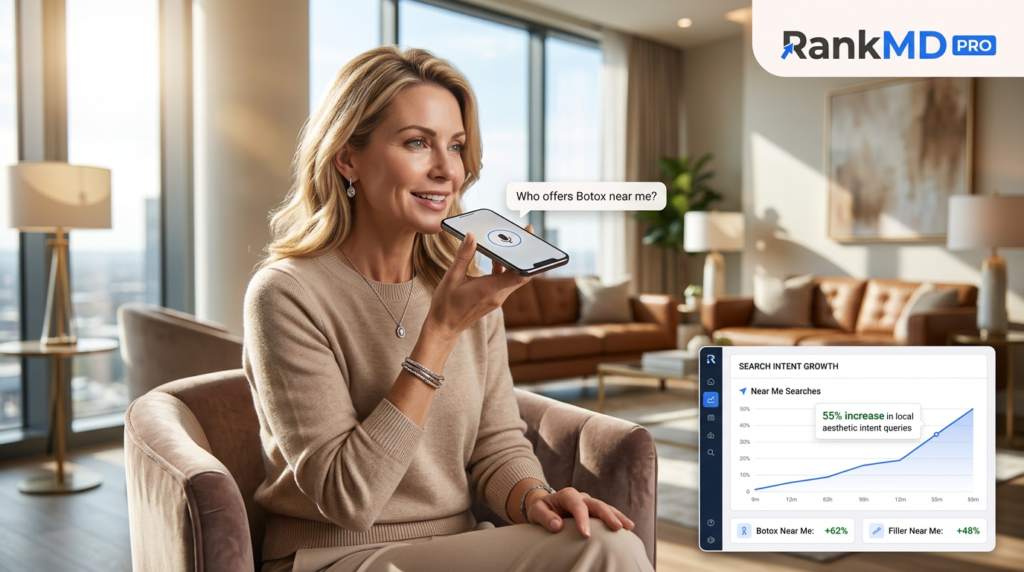
Voice search is now a daily habit. People simply ask their phones questions like, “Who offers Botox near me?” or “Where can I get lip fillers near me?” These spoken queries show strong purchase intent meaning the user is often ready to book a consultation. For aesthetic practices, this presents a massive growth opportunity. A solid voice search strategy helps your clinic stand out when local patients need your services most. This guide explores how to optimize your cosmetic website for voice search while boosting overall medical SEO performance.
Voice Search and “Near Me” Intent
“Near me” searches are fundamentally local queries. Search engines rely on user location to display nearby results. For an aesthetic clinic or medical spa, these queries target specific treatments:
-
Botox near me
-
Lip fillers near me
-
Dermal fillers near me
-
Laser hair removal near me
-
Skin tightening near me
-
Chemical peel near me
-
Med spa near me
-
Cosmetic clinic near me
-
Microneedling near me
Targeting these phrases through specialized aesthetic SEO strategies helps capture high-intent local traffic looking for immediate cosmetic care.
Use Natural Language on Your Website
Voice search mimics everyday spoken conversations, so your website copy should sound natural too. Avoid stuffing pages with awkward keyword strings. Instead, answer questions smoothly. For instance, avoid writing: “Best Botox near me Botox clinic Botox treatment near me.” That sounds robotic and unnatural. Use conversational phrasing instead: “Looking for Botox near you? Our experienced medical team offers personalized cosmetic treatments tailored to your goals.” This approach reads better for patients and aligns with modern search engine algorithms.
Build Pages Around Real Questions
Patients speak in full questions, and your content should directly answer them. Build informative service pages around common patient inquiries to capture featured snippets and voice search rankings:
-
Botox Questions: Where can I get Botox near me? How much does Botox cost? How long does Botox last?
-
Filler Questions: Where can I get lip fillers near me? How long do dermal fillers last? What should I expect after a facial filler procedure?
-
Skin Treatment Questions: Where can I get a chemical peel near me? What does microneedling do for skin texture? How long does laser hair removal take?
Optimize Your Google Business Profile
Your Google Business Profile (GBP) is crucial for local map pack rankings and voice search visibility. It helps Google verify your practice details and supplies patients with instant answers. Ensure your profile features:
-
Correct business name and medical category
-
Accurate address and service area
-
Direct phone number and website link
-
Up-to-date operating hours
-
Comprehensive service details (e.g., medical spa treatments, anti-aging solutions)
-
High-resolution, professional clinic photos
-
Active patient reviews and management responses
Accurate listings ensure voice search assistants can accurately answer queries like, “What aesthetic clinic is open near me right now?”
Keep Your Business Information Consistent
Your core business details must match identically across the entire web. This includes your Name, Address, and Phone number collectively known as NAP data. Consistency across directories, social profiles, and citation sources helps search engines trust your practice data, strengthening your local organic rankings and patient acquisition pipelines.
Create Local Service Pages
Aesthetic clinics offer diverse procedures. Each core offering deserves a dedicated, high-converting landing page optimized for medical SEO:
-
Botox and neuromodulators
-
Dermal and lip fillers
-
Laser hair removal
-
Microneedling and PRP therapy
-
Chemical peels and skin resurfacing
-
Skin tightening and body contouring
When your practice serves multiple regions, develop targeted location pages (e.g., Botox in Las Vegas). Avoid duplicating pages by simply swapping city names; instead, include genuine local context, driving directions, and localized patient reviews.
Add “Near Me” Language Naturally
You do not need to spam the phrase “near me” across every paragraph. Search engines already detect local intent. Instead, integrate natural, location-based variations supported by healthcare digital marketing best practices:
-
Serving patients throughout the local metropolitan area
-
Conveniently located in Las Vegas for easy patient access
-
Advanced aesthetic treatments near surrounding neighborhoods
-
Easily accessible for clients traveling from nearby communities
Make Your Website Mobile-Friendly
Because the vast majority of voice searches happen on smartphones, mobile optimization is non-negotiable. Ensure your digital platform performs flawlessly across all mobile devices:
Improve Page Speed
Site speed directly impacts user retention. If a patient asks a voice assistant for a med spa, clicks your link, and encounters a sluggish page, they will bounce to a competitor. Optimize your performance by compressing large image files, leveraging modern WebP formats, minimizing heavy scripts, cleaning up unused plugins, and utilizing reliable hosting infrastructure.
Add Clear Contact Information
Patients using voice search often exhibit high commercial intent and want immediate answers. Make connecting effortless by placing your phone number, physical address, operating hours, and prominent calls to action such as “Book a Consultation” or “Call Our Clinic” at the top of every page.
Create an FAQ Section
An FAQ section structured with Schema markup is a powerful asset for capturing voice search results. Keep answers concise, starting with a direct response followed by clarifying details:
How much does Botox cost? Botox pricing varies depending on the treatment area and your personalized aesthetic goals. A professional consultation provides an exact treatment plan and cost estimate tailored to your needs.
Use Question-Based Headings
Structure your content using H2 and H3 question headings that mirror natural speech patterns. Replacing generic titles like “Botox Pricing Information” with conversational alternatives like “How Much Does Botox Cost?” or “Where Can I Get Lip Fillers Near Me?” helps search engines match your pages to spoken user queries.
Add Local Keywords
Incorporate targeted keywords naturally throughout your content to signal your geographic relevance to search algorithms:
Use Conversational Content
Write the way your patients speak. Avoid overly dense medical jargon where simple language works better. By answering common aesthetic questions directly and keeping sentence structures concise, you improve user engagement and make your content much more accessible to search crawlers.
Build Trust With Reviews
Patient reviews heavily influence conversion rates in the cosmetic industry. Prospective clients want authentic proof of results before booking an elective procedure. Encourage satisfied patients to share honest feedback on Google and Yelp. Respond professionally to all reviews to demonstrate active patient care and build brand credibility.
Add Location Details
Provide clear geographical context on your contact page to assist both patients and local search algorithms. Include details such as:
-
Nearby neighborhoods and prominent commercial districts
-
Surrounding cities within your service radius
-
On-site parking availability or valet details
-
Specific building names, suite numbers, and major cross-streets
-
Convenient public transit routes and recognizable local landmarks
Use Local Business Schema
Implement Local Business Schema (structured data markup) on your website. This invisible code helps search engines index your business name, physical address, phone number, operational hours, accepted services, and geographic service area accurately, improving local search visibility.
Focus on Search Intent
Not all search queries share the same goal. Tailor your digital strategy across the conversion funnel:
-
Informational Queries (“What is Botox?”) answer foundational questions.
-
Commercial Intent (“How much do lip fillers cost near me?”) compare options and pricing.
-
Action Intent (“Book a med spa consultation near me”) drive direct conversions and appointment bookings.
Track Your Local SEO Results
Continuous performance tracking ensures your aesthetic marketing strategy delivers measurable ROI. Monitor key performance indicators regularly:
Voice search is reshaping how patients discover local aesthetic practices. By making your clinic easy to find, ensuring your practice information is accurate, and partnering with specialized medical marketing experts like RankMD Pro for comprehensive aesthetic SEO services, you can capture high-intent local traffic and turn casual searches into loyal patients.
Frequently Asked Questions
-
Does Google Business Profile help voice search?
Yes. A fully optimized and accurate profile significantly boosts local map pack visibility and supplies voice assistants with verified business details. -
How can I make my website more conversational?
Write the way patients talk. Use simple phrasing, format headings as natural questions, and provide direct, helpful answers. -
What is the best voice search keyword?
There is no single keyword. Focus on the actual spoken questions your local aesthetic patients ask during consultations. -
How do I measure voice search success?
Track local organic traffic, incoming phone calls, online appointment bookings, direction requests, and overall conversion rates. -
Why is “near me” intent important?
It signals immediate local and action-focused intent, meaning the user is actively looking for a clinic to visit or call right away.