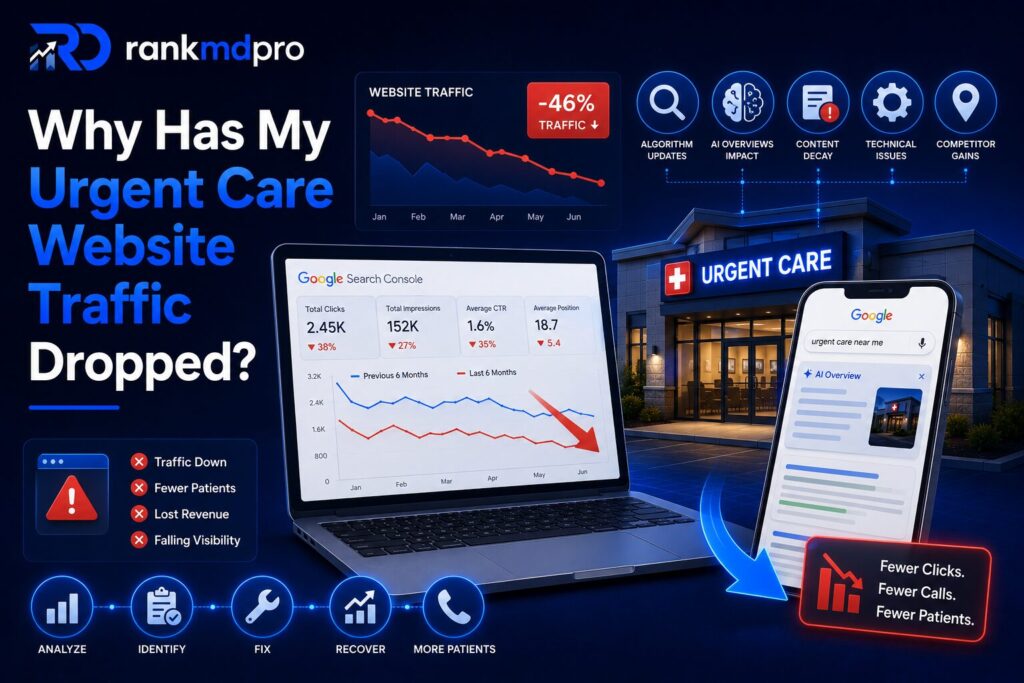
Six months ago your urgent care site was pulling steady organic traffic. Now impressions are down, rankings have slipped, and fewer patients are finding you before choosing a competitor down the street. If you haven’t changed anything on your end, that’s exactly the problem Google has changed plenty.
Traffic drops in 2026 rarely come from one dramatic mistake. They come from a combination of algorithm shifts, AI-driven search behavior, and technical decay that most practices don’t monitor. Here’s how to diagnose exactly what’s happening and fix it before more patients slip to competitors.
Quick Diagnostic: Common Traffic Drop Patterns
| Pattern Observed | Likely Cause | Urgency |
|---|---|---|
| Gradual decline over months | Content decay / competitor gains | Medium |
| Sudden 30%+ drop overnight | Algorithm update or technical issue | High |
| Impressions steady, clicks down | AI Overviews absorbing clicks | High |
| Traffic down, rankings unchanged | Search behavior shift (zero-click) | Medium |
| Specific pages dropped, others stable | Page-level technical or content issue | Medium |
1. Google’s AI Overviews Are Eating Your Clicks
This is the single biggest shift in local healthcare search heading into 2026 and 2027. When someone searches “urgent care near me for a sprained ankle,” Google increasingly answers part of that query directly in an AI Overview before the user ever reaches your listing or website.
Why This Hurts Urgent Care Specifically
Urgent care searches are often symptom-based and informational (“do I need stitches,” “urgent care vs ER for fever“). These exact query types are the ones AI Overviews target first, because they’re answerable without a click.
The Fix
You don’t beat this by writing more content you beat it by structuring content so Google’s AI cites you as the source. That means clear schema markup, direct-answer formatting, and FAQ content written in the same language patients actually search. Sites that get cited inside AI Overviews still capture visibility and trust, even in a lower-click environment.
2. Your Content Has Decayed (And You Didn’t Notice)
Google reassesses freshness and accuracy constantly. A “Flu Season Hours” page from two years ago, an outdated “COVID Testing” post, or old insurance information doesn’t just look stale to patients it signals to Google that your site isn’t actively maintained.
Signs of Content Decay
- Blog posts referencing outdated years, policies, or services
- Pages with declining engagement metrics
- Competitors publishing fresher, more specific content on the same topics
Fix: Audit your top 20 traffic pages quarterly. Update statistics, service details, and internal links rather than letting them sit untouched.
3. A Core Update Hit Your Local Trust Signals
Google’s rolling core and local updates increasingly reward E-E-A-T (Experience, Expertise, Authoritativeness, Trust) for healthcare content (YMYL Your Money or Your Life category). If your site lacks author credentials, medical review bylines, or clear practice information, recent updates may have quietly suppressed you in favor of more clearly credentialed competitors.
What Google Now Expects From Healthcare Sites
- Named, credentialed medical reviewers on clinical content
- Clear practice ownership and licensing information
- Consistent NAP and structured data across the site
4. Technical Decay Is Silently Suppressing Pages
Sites lose traffic technically far more often than owners realize. Slow page speed, broken internal links, duplicate title tags, or an unoptimized mobile experience all compound over time.
Fast Technical Audit
- Run Core Web Vitals mobile load speed under 2.5s is now table stakes
- Check for crawl errors in Search Console
- Confirm no orphaned or duplicate pages competing against each other
5. Local Competitors Are Simply Outpacing You
Sometimes the honest answer is: nothing broke someone else got better. If a nearby urgent care ramped up review velocity, published more location-specific content, or improved their Google Business Profile, they can absorb map pack and organic visibility that used to be yours.
How to Tell
Compare your review velocity, GBP post frequency, and content publishing cadence against your top 3 local competitors. Gaps here directly translate to traffic gaps.
Real Talk: Why Fixing One Issue Rarely Restores Traffic
Most practices chase a single fix a new blog post, a site speed tweak and wonder why traffic doesn’t recover. In 2026, ranking is a system of compounding signals: AI-search structure, content freshness, technical health, and local trust all work together. Fixing one while ignoring the others produces marginal, short-lived gains.
This is exactly the gap we close at RankMD Pro. We run full diagnostic audits for urgent care and healthcare websites combining technical SEO, E-E-A-T content structuring, and Generative Engine Optimization (GEO) so your site doesn’t just rank, it gets cited and clicked in an AI-first search landscape. Practices we’ve worked with have recovered and exceeded prior traffic levels within 90–120 days by fixing the full system, not isolated symptoms.
If your traffic has dropped and you’re not sure why, guessing costs you patients every day the problem goes unaddressed.
Frequently Asked Questions
Why did my traffic drop even though my rankings look the same in Search Console?
This usually indicates AI Overviews or featured snippets are answering queries directly, reducing clicks even when position holds steady.
Can a Google core update really affect an urgent care site specifically?
Yes healthcare falls under YMYL, so core updates disproportionately impact sites lacking strong credentials, trust signals, or medical accuracy.
Should I remove old blog posts that are underperforming?
Rarely delete update and re-optimize first. Deleting pages loses accumulated authority; refreshing usually recovers it faster.
Does site speed really matter that much for local searches?
Yes mobile page speed is a confirmed ranking factor, and urgent care searches are overwhelmingly mobile and urgency-driven.
How do I know if AI Overviews are affecting my urgent care site?
Check Search Console impressions vs. clicks rising impressions with falling click-through rate is a strong signal.
Is it normal for urgent care traffic to be seasonal?
Some seasonality (flu season, allergy season) is normal, but a drop outside expected patterns usually points to a separate cause.
How fast can traffic realistically recover after fixes are made?
Typically 60–120 days, depending on the severity of technical issues and how quickly authority signals are rebuilt.