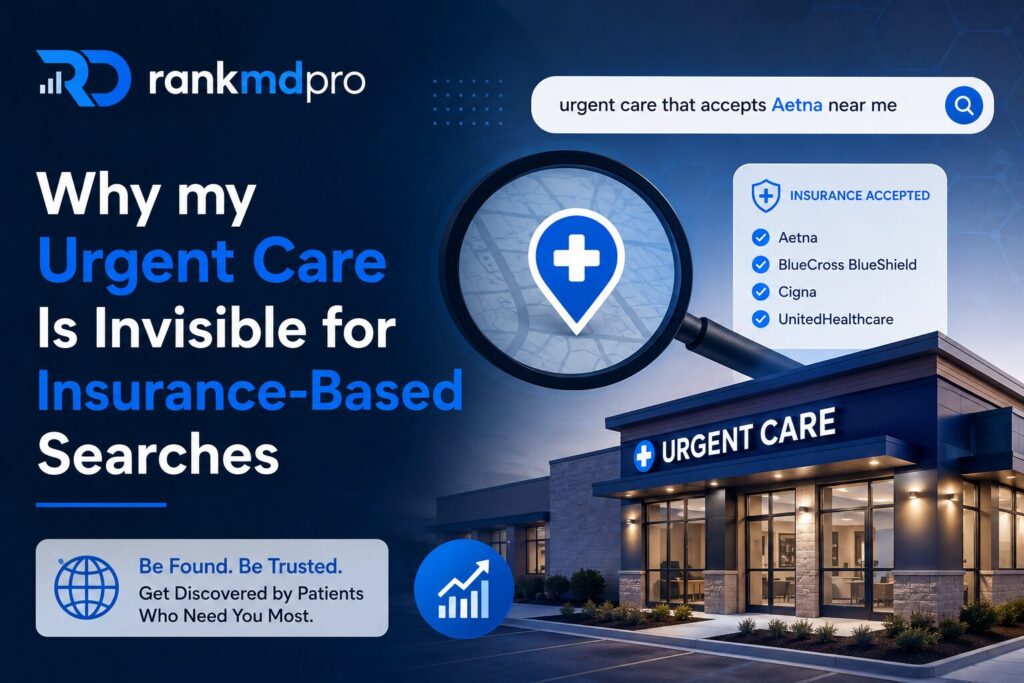
You built your urgent care clinic. You accept most major insurance plans. You have good reviews. Yet when a patient types “urgent care that accepts [insurance name] near me” into Google, your clinic doesn’t appear. Someone else gets that appointment.
This is not a visibility gap. It is a revenue leak and it is happening right now, every single day.
The Insurance-Based Search Problem No One Is Talking About
Most urgent care operators focus their SEO on the obvious keyword: “urgent care near me.” That phrase gets traffic, yes. But the search behavior of real patients in 2026 has evolved dramatically.
Today, a large portion of high-intent urgent care searches are filtered by insurance. Patients are not just looking for any clinic they are looking for a clinic their plan covers, because out-of-network visits can cost 3 to 5 times more.
What patients actually search for:
| Search Query Type | Example | Intent Level |
|---|---|---|
| Generic proximity | “urgent care near me” | Medium |
| Insurance-specific | “urgent care that accepts Aetna near me” | Very High |
| Plan + condition | “walk-in clinic BlueCross strep throat” | Extremely High |
| Provider directory escape | “urgent care not on Cigna directory near me” | High (frustrated patient) |
The third and fourth rows above are where clinics lose the most patients and almost no urgent care website is optimized for them.
Why Google Cannot Find Your Insurance Acceptance Information
Search engines, including Google and AI platforms like ChatGPT and Perplexity, can only surface information they can read and understand. If your insurance information is buried in a PDF, hidden behind a booking widget, or listed only as a phone-call prompt, it does not exist to Google’s crawler.
Here are the five most common reasons your clinic is invisible for insurance-based queries:
1. No dedicated insurance landing page. A single line on your homepage that says “We accept most major insurances” is not indexable content. It contains no semantic signals, no specific insurance names, and no structured data.
2. Missing schema markup. Google’s HealthCareFacility and MedicalBusiness schema allow you to declare accepted insurance plans as structured data. Without it, even well-written content struggles to surface in AI Overviews and featured snippets.
3. No NPI-linked insurance directory presence. Your clinic’s NPI (National Provider Identifier) connects your practice to payer directories. When your NPI records are incomplete or inconsistent, insurance-based local search queries cannot match your profile.
4. Thin Google Business Profile. In 2026, Google’s local algorithm reads your GBP attributes and service descriptions as ranking signals. If your GBP does not list accepted insurance providers in its service or attribute fields, you are missing a primary local ranking signal.
5. Zero content topical authority around insurance topics. If your site has never published a single piece of content addressing insurance acceptance, copays, or in-network care, Google has no basis to consider your site authoritative for those queries.
The Numbers Behind What You Are Losing
The financial impact of this invisibility is significant and measurable.
| Metric | Industry Average |
|---|---|
| % of urgent care patients who check insurance before visiting | 68% |
| Conversion rate: insurance-specific search to appointment | 41% higher than generic search |
| Average urgent care visit revenue | $180 – $320 |
| Estimated monthly visits lost per invisible clinic | 40 – 120 |
| Estimated monthly revenue at risk | $7,200 – $38,400 |
Sources: Advisory Board Healthcare Consumer Survey 2025; MGMA Urgent Care Benchmarking Report 2025.
These are not outlier estimates. A clinic seeing 600 visits per month that captures even 10% more insurance-directed searches adds a meaningful volume of new patient revenue without spending a dollar more on advertising.
How to Make Your Urgent Care Visible for Insurance-Based Searches
Build Dedicated Insurance Acceptance Pages
Each major payer your clinic accepts deserves its own optimized page or a robust section on a master insurance page. The content must include:
- The full legal name of the plan and its common variations (“BlueCross BlueShield” and “BCBS,” for example)
- The specific plan tiers accepted (PPO, HMO, EPO)
- What services are covered under that plan at your clinic
- A clear call to action with your phone number and booking link
This is not stuffing keywords. It is creating genuine, useful information that matches what patients are actively searching for which is precisely what Google’s Helpful Content system rewards in 2026.
Implement Medical Schema for Insurance Data
Your developer or SEO partner should add MedicalBusiness schema with the healthPlanNetworkId and medicalSpecialty properties populated. This is foundational structured data that AI search platforms use to answer “does this clinic accept my insurance” directly in their responses.
When ChatGPT or Google AI Overviews answer an insurance query, they pull from structured data sources first. Clinics without schema are excluded from these answers entirely.
Optimize Your Google Business Profile for Insurance Signals
Go into your GBP today and complete every available attribute. Under “Health and Safety” and “Service Options,” add insurance-related information wherever the platform allows. In your service descriptions, name the conditions you treat and pair them with language like “covered by most PPO plans.”
Review your GBP Q&A section. If patients have asked about insurance there and no one answered, Google treats unanswered questions as negative trust signals. Answer every question.
Fix Your NPI and Payer Directory Listings
Log in to NPPES (the National Plan and Provider Enumeration System) and verify your taxonomy codes and address data are current. Then check your enrollment status directly with your top five payers. Inconsistencies between your NPI record and your payer enrollment records suppress insurance-based search matching.
Publish Insurance-Specific Content That Builds Topical Authority
A recurring content calendar built around insurance topics creates compounding SEO value. Example content clusters that drive insurance-based traffic:
- “Does [Insurance Name] Cover Urgent Care Visits? What You Need to Know”
- “Urgent Care vs. ER Costs with [Insurance Name]”
- “How to Use Your Insurance at an Urgent Care Clinic”
- “What Is My Copay for Urgent Care With [Plan Type]?”
Each of these satisfies a distinct search intent and positions your clinic as the trusted local resource on a question patients genuinely need answered.
The Competitive Advantage That Most Clinics Leave on the Table
The reality is that most urgent care clinics are fighting for the same generic “urgent care near me” keyword while leaving an entire category of high-converting, insurance-specific traffic completely unclaimed.
A patient who searches “urgent care accepts United Healthcare near me” is not browsing. They are ready to go. Their intent is transactional and immediate. Ranking for that query is worth more than ranking for ten generic phrases.
The clinics that invest in insurance-based SEO now are building a durable competitive moat. As Google’s AI continues to shift toward direct answers and GEO (Generative Engine Optimization), the clinics with structured, schema-marked, insurance-specific content will capture the top positions while everyone else competes for what is left.
Is Your Urgent Care Clinic Invisible for Insurance Searches?
If you are not sure where your clinic stands, the fastest way to find out is an SEO audit that specifically examines:
- Your current rankings for insurance-specific local queries
- The completeness of your GBP insurance attributes
- Your schema markup implementation
- Your NPI and payer directory consistency
- Your content coverage of insurance-related topics
RankMD Pro specializes in exactly this kind of diagnostic work for urgent care clinics and medical practices. Our team identifies the specific gaps costing you patient volume and builds the technical and content infrastructure to close them.
Every month you wait is another month your highest-intent patients are booking with a competitor.
Get your free urgent care SEO audit!
Why do insurance-based searches have higher conversion rates than generic searches?
Patients using insurance-specific queries have already made a decision: they want in-network care. They are not comparing options the same way a generic searcher is. The decision friction is lower, so they convert to appointments at a significantly higher rate.
How long does it take to rank for insurance-based keywords?
With dedicated landing pages, proper schema markup, and a GBP update, initial movement can be seen within 30 to 60 days. Full authority for competitive insurance terms in dense markets typically takes 3 to 6 months of consistent effort.
Does adding insurance information to my website violate any HIPAA rules?
No. Publishing general insurance acceptance information is not a HIPAA concern. HIPAA governs protected health information (PHI), which relates to individual patient data not publicly shared insurance participation information.
What if I am in-network with a small or regional insurance plan? Small and regional plans often have far less competition in search results, making them easier to rank for. Creating content around lesser-known regional payers can capture highly targeted traffic with almost no competition.
Can AI tools like ChatGPT or Google AI Overviews surface my insurance information?
Yes but only if it is properly structured. AI search platforms prioritize schema-marked data, GBP attributes, and authoritative content pages when answering insurance-specific queries. Without these, your clinic will not appear in AI-generated answers.
Should every insurance plan get its own page, or can I list them all on one page?
Both approaches work, but the answer depends on your market. In highly competitive metro areas, dedicated pages per major payer outperform consolidated pages. In smaller markets, one well-structured, comprehensive insurance page with strong anchor sections for each plan is typically sufficient.