If you’ve ever searched “med spa near me” from your own clinic’s parking lot and watched a competitor’s name pop up first, you already know the sting. You’re doing great work. Your injectors are skilled, your results speak for themselves, and your patients love you. Yet somehow, a spa with a fraction of your experience is capturing the patients who should be walking through your door.
Here’s the uncomfortable truth: Google doesn’t rank the best medical spa in Naperville. It ranks the medical spa that best proves through data, structure, and content that it is the best. This guide breaks down exactly how that proof is built, section by section, so you can stop losing patients to competitors who simply understand the algorithm better than you do.
By the end of this article, you’ll have a complete, actionable framework for climbing the rankings, dominating the Local Map Pack, and converting that new visibility into a steady stream of booked consultations.
I. Introduction
A. The High-Stakes Landscape of Aesthetics: Why Ranking on Page One Dictates Patient Volume for Naperville Medical Spas
The aesthetics industry is one of the most competitive local verticals in search. Patients researching Botox, filler, or laser treatments rarely scroll past the first five results and almost never make it to page two.
For a Naperville medical spa, this means visibility isn’t a “nice to have” marketing add-on. It’s the primary driver of new patient acquisition. Every position you drop on the results page translates directly into consultations booked with someone else.
The spas winning right now aren’t necessarily the most established or the most talented clinically. They’re the ones who’ve treated SEO as seriously as they treat patient outcomes.
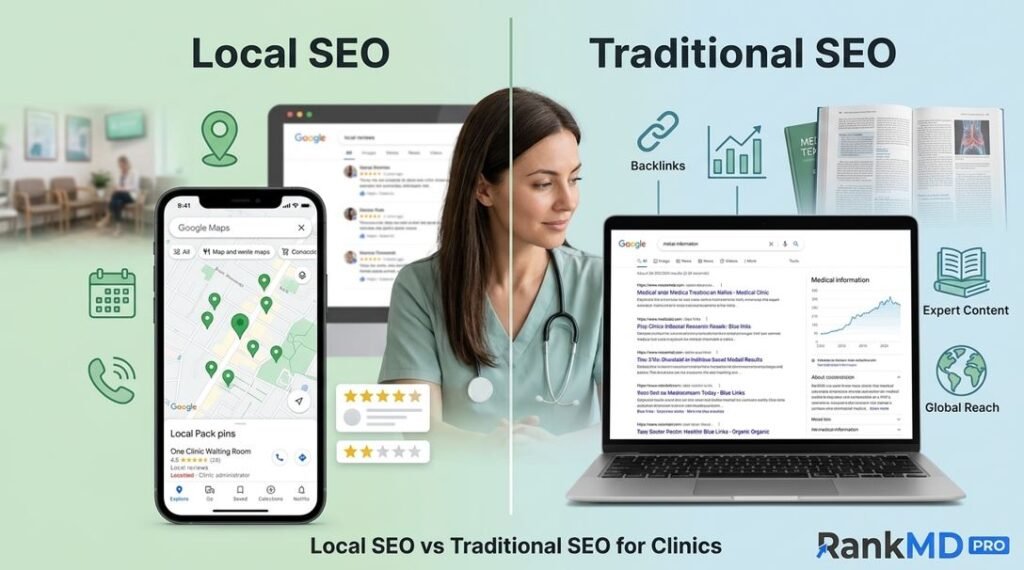
B. The Anatomy of Visibility: Organic Rankings vs. the Local Map Pack
Two distinct battlegrounds determine whether patients find you:
- The Local Map Pack the three business listings shown with a map near the top of local searches, pulled from Google Business Profile data.
- Organic (Blue Link) Rankings the traditional search results below the map, driven by your website’s content, technical health, and authority.
Winning patients consistently requires dominance in both. A spa that only optimizes its Google Business Profile but ignores its website content will plateau. A spa with brilliant content but a neglected profile will lose the map pack where the majority of “near me” clicks actually happen.
C. The Topical Authority Blueprint: How Deep, Interconnected Content Expertise Outranks Generic Competitor Pages
This is where most Naperville med spas fall short. They publish a handful of thin service pages “Botox,” “Filler,” “Laser Hair Removal” each a few hundred words long, and expect to rank.
Google’s algorithm today rewards topical authority: a website that demonstrates comprehensive, interconnected expertise on a subject, not just a page that mentions a keyword. A single “Botox” page competing against a competitor’s fully mapped content ecosystem covering dosage, longevity, aftercare, comparisons, and FAQs is not a fair fight. It’s the difference between a pamphlet and a textbook.
The rest of this guide shows you how to build that textbook.
II. Local SEO Fundamentals: Conquering the Naperville Map Pack
A. Google Business Profile (GBP) Optimization Mastery
Your Google Business Profile is often the very first impression a prospective patient has of your practice before they ever land on your website. Treat it like your digital front desk.
- Accurate NAP Consistency Across Local Directories
Your Name, Address, and Phone number (NAP) must match, character for character, across your website, GBP, and every DuPage and Will County directory listing you appear in (Yelp, Healthgrades, RealSelf, local chamber directories, etc.). Inconsistencies even something as small as “Ste. 200” vs. “Suite 200” quietly erodes the trust signals Google uses to verify your business is legitimate and stable.
Pro tip: Run a citation audit quarterly. Old addresses and outdated phone numbers from a previous location are one of the most common (and most damaging) local SEO mistakes we see.
- Strategic Category Selection
Medical Spa vs. Skin Care Clinic vs. Laser Hair Removal Service these aren’t interchangeable labels. Your primary GBP category should reflect the service that drives the most revenue and search volume, with secondary categories layered underneath.
Choosing the wrong primary category is like opening a bakery and listing it as a “Grocery Store” . You’ll still get some traffic, but you’re actively working against the algorithm’s ability to match you with the right searchers.
- Geotagging and Optimizing Photo/Video Assets
Every image and video you upload to your GBP should be geotagged with your Naperville clinic’s coordinates and named descriptively (e.g., “naperville-morpheus8-results-before-after.jpg” instead of “IMG_4021.jpg”). This reinforces local relevance signals and improves how your listing performs in image-driven local searches.
B. Review Velocity, Quality, and Sentiment Analysis
- Implementing Automated Review Generation Systems Post-Treatment
Review count and recency are two of the strongest local ranking signals Google uses. A steady, natural velocity of new reviews, not a single burst of 50 reviews in one week tells Google your practice is active and consistently trusted.
Set up an automated text or email sequence that triggers 24–48 hours post-treatment, when patient satisfaction is highest and the experience is still fresh.
- Incorporating High-Value Local Keywords Naturally Within Patient Review Responses
When you respond to reviews, you have an SEO opportunity most practices waste with a generic “Thank you!” Instead, naturally reference the treatment and location:
“Thank you, Sarah! We’re so glad your Morpheus8 results exceeded expectations. It’s always a pleasure welcoming Naperville patients into our clinic.”
This reinforces topical and geographic relevance without ever feeling forced or robotic.
C. Proximity and Local Intent Dynamics
- Understanding How User Location Shifts Map Results
Google weighs the searcher’s physical location heavily in local results. A patient searching from downtown Naperville will see a different map pack than one searching from near Route 59 even for the identical query. This is why a single “we’re in Naperville” mention buried on your homepage isn’t enough.
- Creating Dedicated Neighborhood-Targeted Landing Pages
Building unique, valuable landing pages for the surrounding communities you serve Naperville, Warrenville, Lisle, and Aurora allows you to capture proximity-based searches you’d otherwise lose to hyper-local competitors in those areas.
Important: these pages must offer genuinely distinct value (driving directions, neighborhood-specific patient testimonials, local landmarks) rather than a copy-pasted template with the city name swapped out. Google’s algorithms are highly effective at detecting and penalizing thin, duplicated location pages.
III. Topical Authority & Advanced On-Page SEO for Med Spas
A. What Is Topical Authority in Medical Aesthetics?
- Moving Beyond Thin Service Pages to Comprehensive Subject-Matter Clusters
A single page about “Botox in Naperville” tells Google you offer the service. A full content cluster covering how it works, how long it lasts, who’s a candidate, cost ranges, aftercare, and how it compares to alternatives tells Google you are the authority on the service. Only one of these approaches consistently earns top rankings.
- Establishing E-E-A-T for Aesthetic Practitioners and Medical Directors
Google’s Experience, Expertise, Authoritativeness, and Trustworthiness (E-E-A-T) framework matters enormously in medical content. Every service page and article should visibly connect back to your medical director’s credentials, board certifications, and years of hands-on experience. Anonymous or unattributed medical content is a red flag both to patients and to Google’s quality raters.
B. Crafting a Pillar-Cluster Content Architecture
- Pillar Page Example: The Ultimate Guide to Facial Rejuvenation in Naperville
A pillar page is your comprehensive, cornerstone resource broad in scope, deep in credibility, and internally linked to every related subtopic on your site. Think of it as the hub of a wheel.
- Cluster Content Integration
Spokes radiating from that hub might include:
- Botox vs. Dysport: Which Lasts Longer?
- Morpheus8 vs. Traditional Microneedling: A Full Comparison
- Laser Safety Guidelines for Different Skin Types
Each cluster article links back to the pillar page and to relevant sibling articles, creating a dense web of topical relevance that Google’s algorithm interprets as genuine subject-matter mastery.
C. Medical Copywriting and Search Intent Alignment
- Mapping Informational Queries to Transactional Queries
Not every visitor is ready to book. Someone searching “how long does lip filler swelling last” is in research mode but with the right content and a soft, well-placed call-to-action, they can be nurtured toward someone searching “best lip filler provider in Naperville,” ready to schedule.
- Eliminating Medical Jargon Roadblocks
Great medical copywriting speaks like a trusted provider explaining a treatment across the consultation table clear, warm, and precise while still satisfying the semantic depth search engines expect from authoritative healthcare content. Jargon-heavy pages alienate patients; oversimplified pages fail to demonstrate expertise. The sweet spot is clarity without dumbing it down.
IV. Technical SEO & User Experience (UX) for Conversion
A. Core Web Vitals and Mobile Responsiveness
- Optimizing High-Resolution Gallery Images and Video Without Sacrificing Speed
Before-and-after galleries are conversion gold for med spas but unoptimized, oversized images are one of the single biggest causes of slow load times. Compress and serve images in modern formats (WebP) with lazy loading, so patients see stunning results without waiting on a sluggish page.
- Ensuring Seamless Tap-to-Call and Mobile Booking Functionality
The majority of “near me” med spa searches happen on mobile, often while a patient is actively deciding right now. A tap-to-call button that doesn’t work correctly, or a booking widget that takes eight taps to complete, is a direct leak in your sales funnel costing you patients who were ready to convert.
B. Site Architecture and Internal Linking Frameworks
- Structuring URL Hierarchies Logically
A clean, logical URL structure (e.g., website.com/services/injectables/botox-naperville) helps both search engines and patients understand exactly where they are within your site and what to expect.
- Building Strategic Contextual Internal Links
Internally linking from high-traffic blog content toward your highest-margin service pages (like Botox, filler, or Morpheus) directs both “link equity” and warm, ready-to-convert traffic exactly where it matters most to your bottom line.
C. Schema Markup Implementation
- Deploying LocalBusiness, MedicalClinic, and FAQ Schema
Structured data (schema markup) is the behind-the-scenes code that helps Google understand your content with precision your business type, service area, hours, and more. For medical aesthetics, LocalBusiness, MedicalClinic, and FAQ schema are essential building blocks.
- Enhancing Snippet Visibility with Review and Physician Schema
Review and physician schema can unlock star ratings and enhanced snippets directly in search results visually setting your listing apart from competitors and dramatically improving click-through rate before a patient even reaches your site.
V. Off-Page Authority and Digital PR for Med Spas
A. High-Quality Backlink Acquisition Strategies
- Earning Links from Local Chicago-Land Lifestyle Blogs and Wellness Publications
Backlinks from reputable, geographically relevant sources Chicago-area lifestyle blogs, wellness publications, and regional media signal to Google that your practice is a recognized, trusted authority beyond your own website.
- Sourcing Citations Through Local Sponsorships
Sponsoring Naperville community events, local charity galas, or athletic clubs generates natural, high-trust local citations and backlinks while simultaneously building genuine brand goodwill in your community.
B. Managing Brand Mentions and Unlinked Assets
- Tracking Digital Mentions and Converting Them Into Backlinks
When your medical directors are mentioned in press coverage, podcasts, or articles without a link back to your site, that’s an “unlinked mention” and low-hanging fruit. A quick, polite outreach email requesting a link often converts these into valuable authority signals.
- Monitoring Competitor Backlink Profiles
Studying where your top-ranking competitors earn their backlinks reveals winning local link sources you can replicate directories, publications, and partnerships they’ve already proven work in your exact market.
VI. Content Gaps: What Competitors Are Missing (Your Secret Weapon)
A. Addressing Long-Tail Local Questions
- Targeting Hyper-Specific Regional Queries
National chains and generic aggregator sites almost never answer hyper-local, hyper-specific questions. This is your opening. Content targeting these long-tail queries faces dramatically less competition while still attracting highly qualified, ready-to-convert local searchers.
- Creating Content Around Seasonal Skin Concerns Specific to the Midwest Climate
Illinois patients deal with a genuinely different skin environment than someone in Arizona or Florida. Content addressing managing dry, harsh winter skin versus summer UV protection speaks directly to real, seasonal pain points and almost no competitor content addresses this with any real depth.
B. Transparent Pricing and Educational FAQs
- Building Comprehensive Cost-Breakdown and Recovery-Timeline Guides
Pricing transparency is one of the most frequently searched and most poorly answered topics in aesthetics. Comprehensive cost-breakdown and recovery-timeline guides are exactly the kind of content Google favors for featured snippets, because they directly and thoroughly answer a real question.
- Addressing Safety Regulations, FDA Clearances, and Practitioner Credentials Explicitly
Patients considering an injectable or laser treatment are making a decision about their body and their face trust is everything. Explicitly addressing FDA clearances, safety protocols, and practitioner credentials head-on, rather than glossing over them, builds the kind of confidence that turns a page visitor into a booked consultation.
VII. Actionable Roadmap: Step-by-Step Blueprint to Outrank Local Competitors
Ready to put this all into motion? Here’s the phased rollout that turns this framework into real, measurable rankings movement:
- Phase 1 Comprehensive SEO & Competitor Gap Audit: A full technical, local, and content audit benchmarking exactly where you stand against the competitors currently outranking you.
- Phase 2 Google Business Profile Optimization & Review Scaling Sprint: Rebuilding your GBP foundation and implementing systematic, automated review generation.
- Phase 3 Content Expansion & Topical Map Rollout: Publishing a structured pillar-and-cluster content architecture designed around real patient search behavior.
- Phase 4 Local Link Building & Ongoing Performance Tracking: Earning authoritative local backlinks while continuously monitoring keyword movement and consultation conversion rates.
This isn’t a one-time fix, it’s a compounding system. Each phase builds on the last, and practices that commit to the full roadmap consistently outpace competitors still relying on a “set it and forget it” website from years ago.
Ready to Take the Position Your Practice Deserves?
Every day your website sits unoptimized is another day patients searching for exactly what you offer are booking with a competitor instead. You’ve built a practice around real skill and real results. Your search visibility should reflect that.
Get a comprehensive SEO and competitor gap audit for your Naperville medical spa today, and see exactly what’s standing between you and page-one rankings. The practices that act now are the ones patients will be finding first this time next year.
Frequently Asked Questions
How long does it take for a medical spa to rank higher on Google? Most Naperville medical spas begin seeing measurable movement in local rankings within 60–90 days of consistent optimization, with more significant, durable gains typically building over 4–6 months as content authority and backlinks accumulate.
Is Google Business Profile optimization more important than my website’s SEO? Both matter, but they serve different purposes. Your Google Business Profile drives visibility in the Local Map Pack, while your website’s content and technical SEO drive organic rankings and long-term topical authority. Neglecting either one caps your overall visibility.
How many reviews does a med spa need to rank well locally? There’s no fixed magic number Google weighs review quantity, recency, and quality together. A steady, ongoing flow of new reviews consistently outperforms a large but stagnant review count from a single burst months or years ago.
Do blog posts really help a medical spa’s SEO? Yes strategically, not randomly. Blog content built around a pillar-cluster structure directly targeting real patient questions builds the topical authority Google rewards, while also nurturing informational searchers toward becoming booked patients.
What’s the biggest local SEO mistake medical spas make? Inconsistent NAP (Name, Address, Phone) information across directories and thin, generic service pages that fail to demonstrate real topical depth are the two most common and most costly mistakes we see holding practices back.