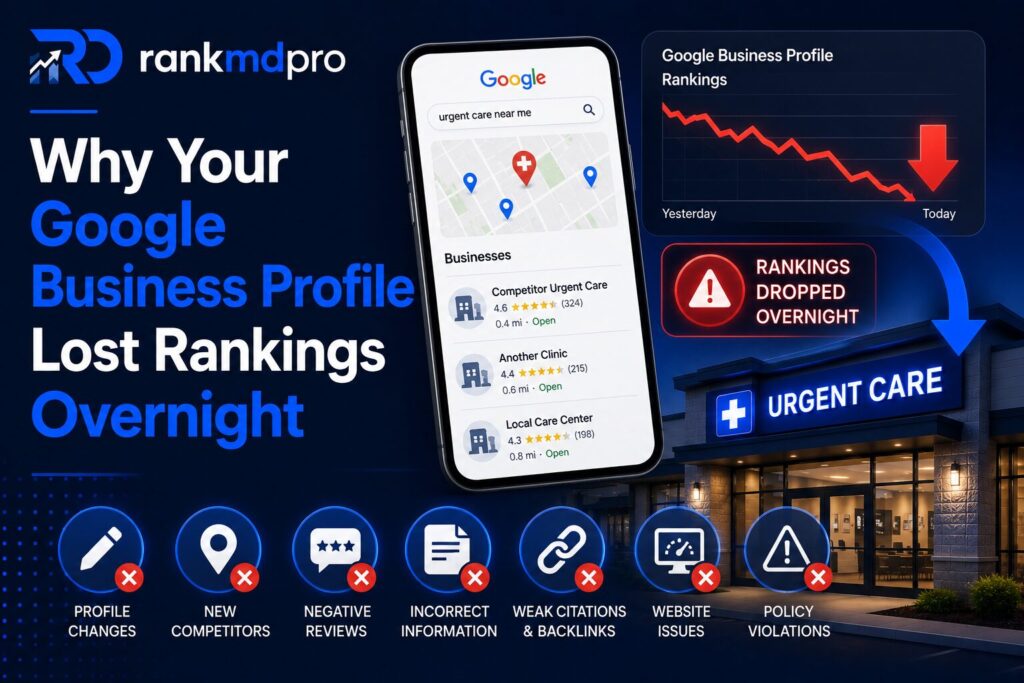
You opened Google Maps this morning. Your clinic used to sit in the top three. Now it is gone buried beneath competitors you have never even heard of. No algorithm update warning. No email from Google. Just vanished rankings and a phone that stopped ringing. If this happened to your medical practice’s Google Business Profile, you are not alone, and you are not powerless. This guide breaks down exactly why GBP rankings drop overnight, what Google’s systems are actually reacting to, and what steps you need to take immediately to recoverand dominate.
What Is a Google Business Profile Ranking Drop and Why Does It Happen?
Your Google Business Profile (GBP) controls your visibility in the Google Map Pack, those three results that appear at the top of a local search for terms like “urgent care near me” or “dentist open Saturday.” According to BrightLocal’s 2025 Local Consumer Review Survey, 98% of people used the internet to find a local business in the past year, and the Map Pack captures over 44% of all local search clicks.
A ranking drop means your profile has lost authority, relevance, or trust signals in Google’s local algorithm. These drops can be sudden and severe, especially in competitive healthcare markets.
| Ranking Signal Category | Weight in Local Algorithm (Approx.) |
|---|---|
| Google Business Profile Relevance | 32% |
| Distance from Searcher | 21% |
| Prominence (Links, Reviews, Citations) | 47% |
Source: Local Search Ranking Factors study, Whitespark 2024
Understanding which of these three pillars collapsed is the first diagnostic step.
Top 7 Reasons Your GBP Rankings Dropped Overnight
1.Ownership or Management Changes on Your Profile
If anyone recently added, removed, or changed ownership access on your GBP account including a previous marketing agency losing access Google can temporarily suppress your profile while it re-verifies authority. This is one of the most common causes of overnight drops in healthcare practices switching agencies.
2. A Competitor Opened Near You
The “proximity” factor in Google’s local algorithm is ruthless. If a new urgent care, dental office, or specialist clinic opened within your service area, it did not just take a piece of the pie, it actively shifted the geographic centroid Google uses to rank results for searches in that area.
3. Your Review Score Dropped or You Got Flagged Reviews
A sudden influx of one-star reviews, even fraudulent ones, can tank your local prominence score. Google weighs both review quantity and recency heavily. A single bad month of reviews can erase months of ranking gains.
4. Your GBP Category or Business Information Was Changed
If someone including you or a team member edited your primary business category, your service area, or your practice hours, Google re-evaluates your entire profile. Even a minor edit like changing “Urgent Care Center” to “Medical Clinic” can cost you significant ranking ground in competitive queries.
5. Google Applied a Core or Local Algorithm Update
Google rolls out local algorithm updates multiple times per year without public announcements. These updates recalibrate how GBP signals are weighted relative to on-page authority and backlinks. Practices with thin citation profiles or inconsistent NAP (Name, Address, Phone) data across directories are most vulnerable.
6. Your Website Lost Authority or Experienced Technical Issues
Your GBP is not an island. Google connects your profile to your website’s authority. If your site experienced a Core Web Vitals failure, lost backlinks, or had pages deindexed, that signal degradation directly impacts your local Map Pack placement.
| Website Factor | Impact on GBP Rankings |
|---|---|
| Site speed below 2.5s LCP | High negative impact |
| Lost referring domains | Moderate to high impact |
| Pages deindexed or removed | High impact |
| Thin or duplicate content added | Moderate impact |
7. Your Profile Was Suspended or Flagged for Policy Violations
Google aggressively penalizes GBP profiles that violate its guidelines especially in regulated industries like healthcare. Using keyword-stuffed business names, incorrect addresses, or misleading service descriptions can trigger automatic suspensions. Competitor-reported spam flags are also increasingly common.
How to Diagnose Exactly What Caused Your Drop
Before you can fix anything, you need to identify the root cause. Here is a rapid diagnostic checklist:
Step 1: Audit Your GBP Dashboard: Check for any unread notifications, ownership changes, or suspended status inside your Google Business Profile Manager.
Step 2: Run a NAP Consistency Check: Verify that your Name, Address, and Phone number are identical across Google, Yelp, Healthgrades, Zocdoc, and all major directories. Even a missing suite number can create citation inconsistency.
Step 3: Review Your Google Search Console: Look for sudden drops in impressions or clicks for your brand keywords. A corresponding website issue often accompanies a GBP drop.
Step 4: Monitor Local Rank Trackers: Tools like BrightLocal, Whitespark, or Local Falcon can show you exactly when your ranking shifted and at what geographic radius.
Step 5: Cross-Reference Algorithm Update Calendars: Check MozCast or Search Engine Roundtable to see if any confirmed updates coincided with your drop date.
The 2026 GBP Recovery Playbook for Medical Practices
Once the cause is identified, recovery follows a clear sequence. Here is what actually works in the current algorithm environment.
First, lock down your profile. Reduce the number of users with management access. Enable two-factor authentication. Turn on notifications for any GBP edits so you are alerted before changes go live.
Second, rebuild review velocity. Google’s local algorithm places increasing weight on review recency. A practice that collected 50 reviews two years ago and nothing since is algorithmically stale. Implement a systematic post-visit review request via SMS or email, this single action recovers more GBP rankings than almost anything else.
Third, rebuild citation authority. Submit or re-verify your profile across the top 50 healthcare-specific and general local directories. In healthcare, authoritative citations include WebMD, Healthgrades, Zocdoc, Vitals, and US News Health alongside standard directories.
Fourth, publish GBP posts weekly. Google’s own documentation confirms that regularly updated profiles signal active, relevant businesses. Posts with local keywords (“urgent care in [city],” “same-day appointments available”) directly reinforce your relevance signals for target queries.
Fifth, improve your on-page local SEO. Ensure your website has dedicated location pages with structured schema markup for LocalBusiness and MedicalOrganization entity types. Google increasingly uses entity-based signals from your website to validate and boost your GBP visibility in AI-powered search results.
Why Healthcare Practices Need Specialized GBP Management
Most generalist SEO agencies treat a restaurant and a medical clinic the same way. They are not. Google applies additional scrutiny to Your Money or Your Life (YMYL) categories which include all healthcare when evaluating content quality, profile legitimacy, and review credibility.
Healthcare GBP profiles face unique challenges that require specialized knowledge: HIPAA-compliant review response strategies, medical schema markup requirements, health entity optimization for AI Overviews, and compliance-aware business description copywriting.
A mismanaged GBP in a medical context does not just cost rankings. It costs patient trust, new appointment bookings, and ultimately, practice revenue.
At RankMD Pro, we specialize exclusively in healthcare SEO and Google Business Profile management for medical practices. We do not serve restaurants. We do not serve retail brands. Every system we have built from our Map Pack Authority Framework to our GBP Citation Engine was engineered for clinics, private practices, and medical groups competing in the most difficult local search environments on Google.
If your practice’s rankings dropped last night, last week, or last month, the window to recover before a competitor consolidates those positions is closing. A free Growth Audit from RankMD Pro will identify exactly what caused your drop, what your competitors are doing differently, and the fastest path to reclaiming your Map Pack position.
Book your free audit at rankmdpro.com
Frequently Asked Questions
How long does it take to recover GBP rankings after a drop?
Recovery timelines vary from two weeks to three months depending on the cause. Profile edits and review-related drops recover faster. Algorithm-based drops tied to website authority can take 60 to 90 days of consistent optimization.
Can a competitor get my Google Business Profile suspended?
Yes. Competitors can flag your GBP for policy violations, and if Google agrees with the report, your profile can be suspended immediately. This is increasingly common in high-competition healthcare markets.
Does adding more photos to my GBP actually help rankings?
Yes, measurably. Profiles with 100 or more photos receive significantly more views and direction requests than profiles with fewer than 10 photos, according to Google’s own data. In healthcare, photos of the facility interior, staff, and waiting area also build patient trust.
Will responding to negative reviews help my GBP ranking?
Review responses do not directly affect ranking, but they signal profile activity to Google and prevent trust erosion with prospective patients who read review threads before booking.
What is the number one thing a medical practice can do to protect its GBP ranking?
Build a consistent, high-velocity review acquisition system. Review recency and quantity are the most consistently impactful factors within a practice’s direct control.
Can I rank in the Map Pack without a strong website?
Temporarily, yes. But long-term Map Pack dominance requires a high-authority website backing your profile. Google uses on-page entity signals and domain authority to validate and sustain GBP rankings, especially in competitive urban healthcare markets.