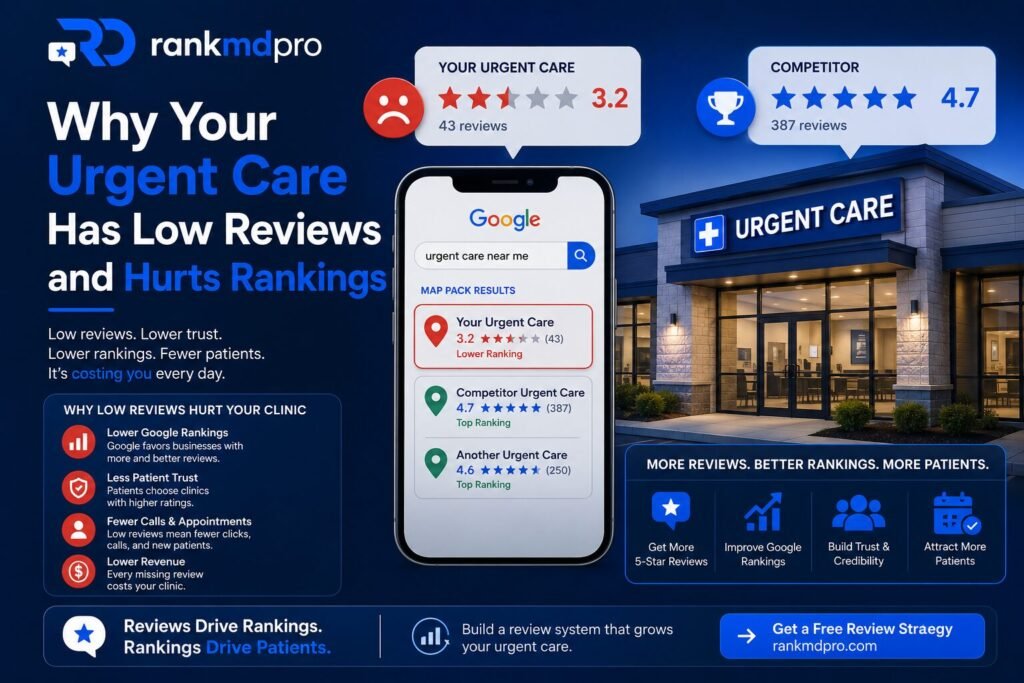
You have a quality clinic. Patients leave satisfied. Your staff is trained, your wait times are reasonable, and your clinical outcomes are solid. Yet your Google Business Profile shows 43 reviews averaging 3.9 stars while the urgent care two miles away has 387 reviews at 4.7 stars and occupies the top Map Pack position for every high-value search in your market.
This is not a coincidence. It is a system failure. And it is costing you more patients every single day than any other problem in your practice’s digital presence.
This post breaks down exactly why low review volume and poor ratings suppress your Google rankings, the specific behavioral and algorithmic mechanisms behind it, and what a properly structured review acquisition system looks like when it is built specifically for urgent care. If you are serious about fixing this problem rather than continuing to hope patients review you organically, read every section.
The Algorithm Reality: How Google Uses Reviews to Rank Local Healthcare Providers
Google’s local ranking algorithm for the Map Pack weighs three primary factors: relevance, distance, and prominence. Reviews are the most controllable component of prominence, and prominence is the factor that separates practices with identical distance and relevance signals.
| Ranking Signal | Component | Your Control Level |
|---|---|---|
| Relevance | GBP categories, services, website content | High |
| Distance | Physical location | None |
| Prominence | Review volume, rating, recency, responses | Very High |
| Prominence | Citation consistency | High |
| Prominence | Backlink authority | Moderate |
| Prominence | Website authority | High |
Reviews influence your Map Pack ranking through four distinct algorithmic mechanisms that most clinic operators do not fully understand.
Review velocity is the rate at which new reviews arrive. Google interprets a consistent flow of recent reviews as evidence that the business is actively operating and currently relevant. A clinic with 300 reviews but none in the past 90 days is algorithmically less favored than a clinic with 80 reviews and five added in the past two weeks.
Review volume is the raw count. All other factors equal, higher volume signals greater patient experience breadth and increases statistical reliability of your rating in Google’s confidence model.
Average rating directly affects both algorithmic ranking and human click-through behavior. Google’s own quality assessments favor practices above 4.5 stars. Below 4.0, patient trust drops sharply and click-through rates decline regardless of Map Pack position.
Review response rate signals active management. Profiles where the owner consistently responds to reviews are treated as more authoritative than abandoned profiles with unanswered feedback.
| Review Profile | Map Pack Likelihood | Patient Trust Level |
|---|---|---|
| Under 50 reviews, any rating | Low | Low |
| 50 to 150 reviews, under 4.0 stars | Low to moderate | Low |
| 50 to 150 reviews, 4.5 stars or above | Moderate | Moderate |
| 150 to 300 reviews, 4.5 stars or above | High | High |
| 300 plus reviews, 4.7 stars or above | Very High | Very High |
| Any volume, no responses to reviews | Suppressed | Reduced |
Why Urgent Care Clinics Specifically Struggle With Review Generation
The review gap in urgent care is not primarily a patient satisfaction problem. It is a structural access problem rooted in how the urgent care patient journey differs from other healthcare settings.
In primary care, patients have ongoing relationships with their provider and multiple touchpoints throughout the year. In dental or specialty care, appointments are scheduled in advance and post-visit communication systems are routine. In urgent care, the visit is episodic, often stress-driven, and the patient departs as quickly as possible once their need is met. There is no scheduled follow-up. There is no ongoing relationship infrastructure. There is no natural moment in the patient journey where leaving a review feels like an obvious next step.
This structural reality explains why the average urgent care clinic generates reviews at a rate of one to three per week organically, while a properly systemized urgent care operation generates eight to fifteen per week from the same patient volume. The difference is entirely process-driven, not satisfaction-driven.
The most common reasons urgent care patients do not leave reviews despite positive experiences include never being asked, being asked at the wrong moment in the patient journey, being directed to a review platform with too much friction, and simply forgetting by the time the impulse to review has faded.
Every one of these barriers is solvable with the right system.
The Four Elements of a High-Performance Urgent Care Review System
A review generation system that consistently produces results for urgent care clinics is built on four operational elements working in sequence.
The first element is timing optimization. The highest review conversion rate occurs when the review request reaches the patient 24 to 48 hours after their visit. At that window, the experience is recent enough to feel relevant but the patient is no longer in acute discomfort and has transitioned back to normal daily activity including smartphone use. Requests sent immediately at discharge or more than 72 hours post-visit convert at significantly lower rates.
The second element is friction elimination. Every additional step between a patient receiving your review request and completing a review reduces conversion by a measurable percentage. The optimal delivery is a direct SMS with a single link that opens directly to your Google review prompt. No login required. No navigation through your website. One tap, one screen, one submission.
The third element is channel selection. SMS outperforms email for review requests in healthcare by a significant margin. Open rates for healthcare SMS messages average 98 percent compared to 21 percent for email. For an urgent care patient who visited once and has no ongoing relationship with your practice, email is frequently ignored. SMS reaches them where they are.
The fourth element is follow-up sequencing. A single request generates a fraction of the reviews that a properly sequenced two-touch system generates. A first message at 24 hours followed by a single follow-up at 72 hours for patients who did not respond to the first request roughly doubles review acquisition rate without becoming intrusive.
| System Element | Weak Implementation | Optimized Implementation |
|---|---|---|
| Request timing | At discharge or never | 24 to 48 hours post-visit |
| Delivery channel | Email only | SMS primary, email secondary |
| Link destination | Homepage or general review page | Direct Google review prompt link |
| Follow-up | None | Single follow-up at 72 hours |
| Monthly review volume (300 visits) | 3 to 8 reviews | 25 to 45 reviews |
How Low Ratings Suppress Rankings Beyond the Algorithm
The algorithmic impact of low ratings is well-documented. The behavioral impact is equally significant and compounds the ranking suppression through a mechanism Google explicitly monitors.
When a patient searches for urgent care, finds your listing at a 3.8-star average, and clicks to a competitor with 4.6 stars instead, Google registers that decision as a negative relevance signal about your listing for that query. This is called pogo-sticking behavior in SEO, and it directly informs Google’s assessment of whether your listing satisfies searcher intent.
The practical consequence is a self-reinforcing cycle. Low ratings reduce click-through rate. Reduced click-through rate signals lower relevance. Lower relevance reduces ranking position. Lower ranking position reduces visibility. Reduced visibility means fewer patients, fewer reviews, and no improvement in rating. The cycle continues until it is deliberately interrupted by a systematic intervention.
Interrupting this cycle requires two parallel tracks: improving the incoming review rate through the acquisition system described above, and actively managing existing negative reviews through professional response strategy.
The Response Strategy That Converts Negative Reviews Into Trust Signals
Negative reviews cannot be deleted. They can, however, be converted from liabilities into evidence of your practice’s professionalism through a response approach that prospective patients read and evaluate when making their provider decision.
The framework that consistently produces the best outcome for urgent care clinics follows four steps in every negative review response.
Acknowledge without admitting fault. Thank the reviewer for taking the time to share their experience. Express genuine concern that their visit did not meet expectations. This step alone de-escalates a significant percentage of negative reviewers and demonstrates empathy to readers.
Take the conversation offline. Provide a specific contact name and direct phone number or email. Invite the reviewer to connect so the situation can be understood and addressed properly. This signals accountability to readers without creating a public back-and-forth that can escalate.
Keep the response brief and professional. Long defensive responses signal anxiety. Concise, calm, empathetic responses signal confidence and maturity.
Never use the patient’s name or any identifying health information in your response. HIPAA compliance in review responses is not optional and violations carry significant regulatory consequences.
| Response Element | Wrong Approach | Right Approach |
|---|---|---|
| Tone | Defensive, explanatory | Empathetic, calm |
| Length | Long, detailed defense | Concise, 3 to 5 sentences |
| Personal information | References visit details | No identifying information |
| Resolution path | Argued in public | Moved to private channel |
| HIPAA compliance | Potentially violated | Strictly observed |
What This System Produces When Fully Implemented
The outcomes for urgent care clinics that implement a complete review acquisition and response management system follow a consistent trajectory.
In the first 60 days, review velocity increases measurably and profile views begin rising as Google registers increased engagement activity. In months three through six, average rating improves as the volume of new positive reviews dilutes historical low ratings. In months six through twelve, Map Pack positioning improves in correlation with review prominence gains. Beyond twelve months, the compounding review profile creates a competitive moat that is genuinely difficult for under-systemized competitors to close.
This is not supplementary marketing activity. It is infrastructure that directly determines your Map Pack position, your patient click-through rate, and your new patient acquisition volume from organic search.
RankMD Pro Builds This System for Urgent Care Clinics
Everything described in this article is operational, not theoretical. RankMD Pro implements complete review acquisition and reputation management systems for urgent care operators, multi-location medical groups, and DSOs as a core component of our healthcare SEO and patient acquisition service.
Our review system implementation includes HIPAA-compliant SMS and email review request automation, direct Google review link configuration, response management protocols and templates, monthly review performance reporting, and integration with your existing practice management workflow.
If your clinic’s review profile is holding your rankings back, the gap between where you are and where you need to be is a solvable systems problem. Request a free growth audit at rankmdpro.com and find out exactly where your review profile stands against your top local competitors and what the prioritized path to closing that gap looks like.
Frequently Asked Questions
Can I ask patients to leave Google reviews without violating HIPAA?
Yes. You can ask patients to leave reviews about their general experience. You cannot reference specific medical details in your requests or responses. A properly designed review request system asks only about the patient experience and never references clinical information.
How many Google reviews does an urgent care need to rank in the Map Pack?
In most markets, 150 or more reviews with a 4.5-star average or higher is competitive for Map Pack positioning. In high-density urban markets, 300 or more reviews are often necessary to hold top-three positions consistently.
Can negative reviews be removed from Google?
Reviews that violate Google’s content policies, including fake reviews, spam, or reviews containing prohibited content, can be flagged for removal. Genuine negative reviews from real patients cannot be removed. Professional response management is the appropriate strategy for legitimate negative reviews.
Does responding to reviews improve Google rankings?
Yes. Review response rate is a confirmed engagement signal that contributes to Google’s assessment of profile authority and active management status. Profiles with consistent response activity outperform profiles with unanswered reviews in local ranking comparisons.
How long does it take for new reviews to improve Map Pack rankings?
Review velocity improvements typically begin influencing profile prominence signals within four to eight weeks. Measurable ranking improvements from review profile enhancement generally appear within three to six months of consistent system implementation.