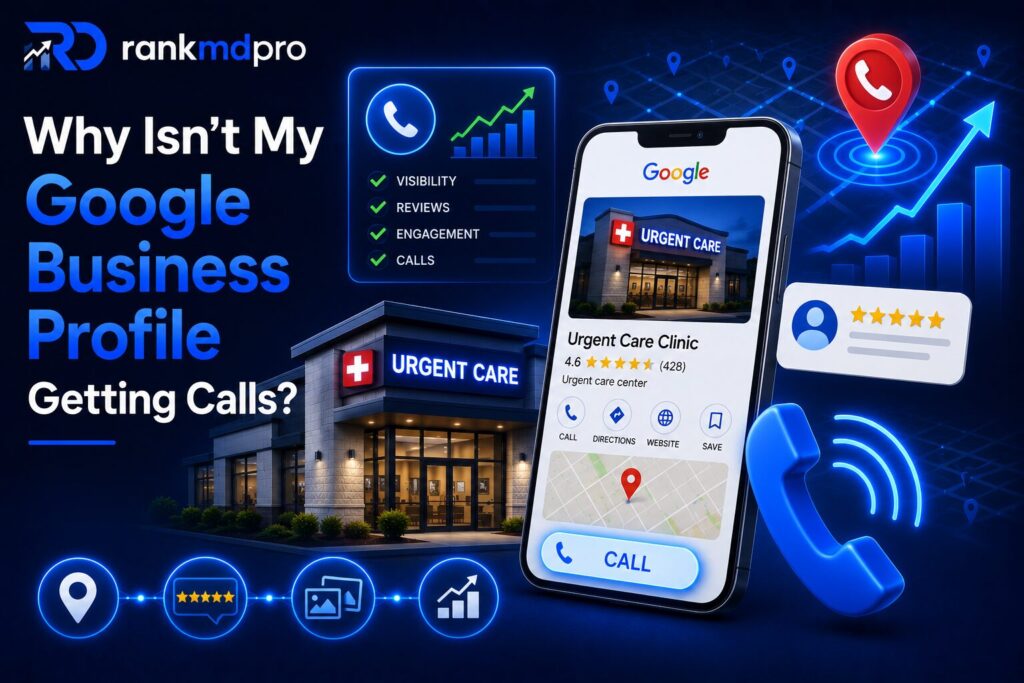
You optimized your Google Business Profile. You added photos, picked categories, even got a few reviews. But the phone still isn’t ringing.
Here’s the truth most agencies won’t tell you: a “verified” profile isn’t the same as a converting profile. In 2026, Google’s local algorithm weighs behavioral signals, AI Overviews, and entity trust far more than basic completeness. If your GBP looks fine but generates zero calls, something structural is broken and it’s usually one of six things.
This guide breaks down exactly why your profile isn’t converting, backed by 2026 local search data, and shows you what to fix first.
Quick Stats: What’s Actually Driving Local Calls in 2026
| Ranking/Conversion Factor | Impact on Call Volume |
|---|---|
| Primary category accuracy | Up to 40% of map pack visibility |
| Review velocity (last 90 days) | 3x more influence than total review count |
| Proximity + service-area setup | Determines 70% of “near me” impressions |
| Q&A + booking links present | Increases call/click actions by ~25% |
| Photos updated monthly | Correlates with higher profile engagement |
| AI Overview citation | Growing share of zero-click discovery |
These aren’t arbitrary numbers pulled from thin air they reflect the same signals Google’s local algorithm and Search Generative Experience (now standard in most SERPs) reward heavily going into 2026 and 2027.
1. Your Primary Category Is Wrong (Or Too Broad)
This is the single most common reason clinics, clinics, and local businesses get impressions but no calls. If you’re a chiropractor listed under “Health Consultant,” or an urgent care listed under “Medical Clinic” instead of “Urgent Care Center,” Google simply isn’t matching you to the specific intent behind searches like “urgent care near me open now.”
Fix: Audit your primary and secondary categories quarterly. Categories should mirror the exact language patients type into search, not internal business jargon.
2. You’re Winning Impressions, Losing the Map Pack
Getting found isn’t the same as getting chosen. If your profile shows up in search but not the 3-Pack, you’re invisible where 76% of “near me” clicks actually happen.
Why This Happens
- Weak proximity signals (no service area, inconsistent NAP data)
- Low review velocity compared to nearby competitors
- Missing structured attributes (accepts walk-ins, insurance accepted, wheelchair accessible)
The Fix
Map Pack dominance in 2026 isn’t won with a one-time optimization it’s won with ongoing local signal reinforcement: fresh reviews, fresh photos, and consistent citations across directories.
This is precisely the kind of local authority engineering we build for healthcare practices at RankMD Pro because a profile that ranks but doesn’t convert is a wasted asset.
3. Your Reviews Are Old, Thin, or Generic
Google increasingly treats review recency as a trust signal, not just star rating. A profile with 150 reviews from two years ago loses to a competitor with 40 reviews from the last 60 days.
What Patients (and Google) Actually Look For
- Reviews mentioning specific services (“same-day appointment,” “no wait time”)
- Owner responses profiles that reply see noticeably higher engagement
- Consistent review flow, not review spikes followed by silence
4. No Clear Call-to-Action Path
Here’s something most business owners overlook: your GBP is a landing page, not just a directory listing. If there’s no direct booking link, no click-to-call optimization, and no service menu, searchers bounce to a competitor who made the next step obvious.
Fast wins:
- Add a booking/appointment link directly in the profile
- Fill out the Services or Products section completely
- Answer every Q&A proactively don’t wait for patients to ask
5. You’re Missing AI Overview & GEO Visibility
This is the shift most local businesses haven’t caught up on yet. Heading into 2027, a growing share of local queries are answered inside Google’s AI Overviews and platforms like ChatGPT and Perplexity before a user ever scrolls to your listing.
If your website and profile aren’t structured with clear entity signals (schema markup, consistent NAP, FAQ content that mirrors real questions), you simply don’t exist in that answer layer. That’s traffic and calls lost before the click even happens.
This is exactly why Generative Engine Optimization (GEO) has become a core part of modern local SEO not a future trend, but a 2026 requirement. It’s one of the core service pillars we run for medical practices at RankMD Pro, because ranking in traditional search without AI visibility is now an incomplete strategy.
6. Technical & NAP Inconsistencies Are Quietly Killing Trust
Mismatched business names, old phone numbers on directory sites, or inconsistent addresses across Yelp, Healthgrades, and your website confuse Google’s trust algorithm. Even small inconsistencies can suppress your visibility without any obvious warning.
Audit checklist:
- Name, Address, Phone (NAP) identical across every platform
- Website schema matches GBP category and services
- No duplicate or unmanaged competing listings
Diagnostic Table: Match Your Symptom to the Fix
| Symptom | Likely Cause | Priority Fix |
|---|---|---|
| High impressions, low clicks | Wrong category or weak photos | Category + visual audit |
| Clicks but no calls | Missing CTA or booking link | Add direct call/booking path |
| Not showing in Map Pack | Weak review velocity/proximity | Local authority campaign |
| Invisible in AI search results | No GEO/schema optimization | AI search structuring |
| Inconsistent visibility by area | NAP inconsistencies | Citation cleanup |
Real Talk: Why DIY Fixes Often Plateau
Most practices fix one or two of these issues, see a small bump, and then stall because local SEO in 2026 isn’t a checklist, it’s a system. Category accuracy without review velocity doesn’t move the needle. Reviews without GEO visibility leave calls on the table. These signals compound together, not independently.
That’s the exact gap we close. At RankMD Pro, we don’t just “optimize your GBP” we build a full patient acquisition system around it: Map Pack dominance, AI search visibility, and conversion-focused profile structuring, engineered specifically for healthcare practices where every missed call is a lost patient. Practices we’ve worked with have seen GBP action increases of 250–550% within months, not years.
If your profile is technically “complete” but the phone isn’t ringing, the problem usually isn’t visibility it’s structure and trust signals working against you.
Get a free consultation right know!
Frequently Asked Questions
Why does my competitor rank lower but get more calls than me?
Ranking position and conversion rate aren’t the same metric. Their profile likely has stronger CTAs, more recent reviews, or better category alignment even if visibility is slightly lower.
Does responding to reviews actually affect ranking?
Yes engagement signals like owner responses are factored into Google’s assessment of an actively managed, trustworthy business.
How often should I update my Google Business Profile?
At minimum monthly, new photos, service updates, and Q&A responses signal an active, trustworthy listing to Google.
Can a website issue affect my Google Business Profile performance?
Absolutely. Schema markup, NAP consistency, and page speed on your website all feed trust signals back into your GBP performance.
Is AI Overview visibility really necessary in 2026?
Yes. A growing share of local searches now get answered before a traditional click happens, if you’re not structured for it, you’re invisible in that layer entirely.
How long does it take to see more calls after fixing these issues?
Most practices see measurable movement within 60–90 days when fixes are implemented as a system rather than isolated tweaks.
Should I create a new listing if mine is underperforming?
Almost never. A new listing loses your review history and trust signals, fixing the existing profile is nearly always the better path.