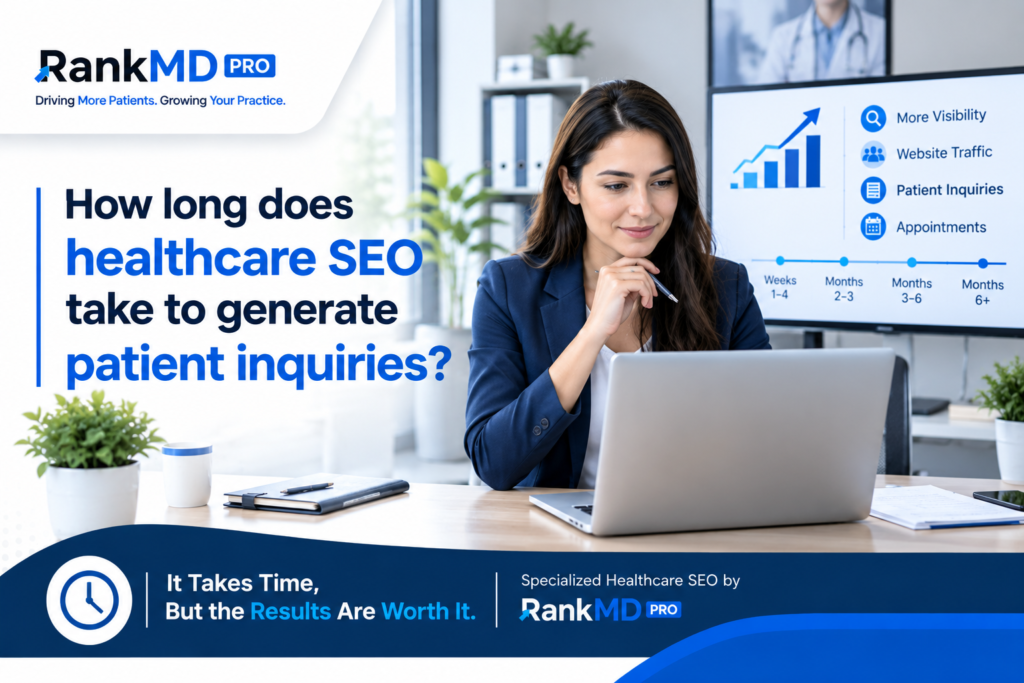
Healthcare SEO can begin producing measurable search and local visibility within the first few months, but patient inquiries often take longer to become consistent. The timeline depends on competition, website quality, local authority, content depth, technical SEO, and how quickly high-intent pages are improved. Explore RankMD Pro’s healthcare SEO strategy for a patient-acquisition-focused approach.
What Happens Before Patient Inquiries Increase?
SEO usually works through several connected stages rather than producing immediate appointments:
- Early stage: Google crawls and processes new or improved pages while Search Console begins showing impressions and query data.
- Visibility stage: Service pages, location pages, and Google Business Profile optimization can begin gaining visibility for relevant searches.
- Intent stage: Higher-value searches such as “dermatologist near me” or “urgent care in Austin” can begin reaching more qualified prospects.
- Conversion stage: Calls, appointment requests, and forms become more meaningful when rankings, local visibility, and website conversion paths work together.
Google confirms that pages may require time to be discovered, crawled, and processed, and that search features or enhanced appearances are not guaranteed.
What Can Speed Up or Slow Down Healthcare SEO?
Faster progress may be possible when:
- The practice already has established domain and local authority.
- Important service pages match high-intent searches.
- Technical problems and indexing issues are resolved quickly.
- Google Business Profile and local signals are properly managed.
- Medical content demonstrates genuine expertise and satisfies patient questions.
Slower progress is common when a site has weak topical authority, duplicated location pages, poor internal linking, limited local relevance, or strong competitors already dominating the Map Pack.
A Practical Example
A Houston cardiology practice may receive little value from targeting only “cardiologist.” A better strategy can connect dedicated service content, local searches, physician information, and appointment-focused pages around searches such as “cardiologist in Houston,” “heart specialist near me,” and specific cardiology services.
The key is to measure qualified inquiries, not simply rankings or traffic. Track organic calls, appointment forms, landing-page conversions, branded searches, Map Pack visibility, and qualified patient actions in addition to keyword positions.
RankMD Pro healthcare SEO services can help practices build this measurement-driven foundation across Healthcare SEO, Local SEO, topical authority, and conversion rate optimization.
Before expecting more appointments, audit your highest-value services, local search visibility, and conversion paths to identify where qualified patients are being lost.