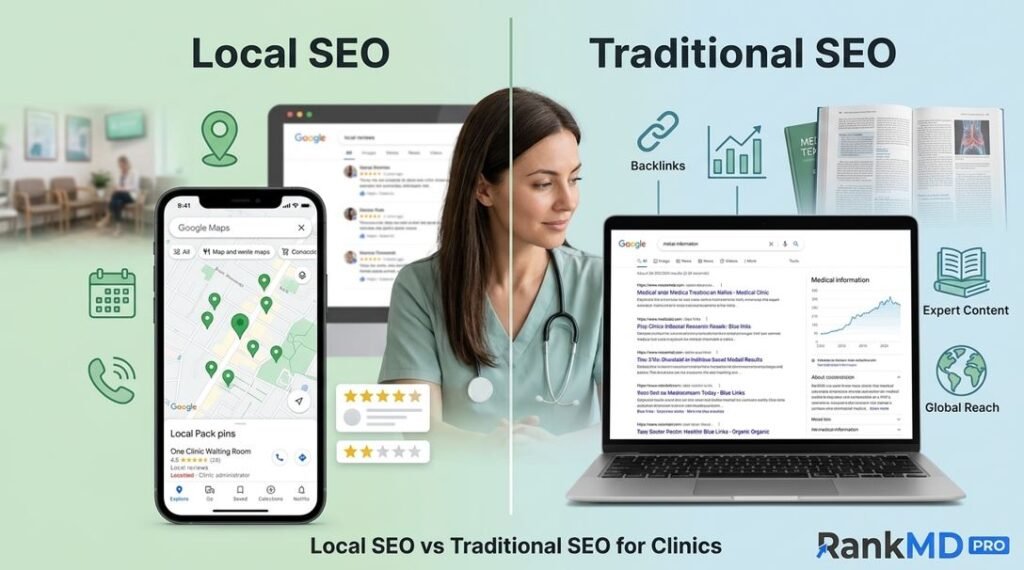
Your urgent care clinic could have the best physicians in town but if your Google reviews are thin, slow, or unmanaged, you are handing patients directly to the competitor down the street. In 2026, online reviews are not a “nice to have.” They are a hard ranking signal that determines whether your clinic shows up in the Google Map Pack or disappears into page two. This guide breaks down exactly how reviews affect your local search rankings, what the data says, and what your clinic must do right now to win.
Why Reviews Are a Core Local Ranking Factor Not Just Social Proof
Google’s local algorithm has three primary ranking pillars: relevance, distance, and prominence. Reviews directly influence prominence the factor that separates Map Pack winners from invisible also-rans.
Here is what the data shows:
| Ranking Factor | Impact on Local Pack Rankings |
|---|---|
| Google review quantity | High |
| Average star rating | High |
| Review recency (last 90 days) | Very High |
| Review response rate | Medium-High |
| Keyword mentions in reviews | Medium |
| Review velocity (pace of new reviews) | Very High |
A 2025 Whitespark Local Search Ranking Factors study found that review signals account for approximately 16% of Google Map Pack ranking factors making it the second most influential category after Google Business Profile optimization itself. For urgent care specifically, where patients are searching with high urgency and low patience, appearing in the top three Map Pack results is the difference between a full waiting room and an empty one.
The mechanics are simple but most clinic owners miss them: Google’s algorithm reads your reviews like a trust ledger. It is not just counting stars it is analyzing review velocity, recency, semantic content (are patients mentioning your services?), and how often you respond.
The 4 Review Signals Google Weighs Most for Urgent Care Clinics
1. Review Velocity: How Fast You Are Earning New Reviews
A clinic with 200 reviews earned over five years looks stale to Google compared to a clinic with 80 reviews earned in the last 12 months. Velocity the pace at which you earn new reviews signals to Google that your practice is active, trusted, and relevant today.
For urgent care clinics, this is both a challenge and an opportunity. You see high patient volume, which means you have more review opportunities per day than most specialty practices. The clinics winning local rankings are systematically capturing this volume.
Target benchmark: Aim for a minimum of 8–12 new reviews per month to maintain ranking momentum.
2. Star Rating Threshold, The 4.2 Rule
Not all star ratings are created equal in Google’s eyes. Research across healthcare verticals consistently shows that clinics with ratings below 4.0 suffer significant ranking suppression. The functional sweet spot for urgent care is 4.2 to 4.7 stars.
| Star Rating Range | Patient Behavior Impact |
|---|---|
| Below 4.0 | 79% of patients will not book |
| 4.0 – 4.2 | Moderate trust, some hesitation |
| 4.2 – 4.7 | Strong trust, high conversion |
| 4.8+ | Sometimes appears inflated, mild skepticism |
The goal is not perfect 5.0 it is authentic authority in the 4.2–4.7 range with consistent volume.
3. Review Recency, Google’s 90-Day Window
Google strongly weights reviews from the last 90 days. A clinic that earned 150 reviews two years ago but has received only 3 in the past quarter will see its prominence score erode. For urgent care clinics with seasonal patient spikes (flu season, summer injuries), this recency bias can cause sharp ranking fluctuations if you are not maintaining a steady review cadence year-round.
4. Keyword-Rich Reviews, The Hidden Ranking Lever
When a patient writes “I came in for a UTI and was seen in 15 minutes this urgent care on [Main Street] is incredible,” that review is doing triple duty: it mentions a specific service, a location signal, and a quality indicator. Google’s NLP engine reads these signals and associates your GBP listing with those service and location terms.
This is why coaching patients (within Google’s guidelines) to mention specific services and experiences in their reviews directly impacts your service-specific keyword rankings.
What Happens When Urgent Care Clinics Ignore Review Management
The consequences are measurable and fast. Here is a typical scenario we see regularly:
A clinic opens strong with 30–40 reviews and lands in the top 3 Map Pack results. No systematic review generation process is in place. Six months pass. A competitor opens nearby with an active review strategy, gaining 20 new reviews per month. Within 90 days, the original clinic drops from position 2 to position 5 below the Map Pack fold. Walk-in volume drops 18, 25%.
The pattern is consistent across markets because the underlying algorithm is consistent. Review neglect is a slow, quiet revenue bleed that most clinic operators only notice when the damage is significant.
A Proven Review Generation System for Urgent Care Clinics
The clinics dominating local rankings in competitive markets are not getting lucky with reviews they have a system. Here is the framework:
Step 1 — Point of Discharge Ask (In-Person) Train front desk staff to verbally request a review at checkout. The script is simple: “We really appreciate your visit today. If you have 60 seconds, a Google review helps other patients in our community find us. We’ll text you a direct link.” This single step can increase review volume by 30–40%.
Step 2 — Automated SMS Follow-Up (Within 2 Hours) A text message sent within two hours of discharge, while the positive experience is fresh, is the highest-converting review request channel in healthcare. Include a direct link to your Google review page. Keep the message under 40 words.
Step 3 — Email Sequence (24 and 72 Hours Post-Visit) For patients who did not respond to the SMS, a two-touch email sequence captures a second wave of reviews. Subject line matters: “Quick question about your visit, [First Name]” consistently outperforms generic “Tell us how we did” subject lines.
Step 4 — Review Response Protocol (Within 24 Hours) Responding to every review, positive and negative, is both a ranking signal and a conversion signal. Patients read responses before booking. A thoughtful, HIPAA-compliant response to a 3-star review can neutralize its reputational impact and signal to Google that your practice is engaged and trustworthy.
Negative Reviews: The Handling That Either Saves or Destroys Your Rankings
Negative reviews are inevitable in urgent care, long wait times, billing confusion, and high-stress patient states guarantee occasional 1-star reviews. The mistake most clinics make is either ignoring them or responding defensively.
Google does not penalize you for having negative reviews. It evaluates how you respond to them. A professional, empathetic, HIPAA-compliant response demonstrates to both Google and prospective patients that your clinic takes quality seriously.
Never: Include patient names, diagnoses, or visit details in your response, this is a HIPAA violation with legal exposure.
Always: Acknowledge the concern, apologize for the experience, and provide a direct contact for resolution offline.
Is Your Urgent Care Clinic Leaving Map Pack Rankings on the Table?
If your clinic has fewer than 50 reviews, a rating below 4.2, or has not received a new review in the past 30 days, you are almost certainly being outranked by competitors who have systematized review generation. The local search landscape for urgent care has become intensely competitive, and review signals are one of the fastest-moving levers available to you.
At RankMD Pro, we specialize exclusively in healthcare SEO, including the review management infrastructure, Google Business Profile optimization, and Map Pack dominance strategies that fill urgent care waiting rooms. We have helped urgent care centers across multiple markets achieve top-3 Map Pack rankings in 90 to 120 days through a combination of review velocity engineering, local citation authority, and GBP semantic optimization.
If you want to know exactly where your review profile stands against your local competitors, we offer a complimentary Local Ranking Audit that breaks down your review signals, GBP health, and Map Pack positioning in detail. No obligation just clarity on what is holding your rankings back.
Frequently Asked Questions
How many Google reviews does an urgent care clinic need to rank in the Map Pack?
There is no universal threshold, but in most mid-size markets, clinics need at least 75–150 reviews with a 4.2+ rating and consistent monthly velocity to compete in the top 3 positions. In high-competition urban markets, 300+ reviews may be required.
Does responding to Google reviews help with local SEO rankings?
Yes. Google has confirmed that responding to reviews can improve your local search rankings. It also directly impacts patient trust 89% of consumers read business responses to reviews before making a decision.
Can I ask patients to leave Google reviews for my urgent care clinic?
Yes, Google permits businesses to ask for reviews. However, you cannot offer incentives, filter by satisfaction (review gating), or direct only happy patients to review platforms these practices violate Google’s guidelines and can result in penalties.
How long does it take for new reviews to impact local rankings?
Google typically indexes new reviews within 24–72 hours. Ranking improvements from sustained review velocity are usually visible within 30–60 days of implementing a consistent review generation program.
What should I do about fake negative reviews on my Google Business Profile?
Report the review to Google via the GBP dashboard and flag it for removal if it violates Google’s policies (fake reviewer, no actual visit, spam). While Google’s removal process is inconsistent, a professional response to the review in the interim is critical while the dispute is pending.
Does the text content of reviews affect which keywords I rank for?
Yes. Google’s NLP engine reads review content and associates your listing with mentioned services, conditions, and locations. Patients organically mentioning “walk-in clinic,” “fast STD testing,” or “X-ray on site” in reviews reinforces your relevance for those search queries.