If your medical spa is publishing blog posts every week but your phone still isn’t ringing, you’re not alone and you’re not doing anything “wrong.” You’re just missing the one thing Google actually rewards: topical authority.
Most med spa websites are a scattered pile of disconnected pages, a Botox page here, a laser hair removal post there, no structure, no depth, no trust signals. Google looks at that and sees a clinic that might know what it’s talking about. Your competitors, the ones ranking above you right now, look like the clinic that definitely knows what it’s talking about.
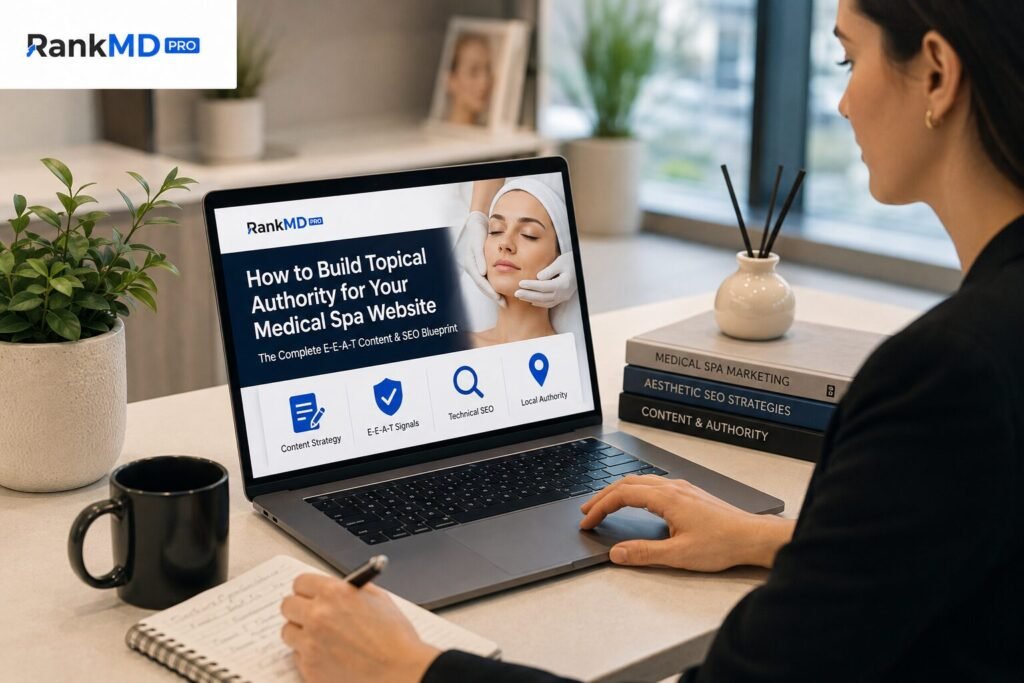
That gap is closeable. In this guide, you’ll get the exact framework content architecture, E-E-A-T credibility signals, technical SEO, and local authority building used to turn a med spa website into the recognized go-to resource in its market. Because in aesthetic medicine, Google treats your content as YMYL (Your Money or Your Life), which means the bar for trust is higher than almost any other industry. Meet that bar, and you don’t just rank you convert.
This isn’t generic SEO advice. It’s a discipline some practices now call Aesthetic SEO search optimization built specifically around the medical, regulatory, and trust requirements of injectables, lasers, and body contouring practices. Firms like RankMDPro’s Aesthetic SEO service specialize exclusively in this niche because generic SEO agencies routinely miss the E-E-A-T requirements that make or break a med spa’s rankings.
Let’s build your authority pillar by pillar.
I Foundation: Defining Your Core Authority Pillars
Before you write a single sentence, you need structure. Authority isn’t built by publishing randomly it’s built by owning entire topics, not just keywords.
Identify Core Service Categories
Start by grouping your treatments into logical clusters instead of treating each service as an island. Most med spas naturally fall into four to six pillars:
- Injectables (Botox, Dysport, dermal fillers, Sculptra)
- Laser Skin Resurfacing (IPL, CO2 laser, laser hair removal)
- Body Contouring (CoolSculpting, EmSculpt, Kybella)
- Medical-Grade Skincare (chemical peels, microneedling, HydraFacial)
Each of these becomes its own content ecosystem. This clustering is the backbone of a real medical spa content strategy. It tells Google (and your patients) that you don’t just offer a service, you specialize in an entire category of care.
Define Target Audience Intent
Every patient moves through a journey, and your content needs to meet them at each stage:
| Stage | Example Query | Content Type |
| Awareness | “What causes wrinkles?” | Educational blog post |
| Consideration | “Botox vs. Dysport” | Comparison guide |
| Decision | “Botox cost near me” | Local landing page |
Pro tip: Most med spas only write for the “Decision” stage pure sales pages. That’s a mistake. Google’s algorithm (and real patients) trust sites that answer the early, non-transactional questions too. That’s how you win search intent optimization for aesthetics by owning the whole conversation, not just the checkout moment.
Competitive Gap Analysis
Pull up the top 5 ranking competitors in your city for your core services. Ask:
- What subtopics haven’t they covered? (Recovery timelines? Combination treatments? Pain management?)
- What questions are showing up in “People Also Ask” that nobody has actually answered well?
- Are their pages thin, outdated, or missing medical citations?
This is where most agencies stop at surface-level keyword research. A dedicated aesthetic SEO agency goes deeper auditing not just keywords but trust gaps: missing author bios, absent medical reviews, no clinical citations. Those gaps are your opportunity.
II. Content Architecture: The Hub-and-Spoke Model
This is the single highest-leverage structural decision you’ll make. Get it right, and every new page you publish makes your entire site stronger, not just that one page.
Pillar Pages (The “Hub”)
For each core service category, build one comprehensive, 2,000+ word definitive guide, something like “The Ultimate Guide to Dermal Fillers” or “Everything You Need to Know About CoolSculpting.”
This page should cover:
- What the treatment is and how it works
- Who’s a good candidate
- What to expect during and after
- Cost ranges
- Risks and safety information
- FAQs
Think of the pillar as the front door to an entire topic comprehensive enough that a patient never has to leave your site to get their questions answered.
Cluster Content (The “Spokes”)
Around each pillar, build supporting articles that go deep on specific long-tail questions:
- “Botox Recovery Timeline: Day-by-Day What to Expect”
- “Dermal Filler Side Effects: What’s Normal vs. What’s Not”
- “Am I a Good Candidate for CoolSculpting?”
- “Botox + Filler Combination: Is It Worth It?”
Each spoke answers one specific question thoroughly; this is exactly the kind of content that captures featured snippets and voice search queries, because it mirrors how people actually ask questions out loud.
Strategic Internal Linking
Here’s where most sites fail: they publish great content but never connect it. Your linking structure should work like a nervous system:
- Every spoke links back to its pillar page (with descriptive anchor text, not “click here”)
- The pillar page links out to every relevant spoke
- Related spokes link to each other where genuinely relevant
This structure isn’t just good UX, it’s how Google’s crawlers understand topical depth and distribute link equity across your site. A page that’s internally linked from 8 relevant articles will consistently outrank an identical page that’s linked from zero.
Common mistake to avoid: Don’t just link every page to every other page for the sake of it. Random, non-contextual linking dilutes relevance signals instead of strengthening them.
III. E-E-A-T Integration: Medical Credibility Signals
This is the section that separates ranking med spas from invisible ones. Because your content touches health decisions, Google applies far stricter trust standards than it does to, say, a recipe blog.
Author Attribution
Every piece of clinical content needs a real, credentialed author not “Admin” or “Staff Writer.” Create a dedicated bio page for every provider (MD, NP, PA, RN) that includes:
- Board certifications and licensure
- Years of experience and specialized training
- Professional photo
- Links to their published work or professional associations
This single change of real author bios is one of the fastest ways to lift E-E-A-T signals across an entire site.
Medical Review Process
Add a visible “Medically Reviewed By [Name, Credentials]” badge on every clinical page, linking directly to that provider’s bio. This tells Google and more importantly, tells nervous patients researching an injectable for the first time that a real medical professional stands behind this information.
Transparency & Citations
Back your clinical claims with links to authoritative sources: PubMed, the FDA, the American Board of Plastic Surgery, or peer-reviewed dermatology journals. Vague claims like “studies show” without a source actively hurt your credibility with both readers and search algorithms.
Clear Disclaimers
Every treatment page needs a visible medical disclaimer covering:
- Results vary by individual
- Risks and potential side effects
- The necessity of an in-person consultation before treatment
This isn’t just a compliance box to check it protects your practice legally while reinforcing that you’re a responsible medical provider, not a sales page dressed up as a clinic.
IV. On-Page & Technical SEO Optimization
Great content on a technically weak site still loses. This is where medical spa SEO gets technical and where most in-house teams need outside expertise.
Entity-Based Schema Markup
Implement structured data so Google understands exactly what your content represents:
- MedicalWebPage schema for treatment pages
- Physician schema for provider bios
- FAQPage schema for your Q&A sections
This schema markup is what makes your FAQs eligible to appear directly in Google search results dramatically increasing visibility without needing to rank #1.
Question-Based Headings (H2/H3)
Structure your subheadings around the exact way people search:
- “Is Botox safe during pregnancy?”
- “How long does filler last?”
- “Does laser hair removal hurt?”
This single tactic is one of the most effective ways to win featured snippets and voice search results, since Google favors content that directly mirrors natural spoken queries.
Multimedia Enrichment
Static text alone won’t cut it in aesthetics. Integrate:
- High-quality, consented before & after galleries
- Short procedure explainer videos
- Infographics breaking down recovery timelines or treatment comparisons
Multimedia keeps visitors on the page longer, which directly improves engagement metrics a signal Google increasingly weighs alongside pure keyword relevance.
Core Web Vitals
The majority of aesthetic patients research treatments on their phones, often between meetings or late at night. If your site loads slowly or isn’t mobile-optimized, you lose them before they read a single word. Prioritize:
- Compressed, fast-loading images (especially before/after galleries)
- Mobile-first responsive design
- Fast server response times
V. Local Authority Building
National authority means little if you don’t dominate your own backyard. Most med spa patients search “near me” or by city name.
Google Business Profile (GBP) Optimization
Keep your GBP services list, photos, and posts perfectly synced with what’s on your website. Inconsistency between your GBP and your site creates confusion for patients and for Google’s trust algorithms.
Localized Content Clusters
Build service pages specific to your service area:
- “Laser Hair Removal in [City Name]”
- “Botox in [Neighborhood/City]”
These pages capture high-intent local searchers who are already deep in the decision stage, arguably the highest-converting traffic your site will ever get.
Local Citations & Reviews
Earn backlinks and mentions from:
- Local news coverage
- Chamber of Commerce directories
- Healthcare and physician directories
These citations validate your physical presence and legitimacy both to patients and to Google’s local ranking algorithm. If building this kind of citation and backlink profile feels overwhelming alongside running a practice, this is exactly the kind of work a specialized Aesthetic SEO partner handles on an ongoing basis.
VI. Maintenance & Authority Growth
Topical authority isn’t a one-time project, it’s a discipline you maintain.
Content Pruning
Regularly audit your site and remove, merge, or rewrite pages that are thin, outdated, or getting zero traffic. A bloated site full of weak pages actively drags down your strong ones. Less, but better, consistently outperforms more, but mediocre.
Periodic Refreshing
Treatment protocols, pricing, and statistics change. Update your key pages every 6–12 months Google rewards freshness on YMYL content, and outdated pricing or protocol information erodes patient trust fast.
Authority Tracking
Track more than just rankings. Monitor:
- Keyword growth across entire topic clusters (not just individual pages)
- Organic traffic lift specifically on your pillar pages
- Conversion rate from organic visitors to booked consultations
This is the metric that actually matters: traffic is vanity, booked consultations are the business.
Turning Authority Into Appointments
Here’s the part most guides leave out: content that ranks but doesn’t convert is a wasted investment. Every page in this framework should include a soft CTA a “Ready to see if [treatment] is right for you? Book a free consultation” placed naturally after you’ve delivered real value, not before.
Your pillar pages, especially, should function like a sales funnel: educate first, build trust through E-E-A-T signals, then guide the reader toward booking without ever feeling like a pushy sales pitch. That balance between genuine patient education and conversion design is the exact discipline behind effective Aesthetic SEO, and it’s why practices increasingly bring in specialists rather than trying to DIY this alongside running a clinic.
Key Takeaways
- Structure first: Group your services into pillars, then build hub-and-spoke content around each one.
- Trust is non-negotiable: Real author bios, medical review badges, and cited sources are the price of entry for YMYL content.
- Technical SEO amplifies content: Schema markup, question-based headings, and Core Web Vitals determine whether your great content even gets seen.
- Local wins conversions: City-specific pages and consistent GBP data capture the highest-intent traffic.
- Authority requires maintenance: Prune, refresh, and track topical authority decays if you let it.
If you’re ready to stop guessing and start building a content system that actually converts visitors into booked patients, a specialized medical spa SEO strategy built specifically around E-E-A-T and YMYL requirements is the fastest path there.
Frequently Asked Questions
What is topical authority in SEO?
Topical authority is when a website comprehensively covers every relevant aspect of a subject, signaling to Google (and readers) that it’s a trustworthy, expert source on that topic rather than having scattered, shallow pages on many unrelated subjects.
Why is E-E-A-T especially important for medical spas?
Medical spa services fall under Google’s YMYL (Your Money or Your Life) classification because they involve health and financial decisions. Google applies stricter trust and credibility standards to this content, making Experience, Expertise, Authoritativeness, and Trustworthiness essential ranking factors.
How long should a pillar page be?
A strong pillar page is typically 2,000+ words, covering the treatment comprehensively enough to answer nearly every question a prospective patient might have, while linking out to more detailed cluster articles for specific subtopics.
How often should I update my med spa’s website content?
Review and refresh key pages especially pricing, statistics, and treatment protocols every 6 to 12 months. Outdated information on YMYL content can hurt both rankings and patient trust.
Do I need a doctor to review all my content?
Yes. A visible “Medically Reviewed By” credential, linked to a real provider’s bio, is one of the strongest trust signals you can add to clinical content and is increasingly expected by both patients and Google.
How is Aesthetic SEO different from general SEO?
Aesthetic SEO applies SEO strategy specifically to the medical, regulatory, and trust requirements unique to injectables, laser treatments, and body contouring including E-E-A-T compliance, medical schema markup, and disclaimers that generic SEO approaches typically overlook.
Ready to build real topical authority for your practice?
Every month you wait is a month your competitors get further ahead in the rankings. Talk to an Aesthetic SEO specialist and get a content roadmap built specifically for your services, your market, and your growth goals.