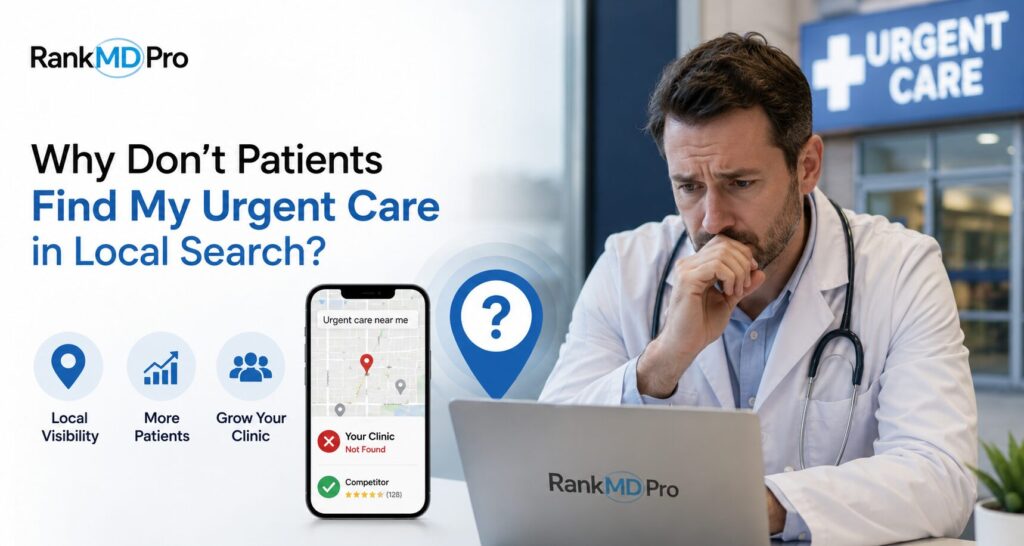
You built your urgent care clinic to serve your community. You hired skilled staff, invested in equipment, and kept your doors open when other practices couldn’t. Yet when a patient three blocks away types “urgent care near me” into Google at 9 PM, your clinic doesn’t appear. Someone else gets that visit. And the next one. And the one after that.
This isn’t bad luck. It’s a local search visibility problemand it’s costing you real revenue every single day. The good news: it’s fixable. This guide breaks down exactly why patients can’t find your urgent care online and what it takes to dominate local search in your area.
The Urgent Care Local Search Problem Is Bigger Than You Think
Before diving into causes and fixes, it’s worth understanding the scale of what’s at stake.
| Stat | Data Point |
| Patients who use Google to find healthcare providers | 77% (Google/Ipsos) |
| Patients who choose a provider in the Google Map Pack (top 3) | Over 50% |
| “Urgent care near me” monthly searches in the US | 9.1 million+ |
| Patients who never scroll past page one | 92% |
| Urgent cares that have fully optimized Google Business Profiles | Less than 30% |
That last number is the opportunity. Most urgent care clinics are sitting on unoptimized digital real estate while competitors who invested in local SEO quietly absorb a majority of the walk-in patient volume.
If you’re not in the Google Map Pack — the three business listings that appear at the top of a local search, you are functionally invisible to the majority of patients searching right now.
Reason #1: Your Google Business Profile Is Incomplete or Neglected
Your Google Business Profile (GBP) is the single most important asset in local search. It powers your Map Pack listing, feeds Google’s local algorithm, and is the first thing a patient sees before they ever visit your website.
Most urgent care clinics have a GBP but most also have a GBP that’s doing almost nothing for them.
Common Google Business Profile Mistakes in Urgent Care
Here’s what a neglected profile looks like versus an optimized one:
| Profile Element | Neglected Profile | Optimized Profile |
| Business category | “Medical Clinic” | “Urgent Care Center” (primary) + “Walk-in Clinic,” “Emergency Care Facility” |
| Hours | Incomplete or wrong | Complete with holiday hours, special hours |
| Photos | 0–5 generic images | 25+ photos: staff, facility, exterior, equipment |
| Posts | None | Weekly posts: wait times, services, health tips |
| Reviews | Under 20 reviews | 50–200+ recent reviews with responses |
| Services listed | None | Full service list: X-ray, COVID testing, flu shots, etc. |
| Q&A section | Empty | Answered common patient questions |
Google rewards completeness. Every empty field is a missed ranking signal.
How to Fix It
Claim and fully complete your GBP today if you haven’t. Add every service you offer. Upload high-quality photos of your waiting room, staff, and signage. Enable messaging. Set up your booking link. Post updates at least once per week. These are not advanced tactics they are the table stakes of local visibility.
Learn more about why your urgent care clinic isn’t on Google Maps fast GBP is almost always the culprit.
If your GBP needs a professional audit and optimization strategy, RankMD Pro offers a free growth audit that evaluates exactly where your profile is losing ground to competitors.
Reason #2: You’re Not Generating Enough Reviews (Or Responding to Them)
Reviews are local SEO currency. Google’s local ranking algorithm weighs review quantity, recency, rating, and how actively you respond to them.
A clinic with 12 reviews from 2021 cannot outrank a competitor with 180 reviews from the last 6 months even if your care is objectively better.
The Review Math That Matters
| Review Signal | Why Google Cares |
| Volume of reviews | More reviews = stronger proof of real patient activity |
| Review recency | Fresh reviews signal an active, trustworthy business |
| Average rating | Higher ratings improve click-through rate and ranking |
| Response rate | Responding to reviews demonstrates engagement and accountability |
| Keyword presence in reviews | Reviews mentioning “urgent care,” “walk-in,” “fast service” reinforce your relevance |
Urgent care has a natural advantage here: high patient volume. The problem is that most clinics never ask for reviews. Research shows that 70% of patients will leave a review when asked directly and almost none will do it unprompted.
Build a Review Generation System
After each visit, send a follow-up SMS or email with a direct link to your Google review page. Train front-desk staff to verbally ask satisfied patients before they leave. Make the process frictionless: the more clicks between your patient and leaving a review, the less likely it happens.
Never buy fake reviews. Google detects them. They get removed, and your profile can be penalized or suspended.
Reason #3: Your Website Lacks Local SEO Signals
Many urgent care websites are built to look good not to rank. A beautiful website that Google can’t understand is like a billboard in a cornfield: nice, but useless.
Local SEO requires your website to send specific, consistent signals to Google’s algorithm.
Key On-Page Local SEO Signals You May Be Missing
NAP Consistency: Your Name, Address, and Phone number must be identical letter for letteron your website, GBP, and every directory listing across the web. A mismatch between “Ste 200” and “Suite 200” can dilute your local authority.
Location Pages: If you serve multiple neighborhoods or zip codes, you need dedicated location pages for each. A single homepage trying to rank for 12 suburbs will not perform as well as 12 optimized pages targeting each one.
Schema Markup: This is structured data code that tells Google exactly what your business is, where it’s located, what services you offer, and when you’re open. Most urgent care websites have zero schema markup, leaving Google to guess and Google’s guesses rarely favor you.
Title Tags and Meta Descriptions: Every page on your site should have a unique title that includes your target keyword and location. “Urgent Care in [City Name] | [Clinic Name]” is a stronger signal than “Home | [Clinic Name].”
Page Speed: Google uses Core Web Vitals as a ranking factor. If your site loads slowly on mobile, you’re being penalized in search. Over 65% of urgent care searches happen on a smartphone.
Reason #4: You’re Invisible in the Map Pack
The Google Map Pack those three business listings with a map that appear above organic results captures more than half of all local search clicks. If you’re not in it, you’re losing a majority of high-intent traffic to clinics that are.
Getting into the Map Pack requires a combination of:
- Google Business Profile authority (covered above)
- Review signals
- Local citation authority (consistent mentions across Yelp, Healthgrades, WebMD, Bing Places, Apple Maps, etc.)
- Website authority pointing to your local pages
- Proximity to the searcher
- Behavioral signals (click-through rate, calls from the listing, direction requests)
The Citation Gap Is Real
A citation is any online mention of your clinic’s name, address, and phone number. Google uses citations as a trust signal if dozens of reputable directories confirm your business exists at this location, Google is more confident surfacing you.
Most urgent care clinics are listed on fewer than 20 directories. High-performing clinics typically have consistent citations across 60–100+ platforms.
| Directory Type | Examples |
| General business | Google, Bing, Yelp, Apple Maps, Facebook |
| Healthcare-specific | Healthgrades, Zocdoc, WebMD, Vitals, RateMDs |
| Local/regional | Chamber of Commerce, local news sites, neighborhood directories |
| Insurance directories | BCBS, Aetna, UnitedHealthcare provider finders |
Building and maintaining these citations is tedious but essential. Incorrect or duplicate listings actively hurt your rankings.
Reason #5: Your Content Doesn’t Match What Patients Are Actually Searching
Google ranks pages that best match a searcher’s intent. Most urgent care websites have a homepage, a services page, and a contact page and that’s it. That’s not enough content to rank for the dozens of queries your patients are using every day.
Real Queries Patients Search Before Visiting an Urgent Care
- “urgent care near me open now”
- “walk-in clinic [city] no appointment”
- “urgent care vs ER which should I go to”
- “does urgent care treat UTI”
- “urgent care that accepts [insurance name]”
- “how long is the wait at urgent care near me”
- “urgent care strep throat test near me”
- “urgent care X-ray [neighborhood]”
Our urgent care SEO services include a content strategy built around exactly what patients are searching for.
Each of these is a content opportunity. A clinic with blog posts or FAQ pages that directly answer these questions will rank for them and capture the patient at the exact moment of decision.
Content That Drives Walk-In Volume
A strategic content plan for an urgent care clinic might include:
- Condition-specific pages: “Treating Sprains & Strains,” “Sinus Infection Treatment,” “COVID Testing at Our Clinic”
- Insurance FAQ pages: “Insurances We Accept” with individual carrier pages
- “Urgent Care vs. ER” guide one of the highest-searched healthcare decision queries
- Seasonal content: flu shot availability, back-to-school physicals, summer injury care
- Neighborhood landing pages targeting specific zip codes and communities
This is what healthcare SEO specialists call a topical authority strategy and it’s what separates clinics that dominate page one from those that don’t appear at all.
At RankMD Pro, our Content Fortresses methodology builds exactly this kind of topical authority for urgent care clinics, using clinically reviewed content that satisfies both Google’s algorithms and HIPAA compliance requirements. If you’d like to see what a full content strategy could look like for your clinic, request a free audit at rankmdpro.com.
Reason #6: You’re Not Optimizing for AI Search (The New Front Door)
Google’s landscape has shifted dramatically. AI Overviews now appear above the Map Pack for many healthcare queries, synthesizing answers from the web before a patient even clicks a result. ChatGPT, Perplexity, and Google’s generative search features are increasingly where patients begin their healthcare research. AI search is changing urgent care SEO dramatically read our full guide on adapting to this new landscape.
Clinics that appear in AI-generated answers get cited as trusted sources even before any organic click happens. Those that don’t are invisible to an entirely new category of patient.
Optimizing for AI search (also called Generative Engine Optimization, or GEO) requires:
- High-authority, factually accurate content that AI models trust and cite
- Proper schema markup that helps AI understand your entity and services
- Strong E-E-A-T signals: Expertise, Experience, Authoritativeness, Trustworthiness
- Consistent brand mentions across trusted healthcare platforms
This is a newer discipline, but the clinics building this infrastructure now will have a compounding advantage over the next three to five years.
What a High-Performing Urgent Care Local SEO Strategy Looks Like
Here’s a side-by-side comparison of what a clinic with poor local visibility looks like versus one that has invested in a comprehensive strategy:
| SEO Factor | Struggling Clinic | Dominant Clinic |
| Google Business Profile | Incomplete, few photos | Fully optimized, 100+ photos, weekly posts |
| Reviews | 15 reviews, 3.8 stars | 220 reviews, 4.7 stars, all responded to |
| Local citations | Listed in 18 directories | Consistent across 85+ platforms |
| Website | 5 pages, no schema | 40+ pages, full schema, location pages |
| Content strategy | Homepage only | Condition pages, FAQs, seasonal blogs |
| Map Pack presence | Not ranked | Top 3 for primary keywords |
| AI search presence | Not visible | Cited in Google AI Overviews |
| Monthly patient inquiries from SEO | Under 30 | 200+ |
The gap between these two clinics isn’t talent or quality of care. It’s infrastructure. The dominant clinic has built a patient acquisition system that works 24 hours a day, 7 days a week even when the front desk is closed. Learn exactly why your urgent care clinic isn’t on Google Maps fast. And how to build that same system.The dominant clinic didn’t get there by accident they invested in an urgent care SEO strategy that gets patients consistently.
How RankMD Pro Helps Urgent Care Clinics Dominate Local Search
RankMD Pro is a healthcare-specialized SEO agency built specifically for medical practices that want to grow through organic search. We don’t do generic SEO. Every strategy we build is engineered backward from one outcome: more confirmed patient appointments.
Our Urgent Care SEO services include full Google Business Profile optimization, local citation building and cleanup, technical SEO and schema markup, location-specific content strategies, review generation systems, and Generative Engine Optimization for AI search visibility.
We’ve helped urgent care clinics achieve significant traffic growth, higher Map Pack positions, and consistent month-over-month increases in patient inquiries without increasing paid ad spend.
The first step is a free growth audit. We’ll analyze your current visibility, benchmark you against your top local competitors, and show you exactly where you’re losing patients and what it would take to get them back.
There is no commitment, no sales pressure, and no generic report. Just a clear picture of where you stand and what’s possible.
Get your free urgent care SEO audit!
Frequently Asked Questions
How long does it take for urgent care SEO to produce results?
Most clinics begin seeing measurable improvements in rankings and traffic within 60 to 90 days, with more significant patient inquiry growth typically appearing between months three and six. Local SEO compounds over time clinics that start now will have a meaningful advantage over those that wait.
My urgent care already runs Google Ads. Do I still need SEO?
Yes. Paid ads stop the moment you stop paying. Organic and local SEO builds an asset that continues generating patients at no incremental cost. Most high-performing clinics use both ads for immediate volume, SEO for sustainable, lower-cost patient acquisition over time.
How many reviews does my urgent care need to rank in the Map Pack?
There’s no universal threshold, but in most markets, clinics ranking in the top three have between 80 and 300+ reviews with a rating above 4.5 stars and consistent review activity in the last 30 days. Your exact competitive benchmark depends on your local market.
What’s the difference between local SEO and regular SEO for urgent care?
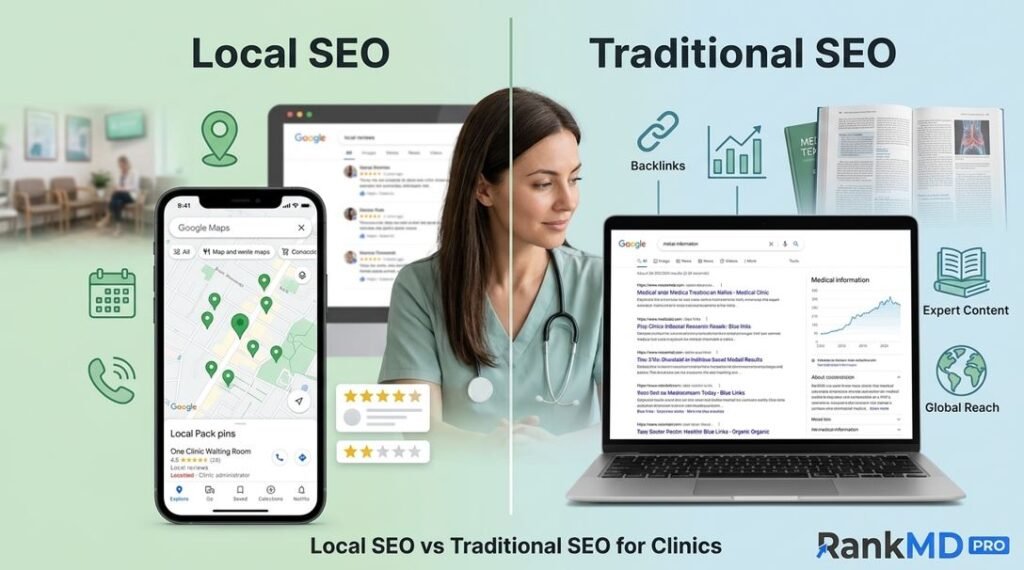
Regular SEO targets broad keyword rankings in organic results. Local SEO specifically optimizes for the Google Map Pack, “near me” searches, and location-specific queries which is where the majority of urgent care patient intent actually lives.
Can a small urgent care clinic compete with large chains in local search?
Yes, and this is one of the most important truths in healthcare SEO. Google’s local algorithm heavily weights proximity and relevance, not just domain authority. A well-optimized independent clinic with strong reviews and a complete GBP will consistently outrank a national chain with a poorly maintained local presence.
What is a Google Business Profile and why does it matter so much?
It is the free listing that appears in Google Maps and the local Map Pack when patients search for nearby clinics. It is the primary ranking factor for local search visibility and often the first impression a patient has of your clinic before visiting your website.
How do I know if my urgent care has a citation problem?
If your clinic’s name, address, or phone number appears differently across different directories, you likely have citation inconsistencies that are diluting your local authority. A professional SEO audit will surface these discrepancies and prioritize which ones to fix first.