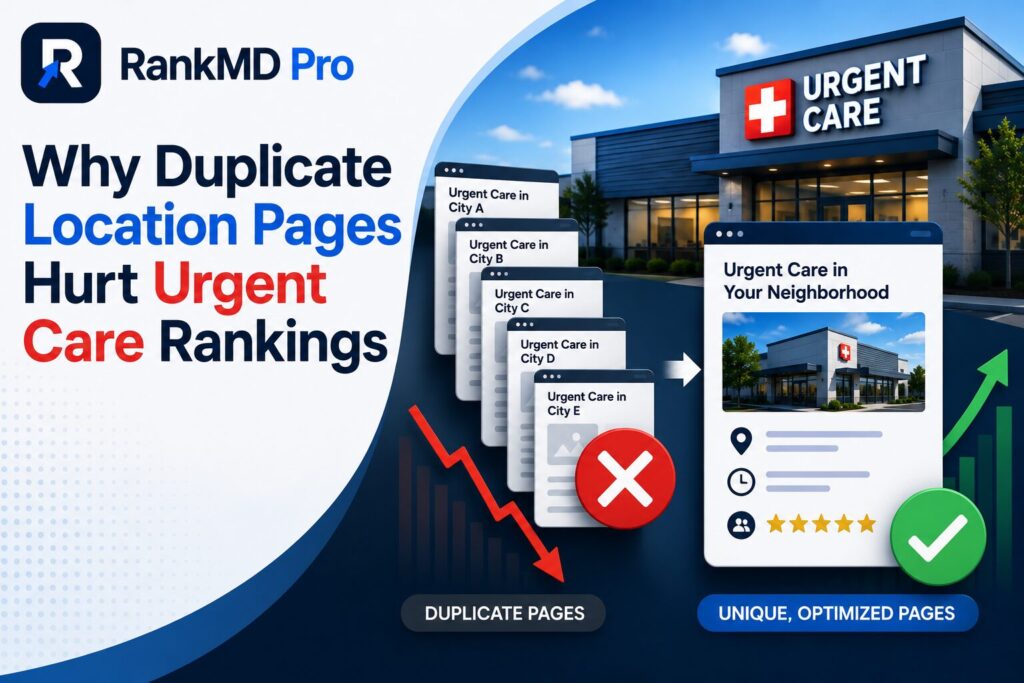
If you run urgent care clinics in five different areas but only two ever show up in search, duplicate content is likely the silent reason. Most multi-location practices build a “locations” template, swap the city name on each page, and assume that’s enough. Google sees straight through it and quietly stops ranking most of those pages entirely.
This guide explains exactly why duplicate location pages suppress your visibility, how Google’s 2026 algorithm detects them, and what to do instead to make every location compete and convert on its own.
Quick Stats: The Cost of Duplicate Location Pages
| Issue | Effect on Rankings |
|---|---|
| Near-duplicate content across pages | Google indexes only one page, ignores the rest |
| Same meta title/description per location | Confuses which page should rank for which area |
| Identical service lists with only city swapped | Signals thin, low-value content to crawlers |
| No unique local schema per location | Weakens map pack eligibility per clinic |
| Duplicate internal linking patterns | Dilutes topical authority instead of building it |
1. What “Duplicate Content” Actually Means for Location Pages
Many practice owners assume duplicate content only means copy-pasted text word for word. In reality, Google’s systems flag near-duplicate content too pages that are structurally and semantically almost identical, even with different city names inserted.
Why This Happens So Often
Agencies and in-house teams build one location template for speed. It’s efficient to produce, but it creates a pattern Google’s algorithm is specifically trained to detect and consolidate.
The Real Cost
When Google identifies duplicate patterns, it doesn’t rank all the pages lower it often picks one canonical version and drops the others from search results almost entirely. That means four out of five of your clinics may be functionally invisible in organic search.
2. How Google Detects and Handles Duplicate Location Pages
Understanding the mechanism helps you avoid it, rather than just patching symptoms.
Signals Google Evaluates
- Content similarity across page bodies (not just meta tags)
- Matching internal linking structures across pages
- Identical FAQ sections reused verbatim
- Similar or absent structured data differentiating each location
What Typically Gets Suppressed
Pages with over roughly 60-70% content overlap are at high risk of being treated as duplicates, with only the strongest version surviving in the index usually your original or highest-authority location.
3. Building Genuinely Unique Location Pages
The fix isn’t more pages it’s making each existing page earn its own ranking signal.
What Needs to Be Unique Per Location
- Neighborhood-specific patient concerns (commute-hour wait times, seasonal illness patterns in that area)
- Local staff or provider information specific to that clinic
- Distinct FAQs addressing that location’s parking, insurance nuances, or hours
- Location-specific reviews rather than a shared company-wide review block
Step-by-Step Rebuild Process
- Audit all location pages side by side for content overlap
- Identify which page currently ranks (the “canonical” Google has chosen)
- Rewrite the remaining pages with genuinely distinct content and local schema
- Add unique supporting content (blog posts) linking back to each location page
- Monitor indexation and rankings over the following 30-60 days
4. Reinforce Each Location With Its Own Topical Cluster
A single unique page is a strong start, but pairing it with supporting content multiplies its authority and further separates it from sibling location pages.
Example Cluster Structure
- Core page: “Urgent Care in [Neighborhood]”
- Supporting post: “[Neighborhood] Urgent Care Wait Times This Flu Season”
- Supporting post: “Insurance Accepted at Our [Neighborhood] Urgent Care Location”
- Supporting post: “What Patients Ask Most at Our [Neighborhood] Clinic”
This structure is exactly what we build for multi-location healthcare brands at RankMD Pro each location engineered as its own authority hub rather than a copy of a template.
Comparison Table: Duplicate vs. Optimized Location Pages
| Element | Duplicate Page (Common Mistake) | Optimized Page (2026 Standard) |
|---|---|---|
| Content | Same template, city swapped | Unique, neighborhood-specific |
| Schema | Generic or missing | Unique LocalBusiness schema per page |
| Reviews | Shared across all locations | Segmented by clinic |
| Internal links | Same pattern site-wide | Linked to unique supporting cluster content |
| Ranking outcome | Only one page indexed/ranks | Every location competes independently |
Real Talk: Why This Problem Compounds the Longer It’s Ignored
Duplicate content issues don’t just stay flat they get worse over time. As competitors build genuinely unique, locally authoritative pages, Google’s confidence in your suppressed pages drops further, making eventual recovery slower and more expensive than fixing it early.
Most in-house marketing teams don’t have the bandwidth to rebuild and maintain unique content, schema, and clusters across five, ten, or twenty locations simultaneously and generic agencies often built the duplicate template in the first place. This is exactly the system RankMD Pro specializes in: full technical audits identifying duplicate and thin location pages, followed by unique content rebuilds and topical clusters engineered specifically for multi-location healthcare practices. Clients who’ve gone through this process typically see previously invisible locations regain map pack visibility within 60-90 days.
If you suspect duplicate content is holding your locations back, the earlier you fix it, the faster and cheaper the recovery.
Frequently Asked Questions
How can I tell if my location pages are being treated as duplicates?
Check Google Search Console’s coverage report for “duplicate, submitted URL not selected as canonical” this directly indicates the issue.
Does using canonical tags fix duplicate location pages?
No, canonical tags simply tell Google which page to keep; the other locations still won’t rank. The real fix is unique content per page.
Can I fix this without hiring an agency?
Yes, if you have the bandwidth to research and write genuinely unique content, build proper schema, and maintain it per location but most practices lack the ongoing capacity to do this at scale.
How many locations need to be duplicate before it hurts my whole domain?
Even two or three near-duplicate pages can signal a pattern that affects how Google evaluates your site’s overall content quality.
Should I merge underperforming location pages instead of fixing them?
Only if that location has genuinely closed or is being consolidated otherwise merging sacrifices local ranking potential entirely.
Will this issue affect my Google Business Profile too?
Indirectly yes, weak or duplicate website pages provide less trust reinforcement for your corresponding GBP listings.
How long does it take to recover rankings after fixing duplicate pages?
Typically 30-90 days depending on how quickly Google re-crawls and reassesses the newly unique content.