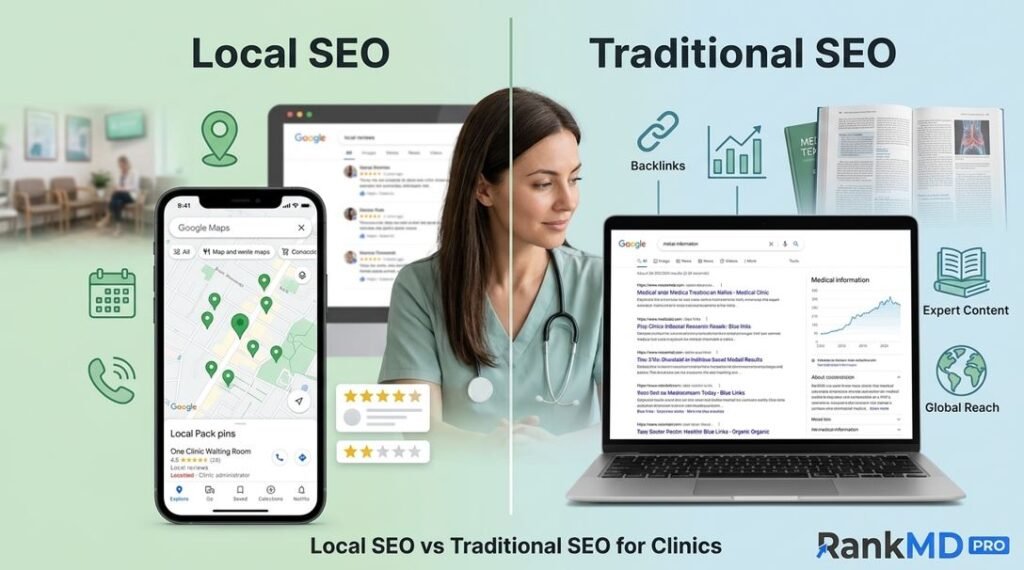
You claimed your Google Business Profile. You filled in your address and phone number. Maybe you even uploaded a few photos. You assumed the patients would follow.
They did not.
Meanwhile, the clinic across town with the same speciality, a comparable reputation, and arguably less clinical experience is showing up at the top of the Map Pack every single time someone searches “urgent care near me” or “doctor near me” in your zip code. Their phone is ringing. Their waiting room has a line. And you are watching it happen from a position of genuine confusion about what they are doing that you are not.
This post answers that question with precision. Not with vague advice about “optimizing your profile” or “getting more reviews.” With specific, actionable, clinically-tested explanations of every element your Google Business Profile is missing, every signal Google is not receiving from your listing, and exactly what a properly executed GBP strategy looks like when it is built to generate patient inquiries rather than just exist on the internet.
By the end of this article you will understand exactly why your profile is underperforming, what the practices outranking you have done differently, and what the path forward looks like for a medical practice that is serious about making Google its most reliable patient acquisition channel.
If you’ve ever asked yourself why competitor urgent care clinics rank higher than yours, the answers below will explain exactly what they’re doing that you’re not and how to close the gap.
The Stakes: What a Fully Optimized Google Business Profile Is Actually Worth
Before diagnosing the problem, the scale of the opportunity deserves to be clearly stated. Most practice owners underestimate how much patient volume flows through Google Business Profile specifically, as distinct from general website SEO.
| Google Search Behavior | Data Point |
|---|---|
| Percentage of patients who use Google to find a healthcare provider | 77% |
| Percentage of “near me” health searches that result in a same-day visit | 88% |
| Percentage of patients who read online reviews before choosing a provider | 94% |
| Click-through rate for Map Pack Position 1 | 28 to 35% |
| Click-through rate for Map Pack Position 3 | 9 to 12% |
| Percentage of users who never scroll past the Map Pack | Over 60% |
| Average revenue difference between a Map Pack Position 1 and Position 4 clinic | Estimated 3 to 5x patient inquiry volume |
Sources: BrightLocal Local Consumer Review Survey, Google Consumer Insights, Moz Local Search Ranking Factors
The Google Map Pack, which is the block of three local business listings that appears at the top of search results for location-based queries, is the most valuable piece of digital real estate in local healthcare marketing. It is seen before organic search results. It is what the majority of searchers click. And it is driven almost entirely by the quality and completeness of your Google Business Profile combined with your website’s local SEO signals.
If your profile is underperforming, you are not just missing some supplementary traffic. You are missing the primary channel through which patients in your market are making their provider decisions right now.
Reason One: Your Profile Is Incomplete in Ways Google Directly Penalizes
The most fundamental reason most medical practice GBPs underperform is deceptively simple. They are incomplete. Not catastrophically incomplete in ways the practice owner would notice, but incomplete in the specific elements Google’s algorithm weights most heavily when deciding who appears in the Map Pack.
Understanding how Google’s local algorithm ranks urgent care in 2026 is the first step to understanding why your profile is underperforming.
Google’s local ranking algorithm rewards profile completeness as a direct signal of credibility and relevance. A profile that has answered every available field, used every available content section, and engaged with every profile feature is treated as more authoritative than one that has filled only the required fields.
Here is the completeness gap that separates high-performing medical GBPs from the average:
| GBP Element | Minimum (What Most Do) | Maximum (What Top Rankers Do) |
|---|---|---|
| Business Name | Legal practice name | Name with primary service keyword where appropriate |
| Primary Category | General: Medical Clinic | Specific: Urgent Care Center, Family Practice Physician, etc. |
| Secondary Categories | None added | 5 to 9 relevant secondary categories |
| Business Description | 1 to 2 sentences | 750 characters of keyword-rich, patient-focused copy |
| Services Section | Not completed | Every individual service listed with descriptions |
| Products Section | Not used | Key services listed as products with pricing where applicable |
| Attributes | Default selections only | All applicable attributes selected including accessibility, telehealth, insurance types |
| Appointment Links | Not added | Direct booking or contact page URL added |
| Website Link | Homepage URL | Specific landing page URL optimized for conversion |
| Hours | Basic open and close | Primary hours plus special hours for holidays and events |
| Phone Number | Main line only | Tracked number for call analytics |
The services section is particularly underutilized by medical practices and particularly valued by Google’s algorithm. When you list every service your practice offers, including specific condition treatments, diagnostic services, and preventive care offerings, you are giving Google explicit data about what patient queries your profile is relevant for. A profile that lists urgent care, STD testing, X-ray, occupational health, and flu shots will appear for all of those searches. A profile that says only “medical clinic” will compete for only the broadest queries.
Reason Two: Your Review Profile Is Weak, Stale, or Unmanaged
If you take nothing else from this article, take this: your review profile is the single most important factor in whether patients choose your practice after finding you on Google, and it is the factor most directly within your control that the majority of medical practices neglect almost entirely.
Professional urgent care SEO services include technical audits and fixes that most clinic owners don’t have the time or expertise to handle themselves from Core Web Vitals to schema markup.
The data on patient review behavior is unambiguous.
| Review Factor | Patient Behavior Data |
|---|---|
| Practices with under 50 reviews | Passed over by majority of patients in favor of practices with more reviews |
| Average rating threshold for patient trust | 4.5 stars or above |
| Recency requirement | Patients want reviews from the past 3 months |
| Impact of unanswered negative review | 45% of patients say it significantly reduces trust |
| Impact of professional response to negative review | 53% of patients say it restores significant trust |
| Percentage of patients who would leave a review if asked | 72% |
| Percentage of patients who are ever actually asked | Under 15% |
Source: BrightLocal Consumer Review Survey, Podium State of Online Reviews Report
The math embedded in that last data point is the most important number in healthcare marketing. Seventy-two percent of your patients would leave a review if you asked them. You are asking fewer than fifteen percent of them. The review gap that is costing you Map Pack rankings and patient trust is almost entirely a process gap, not a satisfaction gap.
A properly structured review generation system sends an automated review request to patients at the right moment in the patient journey, typically 24 to 48 hours after a visit when the experience is fresh and the patient is at home and accessible on their phone. It directs them to a single-click link to your Google profile. It follows up once if no response was received. This system, when implemented correctly, generates a consistent weekly flow of new reviews that compounds over months into a review profile that dominates your local market.
Review response management is the second half of this equation. Every review, positive and negative, deserves a response. Positive responses reinforce patient relationships and signal to Google that the practice is actively managed. Responses to negative reviews demonstrate professionalism and give you the opportunity to correct misperceptions or demonstrate accountability in a way that prospective patients can read and evaluate.
Responding to negative reviews with defensiveness or denial is the most damaging mistake practices make. Responding with acknowledgment, empathy, and an invitation to continue the conversation offline converts a public liability into a trust-building demonstration.
Reason Three: Your Photos Are Doing More Harm Than You Think
Google’s own data shows that business profiles with more than 100 photos receive dramatically more direction requests and phone calls than profiles with fewer than 10 photos. For medical practices, the specific types of photos matter as much as the quantity.
| Photo Type | What It Communicates to the Patient |
|---|---|
| Exterior building photos | Confirms location, reduces first-visit anxiety |
| Interior waiting area | Sets expectations, communicates cleanliness and comfort |
| Exam room photos | Transparency, clinical environment confidence |
| Staff photos with names and roles | Humanizes the practice, builds pre-visit relationship |
| Equipment and technology photos | Demonstrates clinical capability |
| Team in action (HIPAA-compliant) | Authentic environment, team culture |
| Community involvement photos | Trust, local rootedness |
The photos most medical practices upload are three to five stock-quality images of the exterior and a logo. That profile communicates nothing to a patient trying to decide whether to trust this practice with their health. It is the visual equivalent of a blank handshake.
Photos should be geotagged with the practice location before upload, which adds a local SEO signal that most practices miss entirely. They should be updated regularly, with new photos added monthly as part of the ongoing profile maintenance cadence. Google’s algorithm gives recency weight to photo updates in the same way it gives recency weight to posts and reviews.
Reason Four: You Are Not Using Google Posts and They Are Costing You Visibility
Google Posts are short-form content pieces that appear directly on your business profile in search results. They can announce services, promotions, health awareness information, new staff members, extended hours, or any other relevant update. They expire after seven days unless renewed, which means maintaining an active post presence requires a consistent weekly publishing cadence.
Most medical practices have never published a single Google Post. The practices that consistently hold Map Pack positions in competitive markets publish two to four posts per week.
Why does this matter algorithmically? Google interprets an active posting cadence as a signal that the business is currently operational, engaged with its online presence, and relevant to current searches. A profile that has not been updated in three months is treated as less authoritative than one updated three days ago, all else being equal.
Posts also serve a direct conversion function. A patient who finds your profile and sees a current post about same-day availability for flu shots, or about walk-in STD testing, or about extended Saturday hours, receives a specific, timely reason to choose your practice over the competitor whose profile shows nothing but static information.
| Post Type | Example for Medical Practice | Conversion Function |
|---|---|---|
| What’s New | New service or provider announcement | Awareness of expanded offerings |
| Offer | Discounted self-pay visit this week | Direct incentive to act now |
| Event | Free blood pressure screening Saturday | Community engagement driver |
| Health Update | Flu season is here, walk-in testing available | Urgency-driven appointment trigger |
| Hours Update | Extended hours this week | Removes barrier to visit |
Reason Five: Your Q&A Section Is Empty or Filled With Patient Questions You Have Not Answered
The Questions and Answers section of your Google Business Profile appears prominently in your listing and is often the element that determines whether a patient who found you actually contacts you. It is also almost universally neglected by medical practices.
Here is the critical issue with an unanswered Q&A section. Anyone can ask a question on your profile. Anyone can also answer those questions, including people who have no connection to your practice and no accurate information about it. Left unmanaged, your Q&A section can contain incorrect information about your hours, services, pricing, or insurance acceptance that is actively driving patients to competitors.
The correct strategy is to proactively seed your Q&A section with the questions patients most commonly ask before choosing a provider, and to answer those questions yourself with accurate, keyword-rich, reassuring responses.
The most effective patient pre-visit questions to pre-populate include whether walk-in visits are accepted, which insurance plans are accepted, what the average wait time is, whether pediatric patients are seen, whether X-ray or lab services are available on-site, what the self-pay cost is, and whether appointments are required for specific services.
Each answer is an opportunity to provide both useful patient information and keyword-relevant content that Google can use to match your profile to relevant search queries.
Reason Six: Your Local Citation Profile Has Inconsistencies That Undermine Your Ranking Signals
Your Google Business Profile does not exist in isolation. Google cross-references the name, address, and phone number on your GBP against dozens of other directories and data sources across the web to verify that the information is consistent and trustworthy. When inconsistencies exist, which they almost always do for practices that have moved, changed phone numbers, or simply never managed their directory presence, they create what local SEO practitioners call NAP inconsistency, and it is a direct ranking suppressor.
| Citation Problem | Common Cause | Ranking Impact |
|---|---|---|
| Old address still on Yelp or Healthgrades | Previous location not updated | Moderate negative |
| Different phone numbers across directories | Tracking numbers not consolidated | Moderate negative |
| Duplicate listings for same location | Multiple people created listings | Significant negative |
| Inconsistent business name formatting | Legal name vs. DBA variation | Mild negative |
| Missing from key healthcare directories | Profile never created | Missed positive signal |
| Outdated hours on third-party sites | Hours changed, not updated everywhere | Patient frustration plus trust erosion |
A citation audit identifies every instance where your practice information appears online and flags inconsistencies for correction. A citation expansion campaign then systematically builds your presence across the most authoritative healthcare-specific and general local directories to amplify the positive local signal Google receives about your practice.
What a Fully Managed Google Business Profile Actually Produces
When all six of these elements are addressed systematically, the results are measurable and consistent. Here is what the trajectory looks like for a medical practice that moves from a neglected GBP to a fully optimized and actively managed one:
| Timeline | Expected Outcome |
|---|---|
| Month 1 to 2 | Map Pack appearance increases, profile views rise significantly |
| Month 2 to 3 | Phone calls and direction requests begin increasing measurably |
| Month 3 to 6 | Review volume generates consistent new patient trust signal |
| Month 6 to 12 | Sustained Map Pack top-3 positioning in primary service area |
| Month 12 and beyond | Dominant local presence that compounds with continued management |
This is not theoretical. It is the documented trajectory of medical practices that commit to proper GBP management as part of a comprehensive local SEO strategy. The compounding nature of review accumulation, citation consistency, and content recency means that the practices investing in this now are building a moat that becomes increasingly difficult for under-optimized competitors to bridge.
This Is Exactly What RankMD Pro Builds for Medical Practices
Everything described in this article is not optional marketing activity for a medical practice in 2026. It is the infrastructure that determines whether your practice grows through organic patient acquisition or remains dependent on word of mouth and paid advertising for every new patient it sees.
RankMD Pro is a healthcare-exclusive SEO and patient acquisition agency. We do not apply generic digital marketing frameworks to medical practices. We build the specific systems, content, and technical infrastructure that Google’s algorithm rewards in the healthcare vertical.
We serve urgent care operators, DSOs, multi-location medical groups, and independent practices across competitive metropolitan markets who are serious about making Google their most reliable and scalable patient acquisition channel.
If you are ready to understand exactly why your profile is underperforming and precisely what it will take to move it into the Map Pack positions where new patients are being won every single day, request a free growth audit from RankMD Pro.
Frequently Asked Questions
How long does it take for Google Business Profile optimization to produce results?
Initial improvements in profile views and search impressions typically appear within two to four weeks of completing a full profile optimization. Measurable increases in phone calls and direction requests generally follow within four to eight weeks. Sustained Map Pack positioning improvements develop over three to six months as review volume builds and citation consistency is established.
How many Google reviews does a medical practice need to rank in the Map Pack?
There is no universal threshold because review requirements are relative to your specific competitors. In most markets, a practice needs a minimum of 50 to 100 reviews with an average of 4.5 stars or above to be competitive. In high-competition urban markets, 200 or more reviews are often needed to hold top-three positions consistently.
Can I manage my Google Business Profile myself or do I need an agency?
The foundational optimization of a GBP can be completed by a practice owner or manager with the right guidance. The ongoing cadence of posting, review response management, citation monitoring, and performance analysis that sustains and improves rankings over time is difficult to maintain alongside running a medical practice. Most practices that self-manage their GBP allow it to go stale within two to three months of initial setup.
Why does my practice show up in some searches but not others?
Google‘s local algorithm considers relevance, distance, and prominence for every query. Your practice may appear for broad searches like “urgent care” but not for specific service searches like “strep test near me” if your profile does not explicitly list strep testing as a service. Service completeness directly affects which queries trigger your profile.
Does responding to Google reviews actually affect rankings?
Review responses are a confirmed engagement signal that Google uses to assess how actively managed a business profile is. Profiles with consistent review responses are treated as more authoritative than those with unanswered reviews. Beyond rankings, responses directly affect conversion, since prospective patients read how you respond to feedback before deciding whether to call.
What is the most important Google Business Profile category for a medical practice?
The primary category is the most heavily weighted signal in local ranking. For urgent care centers, Urgent Care Center is the correct primary category. For family medicine, Family Practice Physician. Using an overly broad category like Medical Clinic when a more specific relevant category exists is a common error that suppresses rankings for the most valuable searches.
How often should a medical practice post on Google Business Profile?
Two to four posts per week is the cadence that maintains consistent algorithmic freshness signals and provides enough content variety to serve different patient intent queries. Posts expire after seven days, so a weekly minimum of at least one post is required simply to maintain an active post presence on your profile.