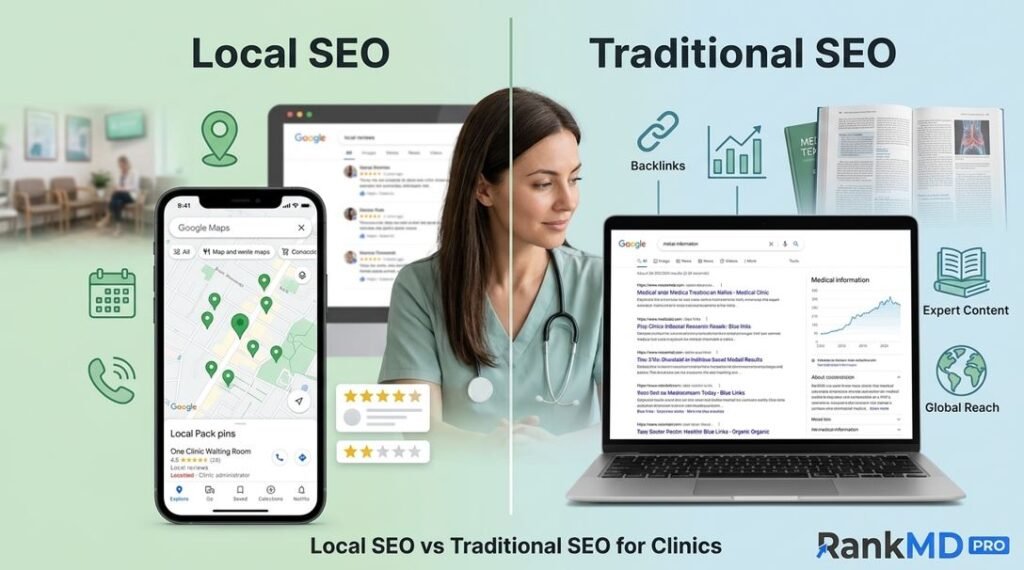
If another medical practice consistently appears above yours in Google, the explanation is rarely just “they use better keywords.”
A competitor may have a stronger Google Business Profile, more relevant service pages, better local authority, clearer provider information, stronger backlinks, better technical performance, or content that answers the searcher’s question more completely.
The important part is finding the specific gap.
If your orthopedic practice ranks below another orthopedic clinic for “knee specialist near me,” compare the pages and local profiles behind those rankings. If your psychiatry practice loses searches for “psychiatrist in [city],” examine the provider information, location signals, service relevance, reviews, and content supporting the competing practice.
This guide breaks down 10 SEO gaps that can explain why competitors are outranking your medical practice and what to examine before changing your entire strategy.
Why Are Competitors Ranking Higher Than My Medical Practice?
Your competitors may rank higher because their website and local presence provide stronger signals for the searches you care about. Common gaps include weak service-page relevance, incomplete local SEO, limited provider expertise, inconsistent location information, weaker backlinks, poor technical performance, thin specialty content, and insufficient conversion-focused website structure.
1. Their Service Pages Match Search Intent Better
One of the first things to compare is the actual page ranking for your target query.
Suppose you want to rank for:
“cardiologist in Miami.”
Your competing practice has a dedicated cardiology page explaining:
- Cardiology services
- Conditions treated
- Cardiologists
- Office location
- Patient information
- Appointment process
Your website has one paragraph about cardiology buried inside a general “Our Services” page.
The competitor has a much clearer relationship between:
Search → Specialty → Service → Provider → Location
That can create a stronger relevance signal than simply mentioning “cardiology” several times.
If you’re wondering why competitors ranking higher than my medical practice, start by comparing the exact pages Google is ranking—not just the domains.
What to Compare
| Your Page | Competitor Page |
| Search intent | Search intent |
| Service depth | Service depth |
| Conditions covered | Conditions covered |
| Provider information | Provider information |
| Location information | Location information |
| Internal links | Internal links |
| Patient questions answered | Patient questions answered |
The goal isn’t to make your page longer than theirs.
It is to make it more useful for the specific search.
2. Their Google Business Profile Is More Relevant to Local Searches
For location-based healthcare searches, your website isn’t the only asset competing.
Google Business Profiles also matter.
Google identifies relevance, distance, and prominence as key factors in local rankings. Google Business Profile Help: How to improve your local ranking on Google
Compare your practice with the competitors appearing in the Map Pack.
Check:
- Primary category
- Services
- Reviews
- Review recency
- Photos
- Hours
- Address
- Website
- Business information
Don’t assume the competitor with the most reviews automatically wins every search.
A practice can outperform another for a particular query because its business information and website are more relevant to that search.
3. Your Website Doesn’t Demonstrate Enough Provider Expertise
Healthcare is different from many commercial industries because people make decisions involving their health.
A generic author bio saying:
“Our medical experts provide high-quality care.”
doesn’t demonstrate much.
Compare that with a provider page that clearly identifies:
- Physician name
- Specialty
- Education
- Relevant qualifications
- Clinical focus
- Professional affiliations where appropriate
- Services provided
- Practice location
Google’s guidance on creating helpful content emphasizes demonstrating who created content and why readers should trust it, particularly for topics where accuracy matters.
For medical websites, legitimate expertise should be visible and verifiable, not merely claimed.
4. Your Competitor Has Built a Stronger Specialty Content Cluster
A single service page rarely establishes comprehensive topical coverage.
Consider an orthopedic practice.
A competitor might have useful pages covering:
Orthopedics
→ Knee pain
→ Shoulder injuries
→ Sports injuries
→ Joint replacement
→ Arthritis
→ Physical therapy
→ Specific orthopedic procedures
→ Orthopedic providers
→ Locations
Those pages can support one another through relevant internal links.
Your site may have:
Orthopedic Services
and five unrelated blog posts.
That creates a very different information architecture.
Build Around the Actual Specialty
A useful specialty cluster can include:
- Core specialty page
- Service pages
- Condition pages
- Procedure pages
- Provider pages
- Location pages
- Patient education
- FAQs
Don’t create pages simply to increase URL count.
Every page should answer a distinct patient or search need.
5. Your Competitor Has Better Local Relevance
A medical practice may technically serve an entire metropolitan region while having only one generic location page.
A competitor might provide genuinely useful information for each actual office.
For example:
Main practice
→ Cardiology
→ Downtown location
→ North location
→ South location
Each legitimate location can provide information about:
- Address
- Providers
- Services available
- Hours
- Parking or access information where useful
- Appointment process
- Communities reasonably served
Don’t create fake locations or virtual offices simply to target more cities.
Google’s Business Profile guidelines require businesses to accurately represent eligible real-world locations. Google Business Profile Help: Business eligibility and ownership guidelines
Local SEO should reflect the practice you actually operate.
6. Their Website Has Stronger Authority Signals
Sometimes two practices publish similar content, but one has a significantly stronger website authority profile.
Look at where competitors are earning legitimate links and mentions.
Potential sources include:
- Medical associations
- Local healthcare organizations
- Hospitals
- Universities
- Professional publications
- Local news organizations
- Community organizations
- Relevant healthcare directories
The goal is not to collect hundreds of low-quality directory links.
A handful of relevant, credible references can be more meaningful than a large collection of unrelated sites.
Competitor Backlink Audit
For each major competitor, identify:
Which domains link to them?
Are those websites relevant to healthcare?
Are links pointing to the homepage or important specialty pages?
Do they have local authority that your practice lacks?
This can reveal an SEO gap that keyword research won’t show.
7. Your Medical Content May Answer the Question Without Helping the Patient
Healthcare blogs often fail in one of two directions.
They’re either:
Too thin
or
Too generic.
For example:
“Back pain can have many causes. Consult a healthcare professional if you have concerns.”
That’s medically cautious but provides little useful information.
A stronger article can explain:
- Common causes
- Symptoms that may require evaluation
- Relevant risk factors
- When professional assessment may be appropriate
- Which specialty typically evaluates the problem
- What patients can expect from an evaluation
The content should remain medically responsible and avoid diagnosing readers.
This is where E-E-A-T matters. The objective isn’t to sound authoritative. It is to demonstrate genuine expertise through accurate, useful information and identifiable medical authorship or review where appropriate.
8. Your Technical SEO May Be Holding Back Otherwise Good Content
Technical problems are easy to overlook because they don’t always appear in a ranking report.
Check:
- Indexation
- Canonical tags
- XML sitemap
- Robots directives
- Broken internal links
- Redirect chains
- Mobile usability
- Core Web Vitals
- Duplicate pages
- HTTPS
- Structured data
- Page rendering
Google explains that technical requirements help ensure content can be crawled, indexed, and served properly in Search. Google Search Technical Requirements
You don’t need to chase every technical metric simply because a competitor has a faster score.
First identify issues that prevent important pages from being properly discovered, indexed, rendered, or experienced by users.
9. Their Internal Linking Is Helping Google Understand Their Website
Internal links do more than help visitors navigate.
They create relationships between relevant pages.
Imagine your website has:
Cardiology
→ Heart Disease
→ Arrhythmia
→ Echocardiogram
→ Preventive Cardiology
→ Cardiologist
If these pages are genuinely related and linked appropriately, users and search engines can better understand the site’s structure.
A common medical website problem is having valuable content that is effectively isolated.
A blog about heart palpitations may never link to the relevant cardiology service.
A page about knee replacement may never connect to the orthopedic provider.
A location page may never link to the services actually offered there.
Internal linking should follow the patient’s information needs.
10. Your Competitor May Have a Better Overall Search-to-Appointment Experience
This is the gap many SEO audits miss.
Imagine two practices rank next to each other.
Practice A
Search result → generic homepage → difficult navigation → unclear provider → buried phone number.
Practice B
Search result → relevant service page → provider information → location → reviews → clear appointment action.
Even if both practices rank well, Practice B has removed more uncertainty between the search and the appointment.
That doesn’t mean every page needs a large “Book Now” button.
The appropriate action depends on the specialty and patient intent.
But the website should make the next practical step obvious.
How to Find the Exact SEO Gap Between Your Practice and a Competitor
If you’re asking why are my competitors ranking higher than my medical practice, don’t start by copying their keywords.
Run a page-by-page and profile-by-profile comparison.
Step 1: Choose One Valuable Search
Don’t audit 500 keywords at once.
Start with a commercially meaningful search such as:
“orthopedic surgeon in [city]”
or
“dermatologist near me.”
Step 2: Identify the Actual Ranking Pages
Record the top results.
Look at the exact URL ranking—not merely the competitor’s homepage.
Step 3: Compare Search Intent
Ask:
Why would someone search this phrase?
Then determine which page answers that reason most directly.
Step 4: Compare Medical Expertise
Review provider information, authorship, medical review processes, credentials, and clinical specificity.
Step 5: Compare Local Signals
Check Google Business Profiles, reviews, categories, location information, and local references.
Step 6: Compare Content Architecture
Look at related service, condition, procedure, provider, and location pages.
Step 7: Compare Authority
Analyze relevant backlinks and legitimate healthcare references.
Step 8: Check Technical Foundations
Confirm that important pages are indexable, internally linked, mobile-friendly, and technically accessible.
Step 9: Test the Patient Experience
Open both websites on your phone.
Try to find the provider.
Try to find the service.
Try to find the location.
Try to contact the practice.
The comparison often reveals issues that an SEO tool alone cannot.
10 SEO Gaps at a Glance
| SEO Gap | What to Check |
| Search intent | Does the page satisfy the query? |
| Service relevance | Is the requested service clearly covered? |
| Local SEO | Is the practice locally relevant? |
| Provider expertise | Are credentials and expertise identifiable? |
| Content depth | Does the site cover the specialty comprehensively? |
| Location architecture | Are legitimate locations properly represented? |
| Authority | Does the practice have relevant external references? |
| Technical SEO | Can Google crawl and index important pages? |
| Internal linking | Are related pages logically connected? |
| Conversion path | Can patients easily understand what to do next? |
What Should You Fix First?
Not every SEO gap deserves the same priority.
If your service pages aren’t indexed, fixing technical issues comes first.
If your pages rank but attract irrelevant searches, improve search intent and content targeting.
If your website ranks but competitors dominate local searches, investigate your Google Business Profile and local prominence.
If you receive qualified visitors but few inquiries, examine the service page and conversion path.
The right fix depends on the gap—not on a generic SEO checklist.
Frequently Asked Questions
Why are my competitors ranking higher than my medical practice?
They may have stronger relevance, local signals, provider information, specialty content, website authority, technical foundations, or better alignment with the searcher’s intent. The exact cause requires comparing the pages and local profiles ranking for the same queries.
How do I find my medical practice’s SEO gaps?
Compare your highest-value search queries with the pages ranking above you. Review search intent, content, provider expertise, local SEO, Google Business Profile signals, backlinks, internal linking, technical SEO, and conversion paths.
Does having more content help a medical practice rank higher?
Not automatically. More pages can create value when they address distinct patient questions or services. Publishing repetitive articles simply to increase word count or keyword coverage can create a larger site without solving the ranking problem.
Should I copy my competitor’s medical SEO strategy?
No. Competitor research should reveal opportunities and weaknesses, not provide a template to duplicate. Your content should reflect your actual providers, services, locations, expertise, and patient needs.
How important are backlinks for medical SEO?
Relevant, trustworthy backlinks can contribute to website authority, but they are only one part of SEO. A practice should not ignore search intent, medical content quality, local SEO, technical accessibility, or user experience while pursuing links.
Why does my competitor rank for a keyword even though my website has more content?
Google doesn’t rank pages simply by word count. A shorter page can outperform a longer one if it provides a more relevant and useful answer, has stronger authority signals, better local relevance, or better satisfies the searcher’s intent.
Your Competitor’s Ranking Is a Clue, Not a Template
If you’re searching why are my competitors ranking higher than my medical practice, don’t respond by publishing another generic 1,500-word article or adding the same keywords to your homepage.
Find the actual difference.
Compare the ranking page, provider information, specialty coverage, Google Business Profile, local authority, backlinks, technical foundation, internal links, and patient experience.
Then prioritize the gaps that directly affect the searches that matter to your practice.
RankMD Pro can perform a healthcare-focused SEO audit that compares your website and local presence against the practices already competing for your target searches.
Find the SEO gaps holding your medical practice below competitors → Get Your Healthcare SEO Audit